 Sarah Kher-Bek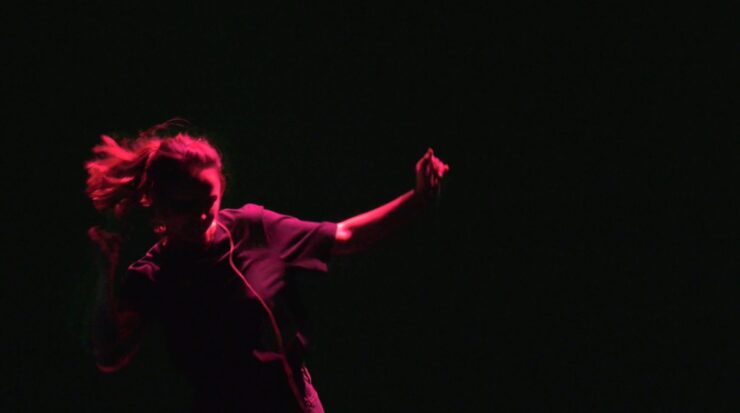
There are some stories we watch, and then there are stories that crawl underneath your skin.
Mary-Agnes O’Loughlin’s Glimpses of Heaven is the latter.
O’Loughlin takes a stage too tiny to even fit a bed and somehow finds a way to hold an enormous world within it. A world of love, addiction, grief and memory. A world that burrows deep and leaves a scar. It might stop hurting eventually, but it will never stop belonging to you.
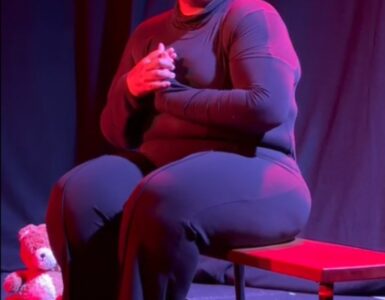
We enter an apartment of a life already lived. Mismatched vintage furniture; boots inexplicably glued to a bookshelf, permanently ready to take off; a shoe turned ashtray, stuffed so tightly with cigarette butts there is no room for a foot to even think of entering. Hannah puts down her handbag and begins clearing away the “rubbish.” But nothing here is just rubbish. Every object seems to have something waiting inside.
A letter is the first thing to pull us backwards. Written by her mother the day before Hannah was born, it speaks of how much she loved carrying her daughter, cherishing every last kick and punch before they could finally meet.
And from there, the past refuses to stay put.
O’Loughlin doesn’t simply retell Hannah’s childhood; she seems to completely fall inside her memories. Her voice softens, her cadence shifts, and suddenly the woman before us gives way to the child she once was. We don’t watch the memory from a distance. For a moment, we live inside it with her.
And then, almost casually, she leaves it.
Again and again, I found myself still sitting in the devastation of a memory while Hannah had already returned to the present. I wanted her to wait. Just for a moment. Let me finish feeling what had just happened.
But for Hannah, there was no time.
She was a child forced to leave one feeling unfinished whenever the next moment demanded something of her. When her mother needed saving or simply looking after, Hannah responded. Somewhere in that emotional whiplash, I began to understand why O’Loughlin never waits for us to catch up. Hannah never had the luxury of catching up either.
Even in the present, the child never completely disappears. She isn’t simply an adult looking back; she is carrying the child who survived it, bleeding quietly into the woman Hannah has become — older, scarred, but never entirely separate.
Some things don’t disappear simply because time has passed.
We meet Hannah’s mother first through tenderness. Her love for her daughter is never a question. “Was your heart happy today?” Words that seemed always to be waiting on her tongue. Not, “Are you okay?” but, “How is the very centre of you?”
This is who her mother was.
Hannah’s mother is not an easy villain. As the drinking gets worse, the love never disappears. Crucially, neither does the harm. Slowly, the woman who cares so deeply about the interior of her daughter’s life becomes part of the darkness forming inside it.
There were days her mother was unrecognisable. Addiction moves her in and out of reach. Sometimes she is right there — whimsical, brilliant, performing on stage as Hannah watches the audience discover what she already knows. Other times, Hannah is left searching for her inside the person standing in front of her.
And still, Hannah adores her.
Her love doesn’t require the show to sanitise her mother, and the harm doesn’t fold that love into something smaller. Both exist at full size.
And somehow, Hannah dances through it.
When the world around her becomes too much to hold still, neither does she. O’Loughlin throws herself into movement with childlike abandon, dancing through moments that might otherwise collapse beneath their own weight — ridiculous, exuberant and insanely hilarious. She finds absurdity in the devastation. Humour is how she retains ownership of her own story.
Children have little control over what happens to them. A performer controls how it is told. O’Loughlin decides when we enter a memory and when we are ripped back out, when devastation is allowed to sit and when she dances straight through it. The pain remains, but it does not get to dictate the rhythm of the story.
And eventually, there is a moment Hannah cannot dance through.
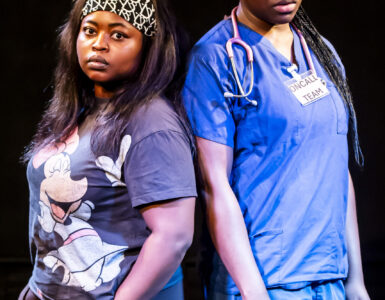
Hannah saves her mother’s life following an overdose. We are taken to the hospital, where her mother lies in a coma. She asks the nurse to guide her hand towards her mother’s. After a lifetime spent looking for her mother, now she cannot look.
With O’Loughlin’s back facing us, one hand outstretched behind her, she begins, softly and brokenly, singing, “I love you, baby and if it’s quite alright I need you baby…”
And so simply, whatever composure remained in the room quietly disappears, and the room breaks with her.
And then, we return to the letter.
The words are the same, but we are not. We have lived through everything that came after them: the love, the promises, and the breaking of them. Her mother asks Hannah to read it. But after a lifetime spent looking after her mother, Hannah finally lets her mother look after her.
“No, you read it to me. I’m going to get comfy.”
And finally, Hannah sits and listens as her mother reads the words she wrote when their story was still anticipation and love.
Everything happened in that tiny room. I laughed, I sobbed, I was devastated and elated. I existed inside memories I was not ready to leave. I caught glimpses of Hannah, young and old. Glimpses of a mother’s love and the destruction of her addiction. Glimpses of joy surviving amongst the grief; of humour, hope and love refusing to disappear simply because something terrible exists beside them.
I witnessed Glimpses of Heaven.
Recommended Drink: You will need a drink after this one, but out of respect, maybe a cup of camomile tea, to soften all your edges.
Performances of Glimpses of Heaven have now concluded at MelbourneFringe 2026.
 Lamesha Ruddock