
 Ash Elliot
This week saw Foldout Theatre’s debut production made its way to Burns Studio Scotland, and what better play to establish a Scottish company than with the Scottish play itself? It’s unlikely you need the plot of Macbeth explained to you (although in fairness, it’s been years since I’ve seen it, and even longer since I’ve seen a sober production – thank you, Drunk Shakespeare), so instead a brief introduction to Foldout itself, in their own words: ‘a new repertory theatre company based in Scotland’, founded in 2025, which exists to ‘challenge closed circles and give space to talented artists who are being overlooked’.
In Foldout’s accompanying programme, director Oat Jenner discusses wanting to ‘create an ethos, a space and a community of artists that [is], at heart, collaborative’, and I think this shines through as one of the production’s strongest elements. The performers have clearly grown this production together from the moment of its inception – they move around each other confidently and comfortably, reacting to each and every word and maintaining a complete tapestry of action even when they might not have any lines in a given scene, with one particularly notable example of this being at Macbeth’s banquet in Act III Scene IV, where Macbeth’s descent into paranoid madness at the sight of his felled ally Banquo is further compounded by the comparative obliviousness of his guests.
While performances were strong across the board, particular commendation must naturally be given to James Miles-Boyd as the play’s eponymous protagonist. Miles-Boyd’s oscillation between Machiavellian usurper and paranoid victim of his own ‘vaulting ambition’ is fantastically compelling, and he doesn’t waste a single soliloquy, bringing a freshness even to quotes so familiar we can recite them in our sleep; we all know the dagger is coming, and yet he still manages to surprise us when it does.
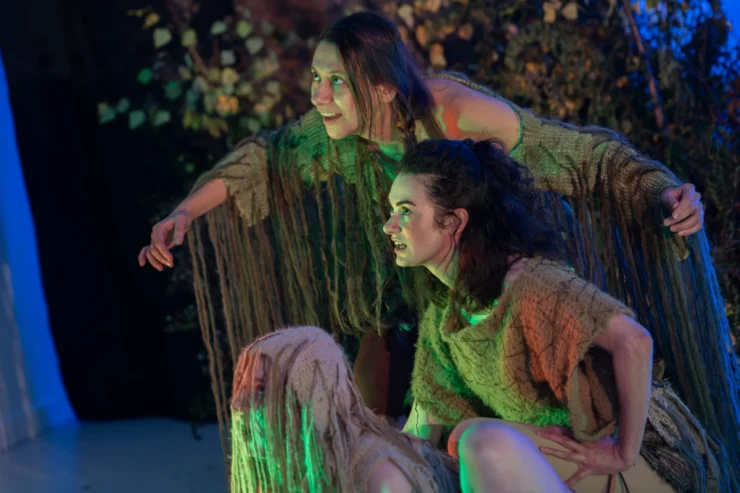
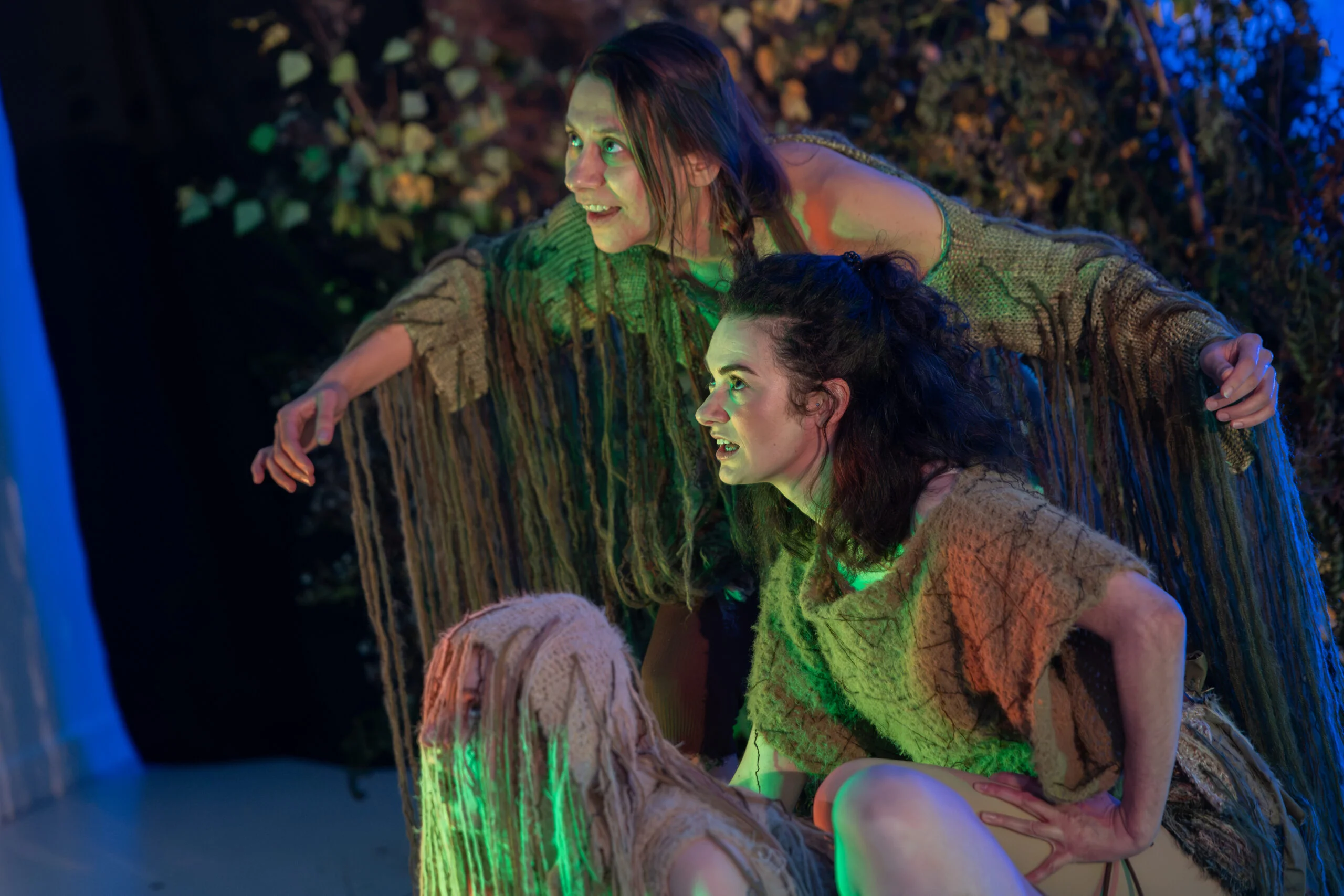
Other standouts include, of course, Neféli Stoikopoulou, who is grounded and utterly convincing as the duplicitous Lady Macbeth, and whose plummet from complete control into absent madness is perhaps a greater tragedy than Macbeth’s own fall from grace. Her chemistry with Miles-Boyd, aided by intimacy co-ordinator Liz Carruthers, makes their collaboration particularly deadly, and Stoikopoulou holds both fictional and paying audience in the palm of her hand as she nudges her husband down the path of no return, all the while making him think it’s his idea. Douglas Yannaghas offers a generous, fatherly performance as the doomed Duncan, while the witches are played with unnerving dryadic mysticism by Rudy Punchard, Rebecca Robin, and Lindsay Jacobs.
The action onstage is supplemented gorgeously by all elements of design, from Rudy Punchard’s clever and cohesive costuming, particularly effective in the case of the three witches whose rustic materials and earthy colour palette mark a clear contrast against the bold tones and sharp lines of the ambitious Macbeths, to Kirsty MacArthur and Phil Hunter’s subtle yet impactful set complete with white drapes and sprawling flora. The synergy of Tom Showell’s lighting and Jack Oldcorn’s sound design creates a consistently immersive and at times unsettling atmosphere, and the use of shadow is particularly clever in the cases of Banquo’s ghost and the final battle at Dunsinane, breathing as much life into the play’s settings as its characters.
I also enjoyed the rhythmic and often times slightly eldritch vocalisations and movements used throughout the piece, although I do feel that the opening full company dance sequence comes off as slightly hesitant, not quite reaching the maenadic levels of frenzy it tries to convey – the sequence seeks to warn us of the animalistic brutality to come, and I’d love to have seen the actors feel more confident in their performance from the off. I also didn’t feel entirely satisfied by Foldout’s choice to reinvent Malcolm as a woman. While I appreciate and understand the reasoning behind having a woman as the bearer of hope and order against a backdrop of male-driven ambition and violence, it doesn’t feel like there is sufficient opportunity to develop this to its full potential within the confines of the text.
Overall, Foldout has created a production which is both impactful and arresting, and doesn’t fall pray to the major pratfall of the Scottish play – the fact it’s been done so many times it’s hard to make it feel fresh and new. Foldout’s Macbeth makes excellent use of its ensemble, and I am certain its collaboration-first approach will serve the company well in future productions. I look forward to seeing what they put their minds to next.
Performances of Macbeth have now concluded, but Foldout Theatre’s upcoming projects can be found on Instagram at @foldouttheatrecompany
Something strong and brewed in a cauldron – hold the eye of newt.
Macbeth
About the show
Ambition. Ritual. Blood. Power. Foldout brings you an exciting, explosive and ritualistic take on Shakespeare’s Macbeth. Come and experience a raw and visceral production of one of Shakespeare’s greatest tragedies, brought to life by a collective of emerging Scottish talent. Expect shadows, movement and music as we delve into a world where ambition consumes, power corrupts and the consequences of our choices cannot be escaped.
 Moss Meunier
 Shay Mace