

 Lola Rose Wood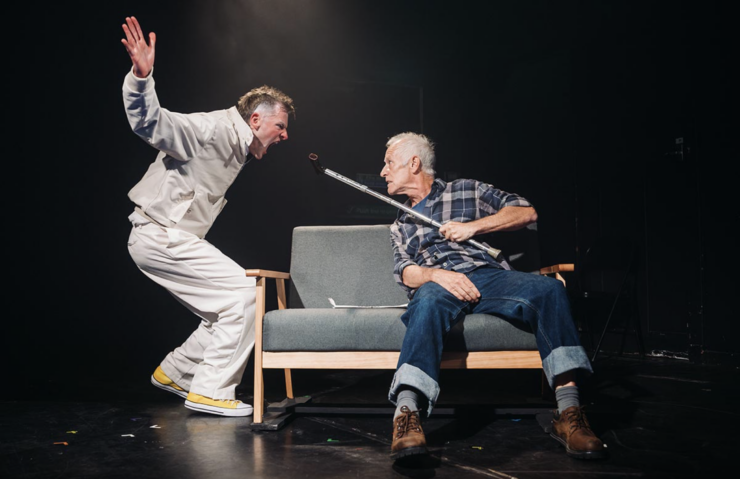
Emma’s dad Francis is kind of annoying, in that cynical sarcastic way that only dads can be. But she loves him, because he’s her dad, and he loves her, and it is this filial love/duty on which the heart and soul of Nesting is built.
Emma can’t stop pissing herself (because she’s pregnant). There’s a baby crying. This sound design is confusing. No wait, it’s a real baby crying in the front row. How fitting for a show about a soon to be single mother living at home with her widowed dad. Luckily she has a sexy doctor, played by the playwright himself, Peter McCormick. It’s a good time to typecast yourself as a sexy NHS doctor I reckon, there still seems to be a lot of roles going whilst plays about our crumbling healthcare system are on trend.
A montage of hospital scenes – something’s wrong with Francis’ hand. Who keeps moving this large wall of curtains on wheels? And who keeps opening and closing the curtains like magic? The slick dynamism of Ben Standish’s directing paired with Peter McCormick’s pacy script keeps all this medical exposition hurtling towards a diagnosis: Francis has Motor Neurone Disease. Shit. I can’t remember the details but I know that’s a bad one.
Is that how an EMG sounds? Sonia Killman’s immersive sound design surrounds us with the static crackle of electrical activity in muscle cells. Degenerative. Life limiting. I can’t work out who this debilitating condition sucks more for – the patient or his pregnant carer? The rest of the play circles this question like an intrusive thought – or an intrusive seagull.
Finally, a seagull I’m excited to see on stage. Not a re-staging of Chekov, but an actual larger than life seagull, played with disturbingly sinister alacrity by Michael Guest as he pecks out pizza boxes from the bin. Was Guest ever a seagull in a previous life, I wonder? I rate the decision to dress him in a beige normcore outfit and yellow converse instead of wings.
Whilst Emma tries to cope with becoming a carer for her dad, her dad is busy doing cryptic crosswords with a seagull, and the seagull is busy to convince Francis to relinquish his body and life to him in order to save his daughter from the burden of care. It’s a brilliantly bizarre and human premise.
We have been lifted out of kitchen sink naturalism (woohoo!) and dropped into… magical realism? I wouldn’t call this Absurd – weird, yes. Strange, absolutely. Fantastical, even. But not absurd. Everything keeps it’s meaning, including death, and the seagull does a lot of explaining for itself. In fact, the more it explains, the less I understand.
Why is this seagull telling us about Lazarus, the man whom Jesus raised from the dead? And about the women who watched his body, Martha and Mary – would we expect them to weep over his body a second time? Even this dorito-loving bird brain can see how it is always the women who shoulder the burden of care.
I don’t like this seagull anymore. He’s scary. And making bestiality jokes about David Attenborough. Why does this gull want to force his way inside Francis’ body so badly? Are all seagulls secretly seeking human bodies to wear? Or is this seagull in a special kind of cult? Or is Francis maybe just imagining things?
This poor woman. What a stroke of unbelievable bad luck to have absolutely no one in the world around to support you: no friends, no mum, no partner, and the one person in the world who is meant to care for you suddenly diagnosed with MND and best mates with a seagull. It beggars belief, it really does. But Francesca Hess’s deeply human performance keeps this unlikely premise grounded.
Peter McCormick tries to do a David Ireland and stage a horribly unhinged act of violence on stage. It doesn’t land, perhaps because Billie Mack’s performance is impossible not to empathise with, or because the dog is not convincingly real.
This is my favourite moment in the play. Our laissez fair doctor drops the jokes and gets teary-eyed as he recalls caring for his own Grandad in his final years. ‘Did you look after him?’ Emma asks, desperate for any kind of help or support, ‘Well, my mum looked after him most of the time, but I helped’. We all laugh – then sigh. Isn’t that always the way? Doesn’t the care of the elderly, the young, the sick, the disabled, the care of everyone who our care-less systems let down, always seem to fall on the shoulders of women? Why should we bear it?
Because that’s what love is, this play seems to suggest, caring for someone at the expense of your own needs. All I can think about is how things are only going to get harder. How will Emma cope once her baby’s actually here? I’m worried for her, but what choice does she have?
When Emma sees the giant seagull breaking through their window with Furie-like wings, she doesn’t even think, she fights. Standish creates the most memorable mise en scènes in this Bird VS Human fight sequence, that start off funny, but swells into sorrow. THIS is what love is: it’s not building a crib or shaving someone’s face for them, it’s fighting off a giant seagull with a zimmer frame to keep someone you love alive, it’s pure instinct. You don’t question it, you just fight.
“Hope is the thing with feathers” – I’ve been waiting for this line for the whole play. But how does Emily Dickinson’s idea of Hope relate to this scheming seagull? Is hope for Francis, the dream of assisted dying? Of freeing the one he loves from the burden of washing his inert body? Maybe he should have talked to his daughter. If men could talk about their feelings to people instead of only to animals, would this still play be necessary?
Ah, Emma, standing centre stage cradling her newborn baby. Why do so so sooo many plays end with a baby? The symbolic value of the babe is clearly unbeatable: the future takes precedence over the past, parental love wins all. But is it really that simple? The haunting figure that lies on the sofa behind Emma reminds us it is not, something is always sacrificed for care.
Recommended Drink: Have a cuppa tea, have a cuppa tea – I’ll pop the kettle on.
Catch Nesting at Summerhall until August 31st at 16:30 (65mins). Tickets are available through the EdFringe Online Box Office.
 Shay Mace
 Lamesha Ruddock