


 Shay Mace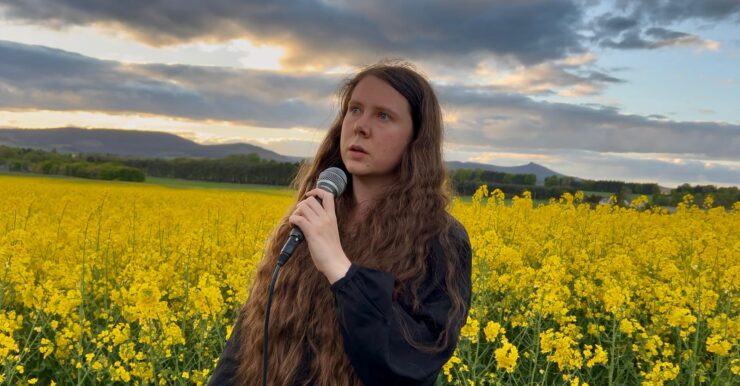
Content Warning: Discussion of Sexual Violence
Lucy Beth’s immaculately performed speculative spoken word storytelling piece gives voice to Isabelle, the subject of the ‘bothy ballad’ Bogie’s Bonny Belle that had once twisted her story of survival and recovery into misogyny and objectification. The daughter of an enterprising farmer in Huntly, Aberdeenshire, Isabelle’s life is turned on its head when young farmhand James Bowman shows up for a short term of work. Flirtation turns into abject violence, and we see Isabelle look back on how that one act transformed her life and perceptions of her both locally, and then embedded into folklore through the aforementioned ballad.
The piece is delivered entirely in Doric, the dialect of the Scots language spoken in both Isabelle and Lucy’s home turf in the North East of Scotland. This occurs with the exception of an opening moment where Lucy seeks to ground us in some of the key terminology of the folklore she is exploring. This piece is a reclamation – both of Isabelle’s story and of her mother tongue, and a unique opportunity for audiences coming from outside of the North East to immerse themselves in Doric prose. Lucy translates to us both in poised vocal delivery and movement within the piece that illustrates Isabelle’s journey. Both elements are exceptionally deployed, and deliver a powerful, gut-wrenching, and sensitively delivered moment when we see the acts of violence actually occur against Isabelle.
Lucy refuses to allow Isabelle’s story to be strictly defined by the suffering she has endured – depicting her sentimentality towards her upbringing in Huntly, the rolling green hills surrounding her, a heartfelt and comfortable relationship with her supportive father, all offering a three-dimensional picture of this character. This comes unwound as we witness oppressive elements of this lifestyle – notably the forbidding prescriptions of the local parish church when Isabelle gives birth to her first son. There is a tenderness to Lucy’s care for unpacking all elements of Isabelle’s home and public lives, wrapped up in a completely commanding solo performance.
I clung onto Lucy’s every breath over the forty five minute prose, delivered often within rhyming couplets but without any repetitive feeling. It’s an utterly expansive piece of writing also put together by the performer, which delves deeply into all facets of rural life as a young woman in this part of the world. Suppression, liberation, and finding her feet as an adult and a mother are all covered succinctly and expressed in the performance with candour and earnestness.
The moments of explosive pathos are delivered fervently, with moments of purposeful pause intonating and allowing the audience to reflect not just on the language but also the world Isabelle inhabits. This is colourful, refined storytelling at it’s best.
Poised, expansive, and unrelentingly deferential, you shouldn’t miss this remarkable storytelling experience.
Recommended Drink: Tak this with a neat whisky.
Performances of Ma Name is Isabelle have now concluded at Dundee Fringe 2025.
 Sarah Kher-Bek
 Ben Powell