






 Shay Mace

Read our write-up of Day 1 of Gateway Festival and its background here.
Across three nights at Gateway Festival in Edinburgh’s Studio Theatre, six new one act plays are performed two a piece, back-to-back, with vague groupings of theme and identity providing a tether for each evening. Of the second night’s productions, Stomach and Dead People Don’t Have Data see two performances exploring the place of technology in care, medicalisation, biology, and the dissolving place of selfhood against these dehumanising themes. In the age of AI, automation, and attempts to reverse ageing, it was a night of fiercely relevant and urgent topics, unpacked with notably human-driven modes of storytelling.
Gateway Festival continues tonight, Wednesday 4th November, at the Studio Theatre in Edinburgh from 7:30pm (2hrs 15min, inc. interval). Tickets are available through the Capital Theatres Online Box Office.
Stomach – Brilliant and Bizarre Sensory Medicalist Fable
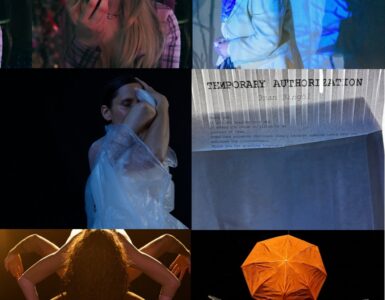
Ben Kay’s immensely personal script devised from “post-surgery scribbles” looks at the disorienting realities of hospitalisation, in tandem conversation with Oliver Sacks’ 1985 neurology anthology novel The Man Who Mistook His Wife for a Hat. Our central Patient character, played skilfully by Tom Catton, unravels his time in an unnamed Scottish hospital, surrounded by disorienting flashing lights and whirring machines, alongside an ominous bag of flesh that dangles over him. Taking its ilk from absurdist and Kafakesque performance, Philomene Cheynet’s tight and auteuristic direction provides a wealth of discovery and introspection, as we watch an out of body experience soon weave into a fabric of indeterminate fever dreams, writhing sensations and senseless conversations with nurses and surgeons.
Jamie Richard-Stewart soon punches through the fourth wall in the form of a Writer’s Blocked Oliver Sacks unwinding the story of Christina, a patient who has lost any form of proprioception, the body’s ability to sense its own position, movement, and force in space without the use of vision. There are twined parallels between the story of our Patient, who dopes himself with painkillers and drifts in, out, within and without consciousness, alongside Giulia Fornari’s performance as Christina, hidden at the back of the stage behind a paper-thin wall and illuminated only by a handheld LED light, soon mirrored by Catton’s character in the form of a phone screen light, to draw a synthesis across time, technology, the hospitalised experience and our evolving relationship to it.
Spectacular visual design from Lighting Designer and Stage Manager Moses Brzeski-Reilly compliments involving soundscapes and vivid diegetic noise from Eric Rogers across the piece, that whirrs and blinds as we are carried through this hallucinogenic experience towards recovery. A powerful moment that sees Patient and Christina’s stories intertwine fully finally loosens the narrative thread into a form of catharsis and revelation. Consciousness, lucidity, and its affects cannot be taken for granted, and are not always the totality of experience that they first seem to us in the sober light of day.
Recommended Drink: Absinthe, drink first… you’ll see after.
Dead People Don’t Have Data – Fervent Comic Exploration of Technology Often A Little Muddled
The play takes its name from a moment within, in which Nurse Heather is told by her domineering Matron Boss that patients do not need to consent to have their personal data handed over to an AI service in the afterlife. There’s an intriguing concept initially there in Laura Tansley’s script, that soon belies a superficial exploration of the existential questions surrounding Artificial Intelligence, our personal data, grief, and the intersections between. The aforementioned AI service, Grievr, at first appears as though it will offer resolution in the afterlife for the bereaved, but in its deployment within the script, doesn’t appear to engage with any clear ethical quandaries.
When a bereaved man appears, his loved one’s phone is put into the device, and he is given the chance to ‘look inside it’. Rather than engaging with chatbots, algorithms or the technology’s evolving power, the script treats AI as a fool’s errand, and as such, leaves out much of the poignant discussion about its controversial place in society. This is the beginning of a series of misgivings around technology within the story – namely that the characters seem to be able to reset a phone by taking a Sim Card out of it – and that completely parallel stories surrounding the licentious social lives of the characters soon come to dominate the narrative.
Comedic elements within the script largely rely on expletives to be delivered, which quickly becomes a crutch for the story. Within the plot, there’s plenty to be said for the care given to explore Heather’s duty of care to her patients, and how her misadventures to carry out her patient’s last wishes soon lands her in hot water, alongside how a long-running affair with a recently deceased man has comes to unravel her personal and professional life. It feels like these are all three separate stories loosely drawn together as one, and as a result, are thinly presented by performers who have too much ground to cover.
There were difficulties in staging the piece too, as it carries across a number of settings that are physically distant from the audience, it was at points hard for certain lines to be heard, and thusly, for certain jokes intrinsic to the script to land.
It feels there’s plenty to unlock in the story that Tansley’s script looks to tell, but it needs a steady reconsideration of precisely what it would like the audience to think and feel about both the characters and the technology at the story’s core, in order to deliver something more impactful or prudent.
Recommended Drink: Have a cup of tea poured by Heather, hoping to avoid another barmy request from a patient.
Gateway Festival continues tonight, Wednesday 4th November, at the Studio Theatre in Edinburgh from 7:30pm (2hrs 15min, inc. interval). Tickets are available through the Capital Theatres Online Box Office.
Please Note: This review features a show where another member of the Binge Fringe writing team is involved in the production. No incentives or promotions have been offered to cover this show, and Conflict of Interest measures have been taken in the editorial process to ensure an impartial, fair review.

 Bianca Tornea