
 Sarah Kher-Bek
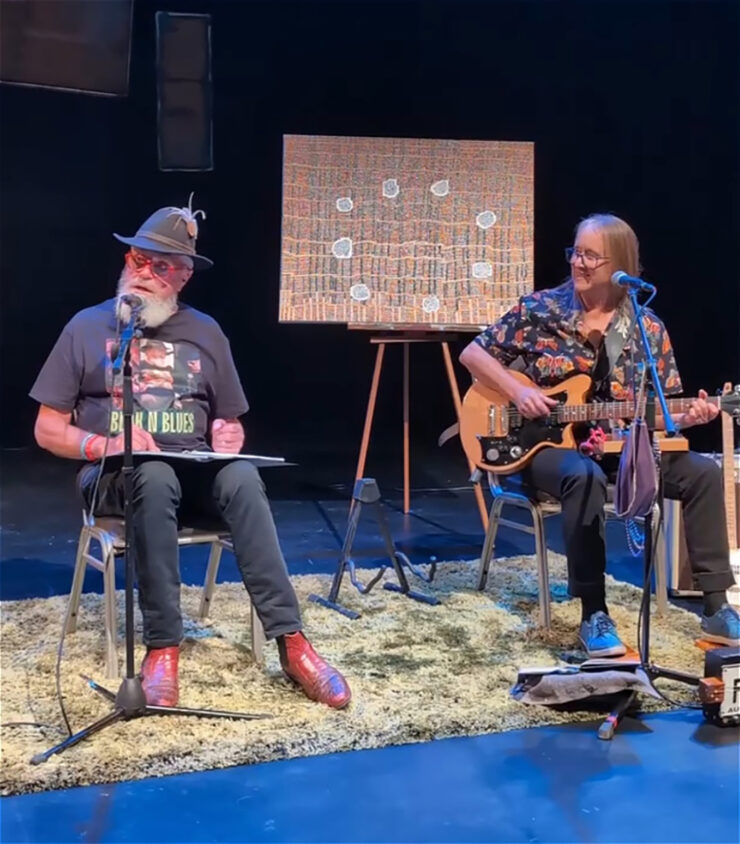
History has a habit of remembering the conquerors. Art remembers the people who survived them. In a dimly lit Melbourne bar, beneath the warm glow of red lights, Wiradjuri poet and artist Uncle Glenn Loughrey and blues musician Fiona Boyes remind us that grief and joy have never been strangers. Sometimes, they even sing together.
In Blak n Blues, poetry and music gather around an invisible campfire. There are stories to be told, histories to be reckoned with, and blues so smooth it feels almost criminal to remain seated.
At the centre of it all are two artists so comfortable in their craft, in themselves and with each other, that they no longer need to prove anything. Instead, we are invited into the unguarded intimacy of two people creating space for each other to exist exactly as they are.
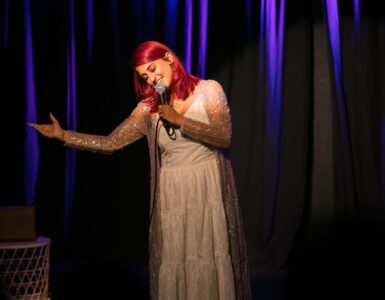
And then there is Fiona Boyes. There are so many ways to describe her, but really, she is just ridiculously cool. She plays as though the blues have always lived somewhere inside her. Her voice is like honey – it drips and thickens and softens exactly when it is meant to. Moving between different guitars, including one fashioned from cigar boxes that produces a beautiful earthy, almost banjo-like twang. Her fingers dance across the strings with a confidence so instinctive it feels almost unfair. It makes you wonder whether the guitars know they have no choice but to surrender to her.
The music slips beneath your skin, settles somewhere in your shoulders and makes sitting still feel like a personal insult. Boyes is cheeky and impossibly warm. Her joy is so infectious that every time she takes the stage, it’s impossible to do anything but smile.
Sat beside her, Uncle Glenn Loughrey has a way of making an entire room lean in. His poetry feels less like a performance and more like being entrusted with a story. And occasionally, an uncomfortable truth that leaves you with a little more to think about than you arrived with. His words carry the weight of Country, memory and the ongoing consequences of colonisation. But it is never simply an account of suffering. There is mischief here, and love, and defiance, and the stubborn insistence on being seen as fully human.
Beneath it all, a question of belonging: who gets to claim it, who gets to deny it, and who has had to fight simply to keep it.
There is something devastating about being made to feel like a stranger in your own homeland. To belong to a place so deeply, only to have that belonging questioned by those who came after you. When a people have been told to disappear, every story they continue to tell becomes an act of resistance.
Sometimes, that resistance begins by questioning the stories we have been taught to believe. One moment that will forever stay with me comes from a poem about the shepherd. Such an innocent-sounding figure, isn’t it? A gentle guardian guiding his flock across rolling green hills. The version we all know and love, the one we’ve been taught to imagine.
But through the lens of colonisation, the shepherd becomes something far more sinister. What some celebrated as progress came at an enormous cost to those who had cared for that land for generations. Even our language carries the fingerprints of those who claimed the authority to define everything around them.
“Naming what was never theirs.”
Uncle Glenn has such a talent for using humour to cut straight through the racist contradictions that plague Australia. Contradictions many have learned to tolerate, or worse, remain silent about. Take the rather ambitious demands to “Make Australia White Again.” There is something immensely absurd about the descendants of colonisers demanding that newcomers leave a land their own ancestors stole from its First Nations People. Imagine arriving uninvited, taking the house, and then complaining about who gets to come through the front door.
And yet, for all the weight these stories carry, the evening never loses its lightness.
And then – Fiona plays.
The room, which falls almost reverently still during Uncle Glenn’s poetry, begins to move again. Shoulders sway, smiles spread, and the blues fill all the spaces between the words.
The beauty of Blak n Blues lies in this exchange.
It is unpredictable in its unfolding. While the poems and songs already exist, the order seems to belong to the moment. Uncle Glenn’s poetry responds to Fiona’s blues, and her music finds its way into the stories he tells.
A conversation between two forms of feeling.
Neither quite knows where the other will take them next, and that’s part of the magic.
Fiona listens to Uncle Glenn. Uncle Glenn listens to Fiona. And the audience listens to both.
In a show about a people whose stories have so often been spoken over, the act of listening becomes part of the art itself. At one point, Uncle Glenn remarks that “you’ve got to live a little to have anything to say.” And as their stories and music weave together, creating a world we are lucky enough to visit, one thing becomes clear: these two have undoubtedly lived.
Blak n Blues confronts the histories this country would rather leave undisturbed, without surrendering the joy, humour and humanity of the people who carry them.
And somewhere between the poetry, the blues and the laughter, you realise that the invisible campfire has done exactly what it was meant to do. It has brought people together.
The fire was never really there. But I swear I could feel its warmth.
And I wasn’t quite ready to leave.
Recommended drink: Bourbon on the rocks, A little warmth, a little bite, and plenty of character.
Performances of Blak N Blues have now concluded at Melbourne Fringe.