




 Sarah Kher-Bek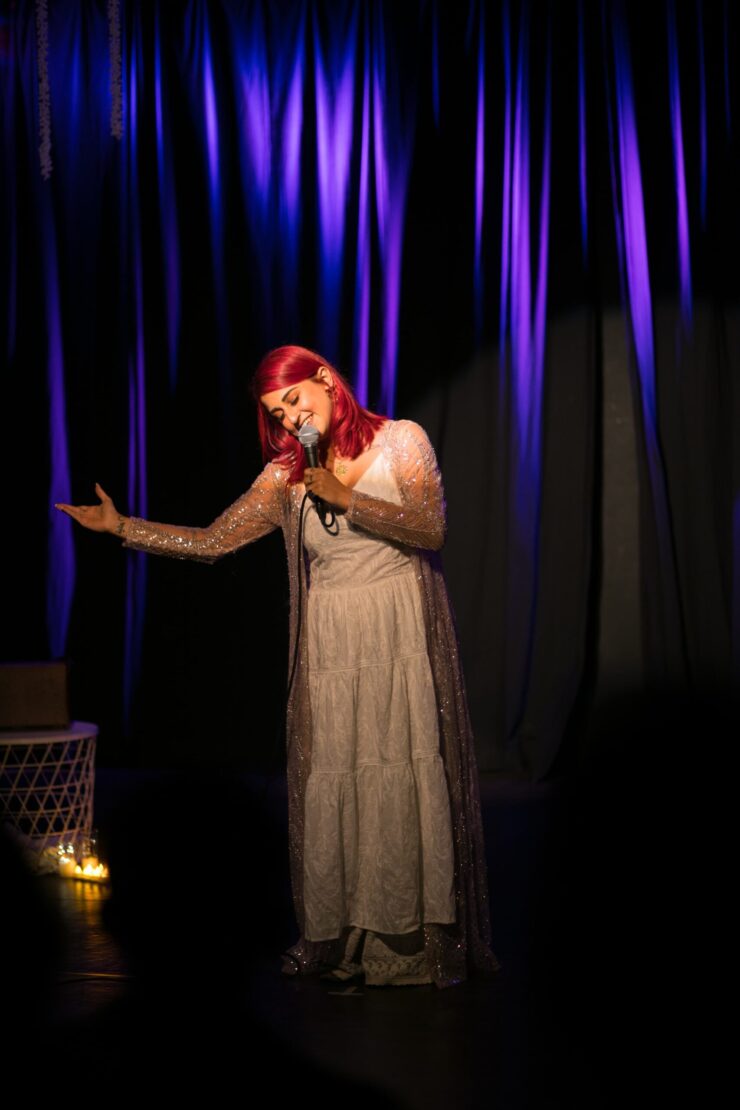
Some inherit houses. Others inherit stories. And when the world asks you where you belong, sometimes the only answer you have is everything you’ve carried with you.
In Ghar: Location Not Found, home is not something easily pinned to a map. Punjab-born and raised partly in Melbourne, Jasmine Babbar is a multilingual poet and storyteller whose work moves between languages, countries and the complicated business of belonging.
Bright, playful and obviously in her element in front of an audience, Babbar seems happiest with a microphone in her hand and a room full of people willing to listen. There is a joy in watching someone so clearly enjoy being heard.
She takes us through the moments that have shaped her, from family memories and childhood dreams to heartbreak, loneliness and building a life in Melbourne. Her humour is wonderfully observant, comparing Melbourne’s unpredictable weather to an emotionally volatile relationship. It’s an analogy anyone who has survived a Victorian spring will understand. Or winter? Summer? Literally any season in this state.
But it is in the stories of her nani that something especially tender begins to emerge.
A song from 1947 evokes a history in which freedom and loss are painfully intertwined. History rarely leaves its wounds behind. They travel through families, through memories, through the stories that become our inheritance.
“She gave me these words and stories as inheritance.”
Her nani’s tenderness continues to shape the woman standing before us. She speaks of trauma, but moves through the world protected by her nani’s love. The people who teach us how to love can continue protecting us long after their stories become our own.
Then there are moments when I don’t understand a single cultural reference. And my God, I love them. There are jokes, expressions and familiar family dynamics that pass me by, while audience members around me laugh in recognition. She makes no effort to explain every reference for my benefit, and I wouldn’t have it any other way. I am a visitor in these memories, and grateful to be one.
For centuries, colonialism has demanded that cultures bend, shrink and reshape themselves to fit the expectations of those who claimed the authority to define them. And somehow, that expectation survives. Explain yourself. Translate yourself. Make your history digestible, your humour accessible, your identity comfortable for someone else’s consumption.
I know first-hand how exhausting it is to be expected to make yourself smaller, just so someone else never has to feel out of place. Here, she refuses. She tells her stories as they belong to her, without stopping to make sure everyone has caught up. Not everything needs to belong to us to be worth witnessing.
Babbar doesn’t simply recount her memories; she seems to inhabit them again, inviting us into the warmth of her world. And yet the production doesn’t always give her storytelling the support it deserves. For a work built around the power of words, there are moments when everything surrounding them seems determined to compete for our attention.
The opening poem is accompanied by a backing track so busy that I struggle to follow the words. Elsewhere, abrupt musical entrances and endings interrupt the storytelling. More considered transitions, allowing the music to fade naturally in and out, could help these elements feel like part of the same work rather than separate pieces assembled in front of us.
The addition of a vocalist is an interesting idea, with songs intended to mark chapters in Babbar’s life. But the collaboration feels underdeveloped, and the vocals rarely add the emotional dimension the production seems to be reaching for. Too often, I find myself wondering what the music contributes to a story already being told so beautifully.
During the two poetry readings, Babbar’s reliance on a printed page occasionally breaks the connection she establishes so naturally elsewhere. Reading poetry is an art in itself, but the repeated shift in eye contact momentarily pulls me away from the words.
And then, towards the end, the music finally finds its place.
A poem about betrayal becomes one of the evening’s most affecting moments. Babbar’s expression changes as she reaches its conclusion, the pain of the memory visible in her face. Here, the words seem to move through her rather than simply come from her.
For the first time, the vocalist feels essential to the storytelling. Rather than interrupting the emotion, her voice carries it forward, allowing the weight of Babbar’s words to linger. What follows is a moving reflection on heartbreak, the things we carry long after leaving someone behind, and the difficult courage it takes to choose yourself.
“For once I didn’t shape myself around everyone else.” There is something quietly devastating about that admission. How much of ourselves do we surrender before we realise we’ve been disappearing?
And perhaps that is where the meaning of home begins to shift. Sometimes the person you must return to is yourself.
Ghar: Location Not Found is warm, funny and deeply personal and its stories are woven with affection and cultural memory. Babbar’s storytelling needs little embellishment. I spent much of the evening smiling at the woman behind the microphone, occasionally wishing the production would stop interrupting the conversation. Her stories already have their own rhythm; the music needs to learn to move with them, rather than asking them to keep time.
But beneath its uneven execution lies something deeply human: the understanding that home is not always something we are given. It lives in the things no distance can take from us, the parts of ourselves we must learn to reclaim, and everything we’ve carried through the world.
Perhaps home was never the place she was looking for.
Perhaps it was the person she was becoming.
Recommended drink: Mango lassi to go with the absolute sweetness of the storytelling.
You can catch Ghar: Location Not Found at the London Arms Bar until October 18th. Tickets are available to book through the Melbourne Fringe website.


 Shay Mace