




 Salvador Kent
He must be deformed somewhere; he gives a strong feeling of deformity, although I couldn’t specify the point.” – from ‘The Strange Case of Doctor Jekyll and Mr Hyde’ by Robert Louis Stevenson.
Disclaimer: Heather Rose Andrews and J.D Henshaw’s version of Jekyll and Hyde has had a lot of critical acclaim. I loved it, but felt like I had more to say about it than a traditional review might let me. So I’ve opted to write a longform piece instead. It is an essay, in the sense it is my analysis, but unlike an academic I have no interest in objectivity. It’s more like a piece of personal cultural analysis of this team’s remarkable adaptation, and the remarkable festival it played at.
It’s an odd contraption. JD Henshaw’s Jekyll and Hyde: A One Woman Show transcends, overwhelmingly because of its peculiarity. It is an adaptation that eschews narrative art in favour of something an older poet might have called the argument (1). It is a work of literary theory that uses Jekyll and Hyde as the cypher through which to explore the Victorian Condition, that strange ghost which permeates our culture today, not only through the gothic, but through most narrative arts.
It is a work that takes for granted some prior knowledge of Jekyll and Hyde, because it guts the text from most of its incidents. It is instead mostly focused on language and philosophy. In this text, these things are mutually exclusive. The language is breathy, relentless and impenetrable in a Beckettian manner, in the sense that Beckett’s tramps are lost Victorians (2). The philosophy is the thematic content of Jekyll and Hyde, demonstrated here through theatre, that is the voice and the body.
JD Henshaw proves to be a fine adapter for this function. He takes an epistolary novel and reconfigures and simplifies it to a play of its main opposition. In this work, there is only Jekyll and Hyde, and they speak to each other through crackled radio. Anything that might have been transmitted through the word is transmitted through voice and image, and the effect is remarkable, opening the door to filmic comparisons that will be made later.
It must be said Heather Rose Andrews is given a relatively Promethean task then, in delivering a text which is primarily interested in ideas, and not the most obvious ones which come to mind. This is a Jekyll and Hyde which is interested in the fine line between civilisation and savagery. What constituted either was really the battleground of the 19th Century. Jekyll and Hyde is precisely the story of this battleground told through one conflicting body.
It’s not unusual for this to be the take given by Jekyll and Hyde, but the adaptor’s positionality to the text is always made clearer by how Hyde is dressed compared to Jekyll. Compare Heather Rose Andrews in the promotional material to Fredic Marsh’s characterisation in the 1931 film (3). (Left, stills from 1932 film. Right, promotional material for Jekyll and Hyde: A One Woman Show).
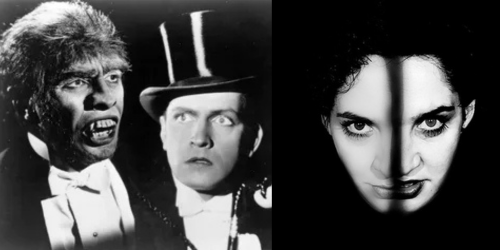
Marsh as Hyde is heavily made up and racialised. This speaks to the Victorian belief that baseness was savage and that criminals could be identified through physiological features. It is the same instinct that led the first eugenicists to elaborate from Darwin’s The Descent of Man. Heather Rose Andrews however, simply changes her facial expression. Her Jekyll and Hyde are shockingly similar. Both can feel pain, both can scream and grunt. The oft-used trope of Jekyll and Hyde as half-faced is not in this adaptation beyond the promotional material.
This far from derives from a lack of skill; both Jekyll and Hyde are expertly drawn, this is rather a choice. Hyde is as present as Jekyll in her body, both Jekyll and Hyde speak with the same cadence and language, both of them come from the same place.
It is a simple step towards the universal, and not a side-stepping of the important intersectional critiques to be made towards the source material, rather a development of this. What is it that makes Hyde ‘down-right detestable’? What is it that makes her ‘ape-like’? (4) Henshaw and Andrews seem to believe it is inherent in the human being, regardless of their positionality. This supreme ambiguity acts both as confrontation and elaboration of the complex issues of identity and evil, and makes Andrews positionality essential, whilst interestingly justifying her lack of ‘womanly’ character.
Indeed, a different adaptation might have read the text through a feminist lens, perhaps creating a piece more narratively-inclined. Instead gender here is used as what you might call an alienation effect, or a leveller. In this version, Hyde is now a woman and she kills boys, but this doesn’t seem to be a comment on femininity. Rather, it universalises Robert Louis Stevenson’s themes. By calling attention to the ‘one woman show’ it liberates ‘woman’ from the submissive role it is placed in in this sort of literature. Everyone kills, including women. Everyone dies, including men. All human beings have the capacity for evil in the body.
This latter thought is the basis of the second theatre JD Henshaw constructs in this adaptation. At one point the text proclaims ‘there is no God’. This Nietszchean allusion sets up a core issue of the 19th Century. If our moralities were defined by Christians, and developed in a Christian manner, what makes something ‘good’? If we were to read Heather Rose Andrews’ Jekyll and Hyde as broadly the same body conflicting through two different languages, we have the assertion of a feeble moral order versus the practice of an alluring chaos. Henshaw and Andrews are remarkably astute to understand the childish instincts at play in the text, and how these are the same instincts that lead this Hyde to draw a particularly Sadean pleasure from killing.
The real interplay between good and evil is through the lights, a welcome surprise at Fringe venues with limited technical capacity. The lights on first impression might come across as amateurish due to blackouts between scenes prolonging proceedings. On reflection though, it emphasies the notion of shadow and light central to Henshaw and Andrews’ argument. It makes the Jekyll and Hyde filmic, but not in a modern sense. The lighting is like the films of old, even before the A-B shot, where we were presented with tableau images. The effect is the whole picture is in the ‘frame’, we have none of the trickery of the 1931 film transformation with the revolving camera. Instead, Henshaw and Andrews’ interpretation of the transformation is remarkably similar to the 1920 film in which the character changes in one shot.
It further highlights the thin line between Jekyll and Hyde, Order and Chaos and Good and Evil in this adaptation. It is also tinted with colours associated with the 1920s German expressionist films, Green and Purple tints are primary here, giving the play a filmic feel despite its lush theatrical reds.
The play’s indedtedness to film however is not to take away from its intrinsic theatre. Rather, film, through a certain lens, is a perfect real-life example of Jekyll and Hyde’s metaphor. Regarding Godard’s magnum opus Histoire(s) du cinema, critic Adrian Martin noted “The Histoire(s) du cinéma is the story of a Fall in the Biblical sense […] Cinema was once, for a precious moment or two, innocent, pure, piercing in its clear vision of the world. Then it was tempted by money, and lost its way. It gets dragged, and it drags itself, in the gutter. But it never entirely loses the memory of what it once was, or the hope of what it might be again in the future. At every moment, the cinema rises and falls, lives and dies, dwells in both the high and the low’ (5).
In this sense, cinema can be read as the actual real-life invention that the Victorians projected. It is the monster in Frankenstein, it is the vampire, it is Mr Hyde. It was a device constructed in the pursuit of progress, and a device tainted by how it gazed. It is a machine of the undead, freezing us in moments. It is capable of capturing our basest instincts as well as our most sublime. JD Henshaw’s Jekyll and Hyde is cinematic in the sense it is a ‘machine’ rather than a story. The machine shows us, like a shot of vodka, all of these philosophical threads that make the novel tick. It does so through a destabilising lens, by presenting it to us through a woman, attempting to make the machine as universal as possible. We see the interiority of good and evil, but in an explicitly Victorian way, perhaps even as a Victorian ghost.
In Henshaw and Andrews’ Jekyll & Hyde machine lies all of the philosophies of its Victorian conception, deconstructions of its sources and filmic depictions. The horror of this work radically does not come from narratives, but the ghosts of ideas. It is a remarkable contraption.
To conclude, it must be said that to put a work of this density on at a Fringe festival feels strangely like a breath of fresh air. I feel like our dreams of Fringe were for texts as unapologetically authorial, and this is clearly a close collaboration between Henshaw and Andrews, to be given a platform such as this one. At the larger Fringe festivals, this is becoming trickier. In Dundee though, time and time again are its audiences being treated to beautiful, idiosyncratic and genuinely unique work. It is a thrill to see a theatre that makes me associate like this. That’s undoubtedly due to this teams skill as artists, but also as programmers too. As we enter the final stretch of the sixth edition of Dundee Fringe, I must implore: avant-garde.
Notes:
(1) The ‘argument’ in especially Renaissance literature is a short summary of the larger work. See John Milton’s 1674 Paradise Lost, or William Blake’s The Marriage of Heaven and Hell.
(2) I came across this formulation in a much better essay than this, but Peter Bogdanovich makes the point pithily “Chaplin was always idiosyncratic and kind of Victorian. You look at any of the features Keaton made, though, and they seem as if they were conceived in the present time” (see this article). This is the precise tension of modernism that Samuel Beckett’s plays explore — the tramps with their bowler hats and suitcases and rope belts are forgotten after modernity blows up the world, so they joke and ruminate amongst themselves.
(3) Mr. Hyde (left) and Dr. Jekyll, both as portrayed by Fredric March, 1931.
Jekyll and Hyde: A One Woman Show. Promotional material.
See Also: https://www.youtube.com/watch?v=LP7RyURZAa0 – Dr. Jekyll & Mr. Hyde (1931) – the transformation scene
(4) Robert Louis Stevenson. The Strange Case of Dr Jekyll and Mr Hyde.
(5) Adrian Martin. A Skeleton Key to Histoire(s) du Cinema. https://www.screeningthepast.com/issue-34-untimely-cinema/a-skeleton-key-to-histoires-du-cinema/

 Clara Sunset
 Ellen Leslie
 Ari Bhatti