



 Salvador Kent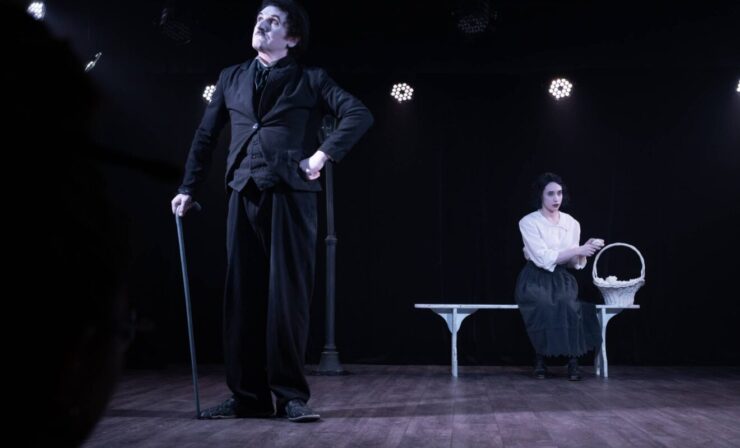
Taking cue from Chaplin’s silent masterpiece City Lights, Alwina Najem-Meyer directs Lights on Chaplin. This is a physical feat, performed with actors donning black and white makeup and moving around the stage with the same fast-paced slapstick that characterises films of Chaplin’s era (an effect of film shot at 18fps being projected at 24fps, which is remarkably transposed to the theatre). At its best, the production is as affective as Chaplin’s work, but perhaps its mix-and-matching of his films leaves a text that lacks the exciting subversion and freshness of the Tramp’s best.
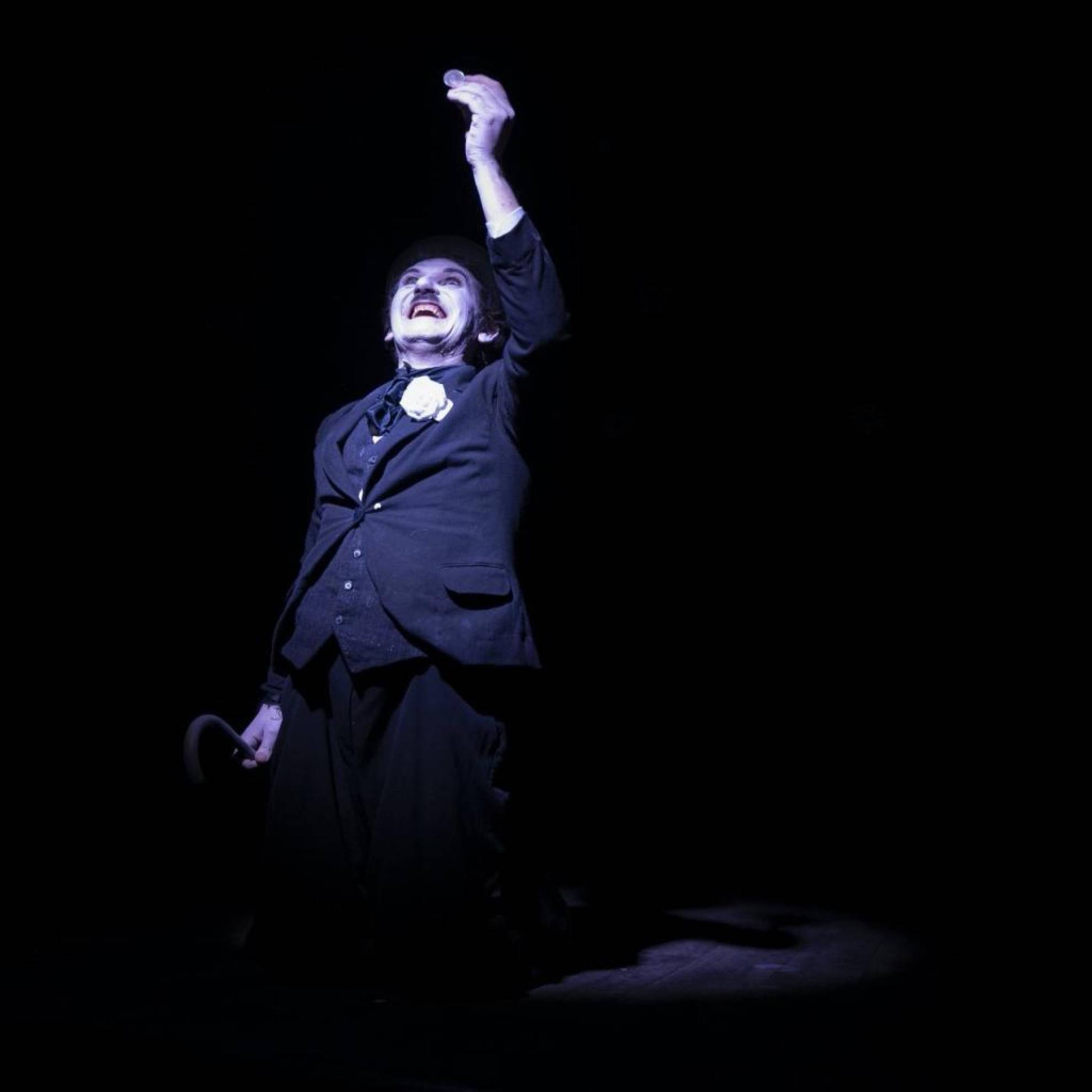
The five strong company astonish in their versatility, and they construct the broadness and business of city life well. Dmitri Rekatchevski has the spirit of the tramp in his portrayal, and the physcality to match. The others play various characters from City Lights and beyond, with scenes transposed from Modern Times also featuring. The rich man, a drunkard, and Najem-Meyer’s beautifully played blind flower girl are characterised with rigour yet playfulness. This is a rich piece of physical theatre on a techincal level. How the panorama of images is acheived with the most minimal number of elements is inspiring. The entire affair is elevated by a gorgeous live piano score, although perhaps the image would be completed by placing the pianist in white-face too.
The adaptation sticks to the beats of City Lights, quite nearly feeling like a shot-for-shot remake unless you go through it with a tootchcomb. What remains of the film and what is changed does raise some questions. The production has Chaplin’s spirit, but mostly lacks Chaplin’s intelligence. There is not enough of a point made about the Tramp as an anachronism. He may be a Tramp, but he is a Tramp with a Victorian dandy and romance that juxtaposes with the new society being built around him.
The society here feels too similar and the dynamics of the city are not sketched out enough. One moment where the hats of Charlot and a Rich Man are swapped and swapped again develops this point nicely, but briefly. Another moment, perhaps the best of the show, has Charlot flirting with the flower-girl as a policeman gets shot. The class-commentary of this image, as well as its placing of the Tramp as an outsider and Romantic is a rich one, only glanced at elsewhere in the work.
Part of the reason this occurs is the substitution of plot points in City Lights for scenes that do indeed have better slapstick, but lack the dramaturgical intelligence. Yes, Charlot as a waiter is funny, but it means we lose Charlot trying to be a gentleman, and some of the text of City Lights is lost. This is a thinner affair than it ought to be. At 80 minutes, it would need to be trimmed to fit the demands of a larger Fringe festival like Edinburgh, and maybe the move here would be to stick to City Lights and focus in on the complexities of that work.
Still, in the construction of slapstick the production cannot be faulted. The famous boxing match is reconstructed for the stage with humour, beauty and a brilliant athleticism. The main romance between the Tramp and the Blind Flower Girl is as moving as it is in the film, just as beautiful and life-affirming. It might be one of the most iconic shot reverse-shots in film history, but staged, the subtlety of the actors gestures is beyond graceful, and the gesture of a red-rose washes the stage with a visual splendour. The greatest moments of this have all of the romance and genius of a Chaplin movie, delivered with great aesthetic care.
Recommended Drink: After the show here in Catania, Mosaik Beer House & Tea Room does some great craft beer.
You can catch Lights on Chaplin at Catania OFF Fringe Festival one last time Teatro Vitaliano Brancati on Sunday 18th October from 17.30 (80min). Tickets are available through the Catania OFF Fringe Festival Online Box Office.
 Shay Mace
 Lamesha Ruddock