 Em Tambree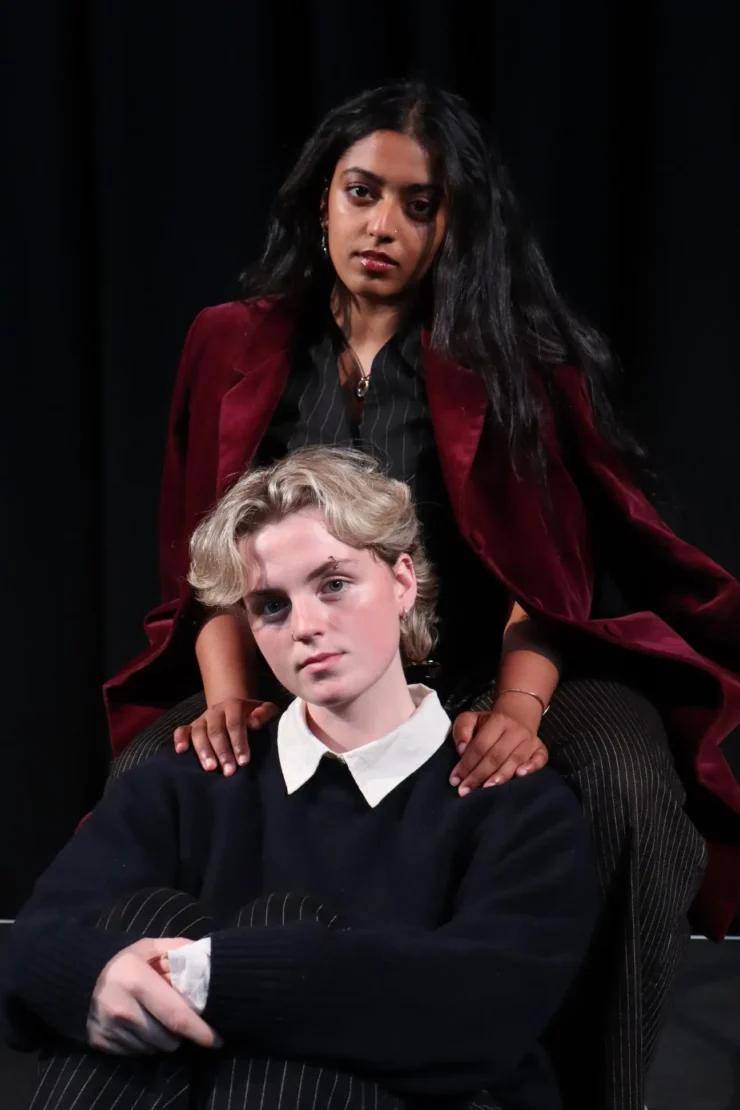
An adaptation is a conversation with the past: a continuation of an influential narrative through a modern-day point of view, illuminating back to ourselves why that story mattered and why it might still matter now.
Mermaids at Fringe advertise this production as Carmilla “with a McCarthy twist.” An intriguing proposition. Yet when an epoch-making novella is stripped of its supernatural danger, sexual appetite and literal stakes, when it has lost every one of its fangs, can it still meaningfully be called an adaptation?
Published in 1872, Sheridan Le Fanu’s Carmilla predates Dracula by a quarter-century and has since become a notorious figure in sapphic literature and gender studies. Her nocturnal existence, bodily exchanges of fluid through kisses along the décolletage, and unconventional relationship with Laura, queer-coded women’s sexuality as an illness capable of threatening moral social order.
I understand why that premise might seem ripe for a Lavender Scare recontextualisation at first glance, but that surface-level instinct overlooks Carmilla’s reclamation within the lesbian and feminist zeitgeist. Without the supernatural element, its coming-of-age allegory also acquires some uncomfortable predatory implications that would benefit from greater dramaturgical care.
To enjoy the production on its own terms, I eventually began treating it as an independent sapphic period drama, closer to Fellow Travelers (2023) than Le Fanu’s gothic tale.
Under those parameters there is much to encourage. Izi Prothero gives a beautiful starring performance as Laura, displaying unconventional instincts that are a director’s dream. Prothero and Nannapaneni approach intimacy with a sensuality and curiosity that feels refreshing, particularly when their connection is allowed to remain soft instead of taboo. An ensemble populated by multiple sapphic characters is similarly a rare occurrence; making me excited for the next generation of queer theatre makers and storytellers.
The instincts of this cast and creative team are worth nurturing. There is a spark of something special in the room. But a spark is not yet a light, nor is a historical parallel an argument, although both offer abundant places from which to begin. The artists must be encouraged to dig beneath initial connections to text in their future work in order to find their own voice. What do they have to say? To the source material? To the themes surviving almost 150 years in our collective consciousness? To themselves?
Small changes to the plot already suggest a perspective I yearn to see and hear more from. Most significantly the production refuses to kill Carmilla, saving her from joining the ever-growing pile of bodies created by ‘bury your gays.’ It is a purposeful choice that demonstrates the company’s commitment to imagining queer lives beyond tragedy. The work knows the ending and queer tropes it wants to reject, but its next task is to discover what it wants to offer in its place.
The direction would benefit from the same curiosity and courage. Extended transitions and frequent scene changes interrupt a story that might instead embrace its dreamlike existence beyond ordinary time. The blocking draws heavily upon familiar conventions of period drama, but a more production-specific physical language could allow this world to emerge.
Greater trust in stillness, ambiguity and their own instincts over convention will help the work find the seduction currently missing from its staging.
However, Carmilla is an ambitious undertaking by student creatives at a formative point in their practice. That is something I will always advocate for. The production’s willingness to approach an influential queer text is commendable and worthy of applause.
I can only review the production currently onstage, but I hope its artists recognise that criticism is not an invitation to retreat. This team has opened a door into an extraordinary lineage of queer, feminist and speculative storytelling. Please keep researching. Keep questioning. Keep learning. Keep making. There is something here worthy of sinking your teeth into.
Recommended Drink: Your cup of joe of choice at Half-Cut Coffee nearby.
Performances of Carmilla have now concluded at EdFringe 2026.
 Shay Mace
 Ellen Leslie