 Shay Mace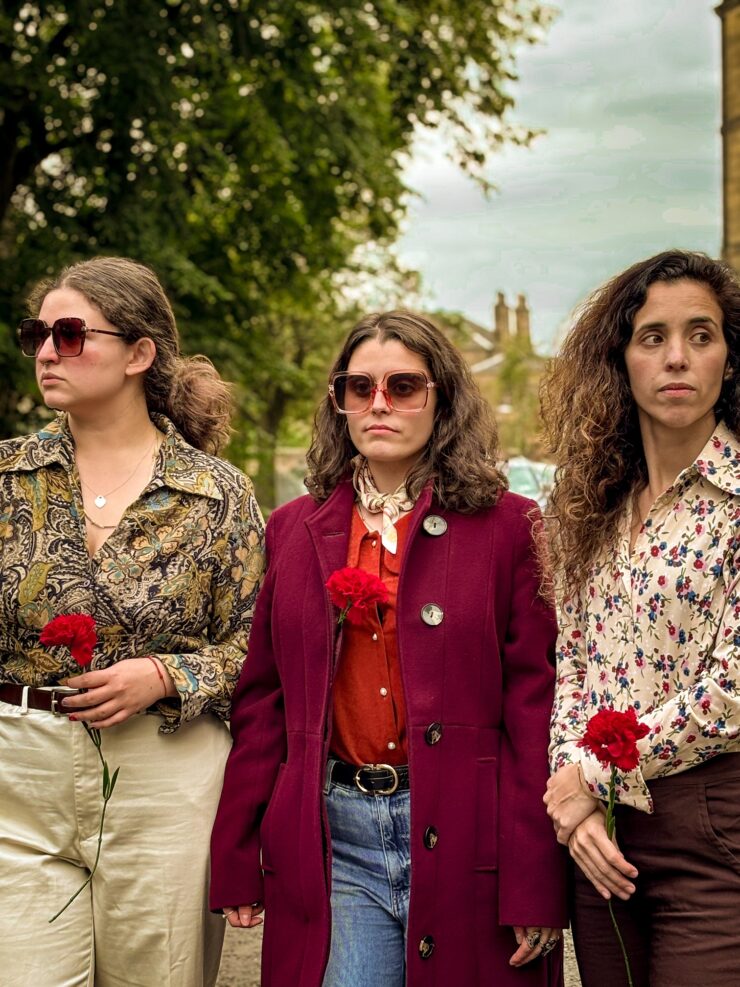
It’s 1972, and the oppressive Estado Novo regime is tightening its conservative grip on Portugal through censorship and repression. Three women stand up to the dictatorship using words, courage and conviction – The Three Marias – Maria Teresa Horta, Maria Isabel Barreno and Maria Velho da Costa, who risked everything they had for freedom of expression. The eponymous play will be heading to the Edinburgh Festival Fringe this August, put together by Voices Collective Company, a UK-based multilingual theatre company creating women-led work that amplifies underrepresented voices across languages, cultures and generations.
We caught up with the team for a pixelated pint to unpack how they’ve brought these three women’s stories to light on the stage. We spoke with playwright-performer Eduarda Nogueira, performer Maria Barros, Director Zuza Sołtykowska, and Producer Flavia D’Avila.
You can catch The Three Marias as part of the Edinburgh Festival Fringe on August 26th – 30th at Studio at Braw Venues @ Grand Lodge from 13:15 (60mins). Tickets are available through the Edinburgh Festival Fringe Online Box Office.
Shay: Hi team – your piece The Three Marias explores the stories of three women facing trial under the oppressive Estado Novo regime of Portugal in 1972 – tell us about these women, and what’s inspired you to bring this story to the stage now.
Eduarda: These were three Portuguese writers, Maria Teresa Horta, Maria Isabel Barreno, and Maria Velho da Costa, who decided to challenge an oppressive regime – Estado Novo – using their voices. Together, they wrote Novas Cartas Portuguesas, a book that led to detention, and a public trial. What inspired me most was their courage. They refused to be silenced. Through literature, they spoke not only about the reality of women living under the dictatorship, but also about wider political and social issues Portugal was facing at the time, including the Colonial War.
I think this story feels particularly relevant today because it reminds us that many of the freedoms we enjoy were fought for by people like these women. Looking back at their story helps us understand the past, but it also encourages us to ask what role artists, writers, and ordinary citizens can play in confronting the challenges of our own time.
Maria: With the rise of individualism, social isolation, collective inaction and apathy that we experience nowadays, it feels empowering to share the story of three women who against all odds (even against the law!) got together, created together and inspired others to do the same. They were revolutionary in an original, intimate and brave way – with their words. With their deepest, most vulnerable desires, pain, dreams, disappointments, doubts, hopes.
And it’s beautiful how these three women were so different from each other, (with different personalities, experiences, views, dreams, artistic styles) and yet they created this book together, with only one voice. They never revealed who wrote what and that was a powerful statement. By taking The Three Marias to the stage and sharing their story, we want to keep the revolution going. And we want to invite the audience to be part of it.
Shay: The piece had a successful work-in-progress run last year, tell us about the journey you’ve been on with the piece since then.
Eduarda: Since the Fringe, the project has continued to grow both artistically and as a company. We secured funding and began a collaboration with Instituto Camões, which has given us the opportunity to further develop the work, expand its reach, invest more in marketing, and better support the artists involved in the project.
Also, the team has grown. While many of the original collaborators have remained the same actors and directors, new artists have joined us, including producer Flavia D’Avila, social media manager Elohor Emekagbor, dramaturg Erdem Avşar, and other creatives who have brought fresh ideas and perspectives to the piece. Together, we’ve continued refining the script, developing the visual language of the play, and deepening the relationships between the women at its centre.
Zuza: It’s incredible seeing the piece grow so much over the past year – last Fringe we were still getting to know the characters, their world, and their stories. This year feels like coming back to old friends, women I love and look up to! For me, an important part of the journey was learning more about the real-life Three Marias – it’s a great conversation starter when meeting people from Portugal! Over the past year, discussing the Portuguese Letters with Portuguese friends, I’ve heard so many incredible family stories centred around that time: the revolution and the struggles of everyday people. These stories have given me a rich emotional background for my work on the show, and I’m so grateful to bring all of this into this year’s production!
Shay: How has the creative process been of putting the show together? Give us an idea of the journey you’ve been on with it so far.
Zuza: My main goal with the creative process is to focus on the characters – the authors of the Portuguese Letters – and conveying the emotional depth of their story. The truth is, they were just ordinary women living in a very difficult political time; there really was no expectation for them to speak up the way they did. I find it fascinating how the letters bloomed from the heat of everyday conversations and domestic life – isn’t this something we all experience?
I find inspiration for the piece in everyday conversations with friends and all the brilliant women I’m lucky to have in my life (several of whom I get to work with every day on this show). I try to bring this energy into the work with the team as well – we all have a purpose in telling this story, and it’s important to keep this creative, collaborative energy flowing. In a way, we’re all like the characters in our show: collaborating, taking inspiration from each other, and working towards a shared goal. Through organic movement, direction, and acting, I want our show to convey the universal power of using your voice that the Three Marias tapped into. We’re inviting the audience into the space to become part of the revolution, and hopefully inspire more people to speak their minds.
Maria: From an actor’s perspective… reflecting on the stories of the women in our lives. Reflecting on our own stories. Sharing these stories with each other, finding the connections with the script and the book. Debating ideas, gaining a deeper understanding of the women in our lives, the characters and ourselves. Sometimes speaking in English and other times in Portuguese.
Shay: What will be the first thing the audience sees, feels, and hears as they enter the space?
Zuza: The audience will feel like they’re entering a cosy chaos of a home – this is the place where all revolutions start, after all! In order to achieve the incredible levels of artistic and intellectual collaboration that the Three Marias came to, they needed to work in a supportive and welcoming space. However, don’t be fooled – this is a home of active revolutionaries, never-resting rebels. The audience will feel the excitement lurking in the corners of everyday domestic life. They might hear snippets of news about the regime on the radio, or catch a snazzy 70s tune…
Shay: What are you hoping the audience might take away from the experience, if anything?
Zuza: If even one person leaves feeling braver about speaking up, that would mean everything to me. I want the audience to come away from the experience knowing they can use their voices too, no matter who they are. All three Marias have very different lives and backstories, something we flesh out in the show. However, each of them was able to contribute to something that moved the world and changed their reality. I’m hoping the audience discovers their own agency to change the world around them.
Maria: Hope, energy, courage, inspiration. Feeling seen.
Flav: An interest in a lesser-known episode of our shared human history. I grew up in Brazil and when I was at school, we stopped learning about what happened in Portugal once we got past the Independence period (which makes sense), so I didn’t know anything about the Estado Novo regime or the Three Marias before I connected with Eduarda. It’s interesting that everyone knows about Hitler and Franco, but no one seems to know or talk much about Salazar, and this was the longest-lasting dictatorship in Europe!
Shay: What journey has the show been on to find itself at EdFringe 2026?
Eduarda:The journey to EdFringe 2026 has been one of continuous development. What started as an idea and a script grew into a company of artists who connected with the story and wanted to help bring it to life. It’s been incredibly rewarding to see the show reach new audiences and introduce more people to these extraordinary women. I hope audiences leave the theatre feeling as inspired by their courage, their friendship and determination as I was when I first discovered their story.
Shay: With EdFringe now just around the corner, what are you most excited for?
Zuza: Oh god, what am I NOT excited about! The Fringe air is different – it’s incredible to see Edinburgh transform into this exciting monster running on creative energy, art, flyers, and excessive partying! It’s a very cheeky director thing for me to say, but the thing I’m most excited for is our premiere, haha! I genuinely can’t wait to get into rehearsals, work with the team, and prepare a thrilling show for Fringe audiences.
Maria: The Edinburgh Fringe is a magical time and you never know what is going to happen, how it’s going to affect you. So I think I’m most excited to see how this time can surprise us and change our lives. And, of course, to play with my friends and work with this amazing team! Being a Portuguese artist living abroad, I also feel excited to share this inspiring piece of Portuguese history with the rest of the world. I also can’t wait to see a million shows and meet other artists. I still can’t believe I get to play one of my idols (Maria Teresa Horta), I’m very excited to get closer to her and feel things her way.
Shay: Given the themes of Binge Fringe, if your show was a beverage of any kind (alcoholic, non-alcoholic – be as creative as you like!), what would it be and why?
Flav: Licor de Merda, obviously. It’s rather lovely with flavours of vanilla and spices, but here’s the thing: it was created during the 1974 revolution deliberately as satire (the name means Shit Liqueur) and has become an established institution. I like that it also carries a layer of theatrical meaning, as in Portuguese we say ‘Merda’ for good luck before a show (the equivalent to ‘Break a leg’). But I could also cast a vote for Ginjinha because it feels more feminine and the red berries remind me of the carnations used a a symbol of the Revolution as well.
A reminder, you can catch The Three Marias as part of the Edinburgh Festival Fringe on August 26th – 30th at Studio at Braw Venues @ Grand Lodge from 13:15 (60mins). Tickets are available through the Edinburgh Festival Fringe Online Box Office.
Image Credit: Rian Thangmi
 Ellen Leslie