

 Elisabeth Flett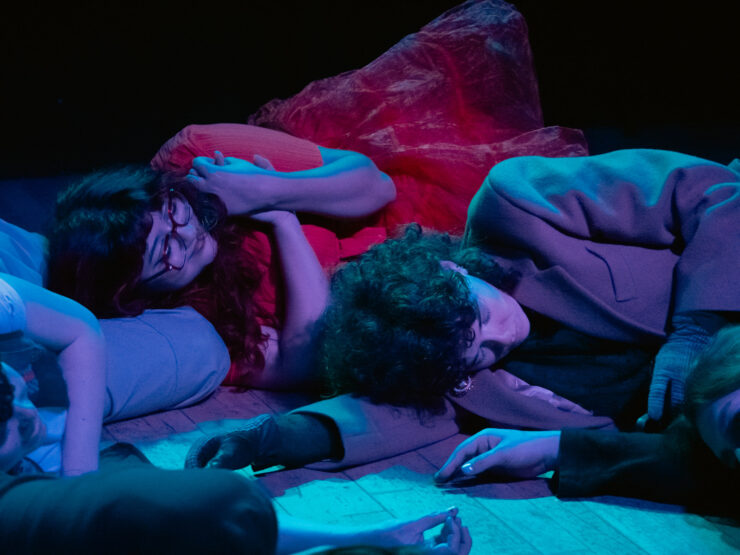
Who are the queer elders in our lives? How do they influence us? What can we learn from them?
Bedrock is a new devised theatre performance – mixing monologues, spoken word and poetry with ensemble movement – which is created with these questions in mind. Starring a cast of young queer people and made in response to interviews and lived experiences, this devised theatre piece seeks to honour LGBTQIA+ elders and inter-generationality in the queer community.
Who gets to be a queer elder when so many of us don’t make it past 36? Is it when you make it past your childhood?”
Bedrock begins with a colour-washed stage, musical instruments and Pride flags scattered around the space in promise of what’s about to come. Interview audio plays over the speaker system as the young cast begin to appear in ones and twos, the six performers greeting each other and helping each other get ready for the performance as voices speak overhead. “Trouble comes and it will come again,” remarks someone on the recording as the performers braid hair and exchange chatter. “Know your history.“
Trouble has indeed come again in 2026 Britain, and Bedrock is a show which acknowledges the queer community’s dread about our current toxic political climate in amongst its more joyful sections about queer found family. There are powerful first-person testimonies about the prejudices faced by cast members in the fight to get gender affirming care, the ever present transphobia permeating our country, the suffocating pressure to fit into gender roles and the overwhelming loneliness which comes with being ‘other’. Cast members also share testimonies about queer elders: the people who know exactly how hard it is to live with these kinds of sorrows, and how much it takes to keep on surviving day after day.
Bedrock was co-created by Az Palta, Cameron Kelsey, Izzie Atkinson, Rosie Phillips, Elsa Kerscher and Rae Web, and the onstage connection between the cast members of this six-piece company is a crucial part of the performance. The company’s use of space-work is excellent, and the strongest parts of the show are the more choreographed movement sections where the lighting, soundtrack and dancing from the performers meld together to create a genuinely transportive audience experience. A section with exultant disco beats, pulsing blue and red lighting and rave-like dancing made me feel like I was at a particularly joyous nightclub.
Although this show is ostensibly about queer elders it quickly opens up into more general themes about queer experience, with ‘to-the-audience’ monologues mixed with ensemble movement sections. There are many strong moments from the cast in these solo sections: Izzie Atkinson’s beautiful vocals and strong dramatic performance and Az Palta’s powerfully bittersweet imagined phone-call about intergenerational queer lives shine in particular.
A few areas of the performance could be tightened up – more vocal projection was sometimes needed from the performers as the spoken lines during group scenes were occasionally hard to hear in the audience, and it would have been interesting for the interview recording excerpts played at the start of the show to be more fully integrated into Bedrock overall – but that’s to be expected when going to see a new devised theatre piece.
Towards the end of Bedrock the show asks the question: when so many queer people die so tragically young – trans women of colour in particular – how does one even define the term ‘queer elder’? What age exactly does the mantle appear on one’s shoulders? When will we all find ourselves with the title attached to our own name? Organ suspension chords hum under this young queer cast during the final scene of the show as they take a moment to imagine their own queer futures. A butch husband. A jazz night. A dog. A house to call their own. It is a deeply powerful moment, heartbreaking in its simplicity.
Queer people just want to love, and be loved. Feel the sun on our face, and drink coffee, and get married, and listen to good music and walk in the street holding hands with our partner without fearing for our lives. The fact that these dreams for our future seem so daring, so outlandish, tells us just how far we have to go before the act of imagining a queer future stops being an act of queer revolution. Shows like Bedrock remind us to keep speaking that revolution into the world until it stops being a dream and starts being our reality. The future is coming. We owe it to our elders to make it there, and to make it into something beautiful. Together.
Performances of Bedrock have now concluded at Assembly Roxy.
Image Credit: Emily Rose Sharp
 Ben Powell
 Lamesha Ruddock
 Shay Mace