 Salvador Kent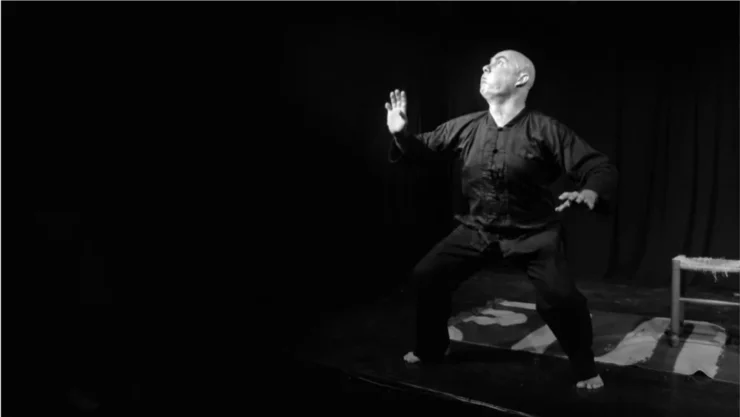
I first heard of Tom Corradini researching clown for a round-up. I then met him at Brewhemia on the eve of Fringe and we had one of those conversations that sends my head spinning – some of the content of which is in the interview below. His theatre is really special, accomplished performances that sit outside the thrust of the festival and hark back to a performance style that is rarer and rarer. Catching Hamlet: Prince of Sweden was a proper Fringe experience, a mighty audience of three was treated to a discussion of Shakespeare’s text and its antecedents, delivered in a beautifully light presentation. It was charming, and I chatted to Tom and Nicholas (Nike).afterwards, his stage partner in the piece…
Teatro Fiscio shows play at the Edinburgh Fringe until the 21 August. You can book tickets here. I’ve only caught Hamlet: Prince of Sweden so far but it is thoroughly recommended.
Salvador: Hey Tom and Team! Tell us a little bit about Teatro Fisico. Where can we find you and what do you do?
Nicholas: We’re at the Fruit Market Gallery very conveniently located right outside the door of Waverley Station. Teatro Fisico is an Italian-based physical theatre company that performs original shows all over the world. Our approach to physical theatre is about telling important, socially relevant stories that break through linguistic and cultural boundaries. Teatro Fisico is a style that exists somewhere in the junction between clowning, dance, mime, music, and prose. Our shows are constantly mixing between comedy and tragedy: the whole spectrum of emotions blends together unexpectedly…as it does in life.
Salvador: Tom and I had a really interesting conversation the other day where you explored how linguistic and physical theatres engage different parts of the brain. Can you expand on this?
Tom: Basically, non-verbal communication activates core functions of the brain—the primordial part linked to the amygdala and the limbic system. Our brain is in a quasi-natural absorption mode. Just to give you an example, dolphins, dogs, and primates are all able to produce and react to non-verbal messages (I’m simplifying here so as not to bore the reader with scientific terms). We are able to process the millions of bits of visual information we receive every minute and spontaneously assess a threat or a friendly situation. We are not required to intellectualise, but rather to use our intuition.
Speech is an enormous leap forward in evolution. It activates completely different areas of the brain, namely the frontal lobe and Broca’s area (dedicated to speech production and grammar). However, it requires mental effort. It is an active function of the brain that consumes a lot of energy. That’s why our level of attention decreases after a certain period when we are listening to or engaging in speech, unless there is some kind of emotional reward attached to it. Imagine the difference between a conversation with friends and listening to a university lecture. In the former, by the way, there is a LOT of non-verbal communication, even if you don’t realise it consciously.
Because of this, physical theatre—Lecoq-style physical theatre in particular—if well performed, creates a unique bond with the audience, as they experience both an emotional-visual response (in the foreground) and an intellectual response (in the background). Overall, I find this type of staging more emotionally engaging and relaxing. It’s a bit like watching a movie.
Salvador: Hamlet Prince of Sweden has an elegant simplicity in its design. How does the company approach designing for unconventional spaces?
Nicholas: Our shows begin from conception with a minimalist design philosophy for props, costumes, and scenography. On a practical level this allows us to bring our shows anywhere, and adapt them to any space. Creatively, that minimalist design is also a great inciter of ideas because it forces us to find uncommon solutions for scenes and storytelling. We have to build a world that the audience can believe in and sink their teeth, even if that world is a sort-of collective imagination that we’re all participating in. It sounds dreamy but it takes very precise movements, gesture, and breath to make the invisible world of imagination come to life.
Salvador: What are you and your performers’ backgrounds in clown and physical theatre, and what are the most important lessons from your formation?
Nicholas: I trained at the Accademia Dell’Arte in Arezzo where I got an MFA in Physical Theatre in 2018. It was a great program that gave me a lot of breadth; the central focus of the Accademia was on making devised theatre. As for training we had LeCoq for movement, commedia mask, Roy Hart voice training with Kevin Crawford and music with Saso Vollamaier, a semester at FLIC Circus School in Turin, and we made our final two shows with Familie Floez and Continuo Divadlo. For clowning specifically I worked with Andre Casaca, founder of Teatro C’art. The work with Roy Hart and Continuo Divadlo has stuck with me the most because both practices challenged me to go beyond my self-imposed limitations and explore the full complexity, depth, and richness of expression that our voices and bodies are capable of. It is a wildly wonderful feeling to do what you once thought was impossible. It motivates me to give everything possible to each performance.
Salvador: Have these shows been elsewhere? Will they tour further after the festival?
Tom: Yes. We are a touring company and this is my full-time job. In 2018, I performed on 168 days out of 365, and when I am not performing, I follow the shows I produce. I’m a bit of a MacGyver, I have an engineering degree, so I cover pretty much all the roles if necessary: technician, stage designer, and music composer. I now compose all the music for my shows. Basically, I strive for autonomy.
Regarding the five shows we perform in Edinburgh: Mister Jackpot has toured since 2021 in Italy, France, and the UK (we premiered in London in March 2025); Shaolin Clown has so far toured in Estonia, Spain, France, Italy, the UK, and India, and in November, I will take it to Pakistan; A Woman in Berlin has toured in Italy in its German version, and we are organising a German tour in February; Hamlet, Prince of Sweden has toured the whole of Italy; and the only one with a shorter touring life is Caligula, because it is a fairly new show—so far, we have toured it in Italy and France.
Our shows are very light and easy to set up. They can work in unconventional spaces as well. I have around 15 shows now, so I am constantly on the road. Before coming here, I was in Portugal with my show Mussolini (which, by the way, participated in the 2025 EdFringe), and after the Fringe, I am driving to Belgium to participate with yet another show (Petto o Coscia?) at the Festival du Brocage in Herve. Then, I will drive back home, rest, and write a new show, which will be a hybrid English-Chinese physical comedy show titled Noodles.
Salvador: How are you finding the festival? (Honestly!) What are you reflecting on?
Tom: Marketing is the most difficult part. Running a theatre company means doing a lot of it. Let’s say, without getting into details, that after 17 years as a full-time performer and theatre producer, I have gained a certain level of credibility. I also attended Avignon Off for nine years in a row (I skipped it this year). I wrote the only available guide out there for non-French-speaking companies that want to perform at Avignon Off, titled The Rough Guide to Avignon Off.
Personally, I do not want to stop at theatre. Screenwriting has always been my passion. I am also a YouTuber now, with quite a large following in my Italian channel (I also have another one in English and German). I’ve been playing the character of Benito Mussolini on YouTube since 2022, featuring various spin-offs (The Mussolini Show, Learn Italian with Mussolini, Mussolini and Hitler parodies, Mussolini in the Future, video game walkthroughs with Mussolini, etc.). I do a lot of different things.
Salvador: Given the themes of Binge Fringe, if your show was a beverage of any kind what would it be and why?
Nicholas: Mister Jackpot dreams of being a bigshot like James Bond, but he works in a small office in Kentucky selling yard care equipment. So it’s gotta be a Bourbon Martini (shaken, not stirred).
Hamlet: Prince of Sweden I’m going with a Screaming Viking (Vodka, Dry Vermouth, Lime Juice, garnished with a celery stalk and cucumber spear) because, as you may know (or will soon find out) Shakespeare’s text was based on the Legend of Amleth, an Old Norse Saga. And for Caligula? A glass of red Cesanese wine, mixed with local Roman honey, garnished with a sprig of pine from the Teutoberg forest, and just smear the whole thing all over your toga.
Tom: Shaolin Clown is Chinese green leaf tea or ginger tea. It’s a meditative show to be sipped quietly.
And A Woman in Berlin 1945 is a high-class red wine, something like an Amarone or Brunello di Montalcino. It’s a delicate show and, unfortunately, touches on deeply moving events linked to the Second World War: the rape of German civilians by the Red Army and the female Soviet soldiers fighting on the Eastern Front. Red is the key colour throughout the show.
A Reminder. Teatro Fiscio shows play at the Edinburgh Fringe until the 21 August. You can book tickets here. Go check it out!
 Lamesha Ruddock