


 Shay Mace
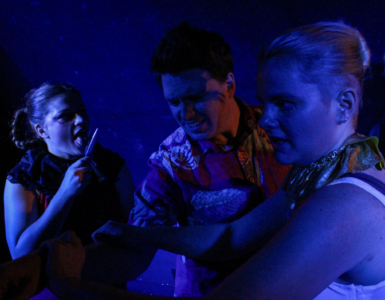
We’re joined today by the ensemble behind upcoming Voila! Theatre Festival show Be Gay, For God’s Sake – shining a light on the intersectionality between queerness, religion, the generation gap, family and faith. The multifaceted team, originating from China and Taiwan, are platforming the stories of Shasha and Song, mother and daughter, living in Inner Mongolia and facing uncomfortable truths as Shasha returns from the UK, left with the weight of what has been left unsaid in the past.
Unpacking the show with us in this interview are playwright-performers Haoyu Wang, Tianxian Tian (also directing, Hector T.J. Huang (also the composer), and stage manager Katherine (Meiyu) Guo. Join us for a pixelated pint as we find out what inspired the piece.
You can catch Be Gay, For God’s Sake as part of Voila! Theatre Festival in London at various time on the 14th, 15th, 21st and 22nd of November at Theatre Deli. Tickets (£12 / £10 conc.) are available through the Voila! Theatre Festival Online Box Office.
Jake: Hi team – your show, a self-described ‘time-bending queer comedy drama’, follows two characters named Shasha and Song. Tell us about them and what has inspired the story.
Haoyu: Shasha is a so-called younger generation — a young woman full of independence and self-discovery. After many years of studying and creating theatre productions with critical thinking, she now knows more clearly what she wants and is brave enough to pursue it. And Shasha is completely different from her mother, Lin Song, a devoted churchgoer, who sees herself as a good daughter, a good mother, and once a good wife — in many aspects. And of course, Song has sacrificed a lot to maintain these identities.
In Song’s view, she believes her daughter should follow the same path she did — to study, to work, to marry (a man), to have children, and to become another “good wife” and “good mother.”
Yet through the experiences Shasha has encountered over the years, she can’t live the life her mom wants her to live, and she also couldn’t understand those decisions her mom made. The irreconcilable tension between them reflects the conflicts that exist in many mother–daughter relationships — not only in East Asia, but everywhere. These tensions do not arise because they don’t love each other, but rather because their love fails to find the right way to be expressed.
This is also the starting point of our creation. The generational question is something everyone who loves their family tries to understand: What is truly the right way to love?
And when the queer question exists between generations, it becomes even more complex —
Can the daughter understand the choices her mother once made?
Does she truly know what her mother sacrificed?
And the mother — has she ever regretted it, after all these years?
When the daughter experiences her own queer awakening, will the mother realise that the logic she once used to justify giving up her own love no longer works for her daughter?
And the best way to understand what they experienced is to go back — to see what really happened back then, and to ask ourselves whether there is something we could change to make our lives better. And of course, we would need God to take us on a journey through time for that.
Jake: How has the creative process been of putting the show together – give us an idea of the journey you’ve been on with it so far.
Tianxin: The initial idea for the show came from Haoyu Wang, who developed the concept in June 2023. She shared it with a friend in China, Xinzhu Wang, who created a short play version in November that year.
In March 2024, Haoyu, Tianxin, and Hector officially began developing the full script together. We met regularly to collaborate and shape the piece, and by April 2025, we had completed a full draft and began submitting it to festivals under the name Oh My My. We began rehearsals in June 2025 and had our debut at Totnes Fringe Festival in July. Then we took the show to the Lambeth Fringe Festival and had our London premiere in October. Now we are looking forward to our run at Voila! Festival.
Jake: What will be the first thing the audience sees, feels, and hears as they enter the space?
Tianxin: A world of paper. The story takes place in Inner Mongolia, China. As the audience enters the space, the first thing they will hear is Inner Mongolian music, carefully chosen by Haoyu, who grew up there, immediately transporting them to the vast, open landscapes of the region.
This is a time-bending comedy; the audience will also see subtle hints of that, teasing what’s to come. At first, the audience will feel alienated. The sound and set design deliberately place them as observers, focusing on the character’s dilemmas rather than being part of the action.
Jake: What are you hoping the audience might take away from the experience, if anything?
Hector: Family is what made us; whether we chose to be moulded by it, it shaped the first boundaries of our world, then we began to build from there. I’d love for the audience to imagine if their world could be different. To see the fabric and structure of someone’s—in this story, Lin Song’s—world being exposed, and then to see it unfold and shift—this can only be done with the imagination and ridiculousness of theatre.
When worlds collide, we are finally shown the limitations of our own. Moving across the globe and resettling in this country, we could finally see home from a distance, and appreciate that there are different ways of thinking, feeling, and being.
All of this is our highest hope for the play. If one person could walk away reflecting on their world and their family, then that is enough. The bottom line is that the audience can be entertained, laugh a little, maybe cry a little. Maybe have a little forgiveness towards their parents and their upbringing. Maybe not. Maybe next time, the family dinner becomes a little easier to endure. Maybe we can find some lightness in the bitterness of it all.
Jake: With Voila Festival 2025 just around the corner, what are you most excited for?
Katherine (Meiyu): The most exciting thing about Voila Festival 2025 is its celebration of global voices and cross-cultural storytelling. Sharing Be Gay, For God’s Sake here means not only reaching new audiences, but also engaging in a creative change of ideas, perspectives and experiences. We love that the Voila Festival encourages connection across languages and cultures; it is a reminder that stories about queerness, identity and intergenerational struggles are universal, even when they are deeply personal. The energy of seeing diverse audiences react, reflect, and discuss these themes is truly inspiring.
Jake: Given the themes of Binge Fringe, if your show was a beverage of any kind (alcoholic, non-alcoholic – be as creative as you like!), what would it be and why?
Tianxin: Absinthe. The Green Fairy. It looks peaceful, but tastes sharp and spicy. It stings, yet is enjoyable, leaving a long-lasting flavour and an unforgettable sensation.
A reminder, you can catch Be Gay, For God’s Sake as part of Voila! Theatre Festival in London at various time on the 14th, 15th, 21st and 22nd of November at Theatre Deli. Tickets (£12 / £10 conc.) are available through the Voila! Theatre Festival Online Box Office.
 Salvador Kent
 Ben Powell