


 Shay Mace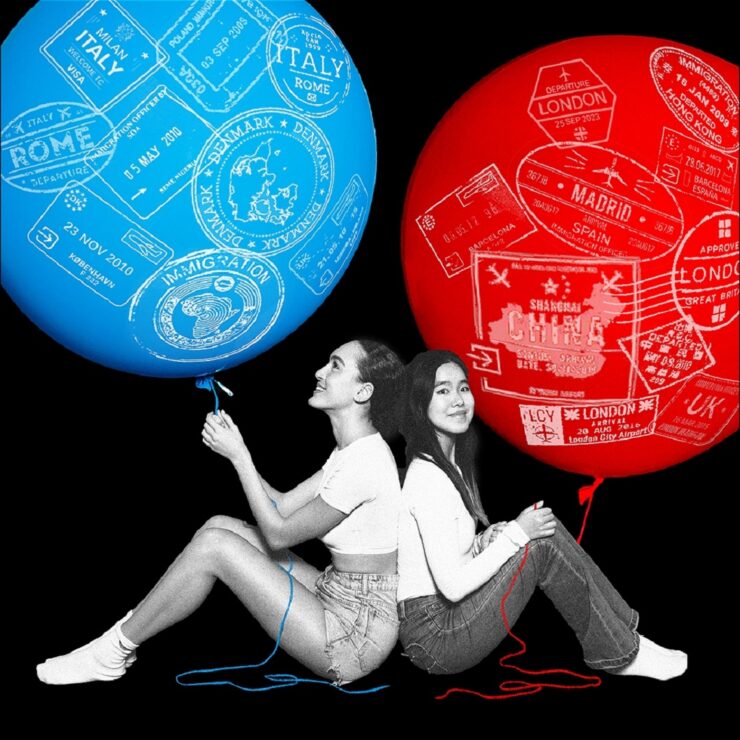
Who am I? Where do I belong? – these are two fundamental questions to all of our identities, to be addressed in the ephemeral, anecdotal and personal sense in Interlink Theatre’s upcoming Voila! Theatre Festival show Neither Here Nor There. Using verbatim theatre and shadow puppety, the documentary piece follows two women—one second-generation Chinese-Spanish, the other mixed-race Danish, Nigerian, and Italian—each navigating multiple worlds.
We caught up with Sunny and Isabell for a pixelated pint to find out more about why they decided to bring their stories to their stage.
You can catch Neither Here Nor There as part of Voila! Theatre Festival at The Playground Theatre in London on Thursday 13th November from 7pm (60mins). Tickets are available through the Voila! Theatre Festival Online Box Office.
Jake: Hi Sunny and Isabell – your upcoming autobiographical piece Neither Here Nor There follows two women wrestling with identity, belonging, and the weight of expectations. Tell us a bit about the main characters and why you decided to tell the story now.
Isabell: Neither Here Nor There is based on a true story and is a piece of autobiographical writing spanning a number of years in my life. The character of Doe was inspired by Yufei Lucía Jiang, who not only lent her story but also her voice in shaping this character. Her thoughtful feedback was instrumental in bringing a fully-realised and complex Doe to life. The character is Chinese-Spanish and grew up in Spain, where she was bullied for being different — for being Chinese in a place that saw her as other. Jane, on the other hand, is inspired by me and by years of journal entries and reflections on the mixed-race experience — belonging to more than one culture yet claimed by none. The two characters mirror each other in their experiences of displacement and identity, but while Jane wrestles with belonging, Doe’s journey gradually leans more toward self-acceptance and finding peace within herself.
The characters are referred to as Jane and Doe in the play text for clarity, as we wanted to leave the names intentionally non-specific. The decision to leave the characters effectively nameless in the performance is deliberate, reflecting the play’s exploration of identity, mixed heritage, and the second-generation immigrant experience.
Sunny: The earliest seed of Neither Here Nor There actually came from our degree show at Goldsmiths, University of London. I’ve always been deeply drawn to themes of cross-cultural communication, identity and belonging, and when I met Isabell, we immediately connected over these shared interests. Over the years, I’ve had countless conversations with Isabell and friends who told me their own stories — about belonging, about being “in between.” Gradually, I realised that this was more than a personal curiosity; it was a collective experience that needed a space and a voice.
Sunny & Isabell: This subject matter is not often explored in depth, and through developing the play we’ve met people who can relate to at least one aspect of the story and, in doing so, come away with a deep sense that they are not alone in this. It’s important to bring these stories out of the margins and into public discourse, so that those unfamiliar with the experience can learn—whether that means becoming more curious about themselves, or, if they don’t share in the experience, becoming more curious about others. The inspiration essentially came from our own lived experiences and the desire to share them with others in hopes of building a community where mixed-race, second-generation immigrants, third-culture, and international individuals are seen and considered. Our story is not unique, and it felt imperative to make that known—many others face similar struggles with identity.
Jake: How has the process been of translating your stories to the stage, and were there any things you didn’t expect to discover as you did so?
Isabell: I’ve been writing this story without even realising it for the past six years — but this year was the first time I ever considered shaping it into a play. Over the past six months, there have been countless rewrites, and we’ve held multiple focus groups made up of mixed-race and second-generation immigrant individuals whose feedback offered invaluable insight into the story’s formation.
The first run in Camden Fringe of the play was nerve-wracking for me. The writing process itself had been deeply therapeutic, but seeing it come to life on stage — and having people watch it in its entirety — felt raw, revealing, and at times, incredibly vulnerable. I hadn’t expected to gain so much clarity on my own story through the process, or to experience such a mix of emotions: fear, joy, and immense gratitude as audiences connected with the story and responded so warmly to its honesty.
It’s been a huge learning curve, but also deeply rewarding to discover that I was capable of doing something I wouldn’t have had the courage to attempt six years ago — or even a year ago.
While my story has been six years in the making and, in some ways, easier to translate to the stage, I made a deliberate effort to do Lucía’s story justice — to preserve her voice and perspective without letting it be lost in my own writing style. Her support has been invaluable, a true reflection of her brilliance and her care for the second-generation immigrant experience. The play continues to evolve, and we’re so grateful for the audience feedback that’s helping shape its ongoing journey.
Sunny: As the producer, I initiated the revival and redevelopment of this project, inviting Isabell to co-create and forming a team of artists who either belong to or are passionate about this community. This play speaks to international, second-generation, and third-culture individuals, immigrants, and anyone questioning their place in society — people shaped by more than one culture, belonging everywhere and nowhere at once. I also wanted our project to be more than just a play — to become a space for connection. I’ve been interviewing people from these backgrounds and incorporating their real voices and stories into the production, so that the audience isn’t just watching Jane and Doe’s story, but also catching glimpses of themselves reflected on stage.
As the director, I wanted to tell these stories in a way that was both intimate and expansive. The piece is story-based, but told through multiple layers — live performance, projection, video, and, most distinctively, shadow puppetry. The puppetry element, inspired by my own childhood memories of Chinese shadow theatre, became an essential narrative device. It can represent people who shaped the characters’ lives — mothers, teachers, classmates, friends — or even their inner emotional worlds. Together with a multifunctional set that transforms from a canteen to a classroom, a immigration office, or a screen for interviews and shadows, the design mirrors the fluidity of identity and memory. Through this process, I discovered how blending these artistic forms can build emotional bridges — between the personal and the collective, between two performers on stage, and between us and the audience.
And as for what I didn’t expect to discover — wearing the hats of producer, director, and performer all at once has been much more intense than I imagined. I wanted everything to be perfect, to do everything myself — from selling tickets to rehearsing, from confirming guest lists before the show to street promoting afterwards, then going home to learn lines and coordinate with every department. It was overwhelming at times, especially when artistic vision and commercial realities conflicted. Balancing creativity with logistics and finances was a real challenge. But through that chaos, everything eventually came together. We successfully completed our Camden Fringe run in August and our Lambeth Fringe run in September, and I’ve learned so much from the experience. Now, I’m fully ready to embrace our upcoming run at the Voila Theatre Festival this November. This project has truly shaped me — not only as an artist, but also as a leader. It’s made me stronger, more resilient, and better prepared for whatever comes next.
Jake: What will be the first thing the audience sees, feels, and hears as they enter the space?
Isabell & Sunny: As the audience enters the space, they’re met with a video compilation of mixed-race and second-generation immigrant individuals speaking about their experiences — an introduction that sets the tone, preludes the performance, and reinforces the documentary theatre element of our play.
The play includes time jumps, showing the characters at different points in their lives — at different ages and in different circumstances. We wanted to explore that interplay with time: how the characters exist on opposite sides of the world yet are connected by a shared feeling of displacement, and how that connection sets the stage for the shadow play to come.
Jake: What are you hoping the audience might take away from the experience, if anything?
Sunny & Isabell: We want the audience to leave reassured that there are others who share their sentiments—their feelings of dislocation, disjointedness, or disconnection. That might be disconnection from themselves, from places they don’t fully recognize as their own, or from places that don’t fully recognize them in return. Every individual experience carries its nuances, but there are also common threads: none of us are exempt from loneliness, confusion, or disappointment.
When given the chance, I believe we can discover what is shared alongside what is uniquely ours. I want the audience to leave feeling a little less lonely and isolated. I want them to find one another, to commiserate, and to build a sense of community together. My hope is that the show sparks connection to counter all the disconnection we so often face.
Put simply: we see you, we hear you, and we understand.
Jake: With Voila Festival 2025 just around the corner, what are you most excited for?
Isabell: I’m excited for the opportunity to share this play with a wider audience and hopefully have it reach even more people. It has already sparked important conversations about what it means to be from many places, yet not entirely claimed by any. I’m also looking forward to meeting other artists, supporting their incredible work, and continuing to build a sense of community through it all — creating space for that ongoing dialogue, for audiences to see themselves, their friends, or even a small reflection of the world within it.
Sunny: I’m really looking forward to immersing myself in the festival — seeing as many shows as I can, learning from other artists, exchanging ideas, and being part of that creative dialogue. I’m especially excited about the Voila Festival opening ceremony on November 3rd, where I hope to meet fellow artists, like-minded creators, people from the industry, and members of the press. Festivals like Voila are such rare opportunities to connect across cultures and disciplines, and that’s something I truly value.
It’s also a huge honour that our production has been recognised by the Danish Embassy. I hope that through Voila Festival, more people will get to see and understand the ideas behind Neither Here Nor There — that it’s not just a performance, but a space for connection and awareness. This project speaks to something universal: the search for identity and belonging. We hope more people can join our space, share their stories, and feel part of this growing community.
Jake: Given the themes of Binge Fringe, if your show was a beverage of any kind (alcoholic, non-alcoholic – be as creative as you like!), what would it be and why?
Isabell: Growing up in Nigeria, I loved Chapman — a concoction of all sorts of things; a little reminiscent of Fanta, but not quite. It was its own thing entirely — a mix, and in that mix, something incredibly special. That’s how I think of this play: a story as special as the community it reflects, a blend of identities and cultures offering its own cultural commentary.
Sunny: If Neither Here Nor There were a beverage, it would be a cup of bubble tea — the milk, the tea, the pearls — each element distinct, yet together they create something new and whole. Bubble tea doesn’t belong to one place anymore — it’s travelled across the world, evolving in every culture that adopts it. In the same way, our story isn’t just about two characters; it’s about everyone who’s ever lived between worlds, learning to belong everywhere and nowhere at once. Like the drink itself, Neither Here Nor There invites people from all backgrounds to share, to connect, and to realise that what makes us different can also bring us together.
A reminder, you can catch Neither Here Nor There as part of Voila! Theatre Festival at The Playground Theatre in London on Thursday 13th November from 7pm (60mins). Tickets are available through the Voila! Theatre Festival Online Box Office.
 Salvador Kent
 Ben Powell
 Lamesha Ruddock