

 Shay Mace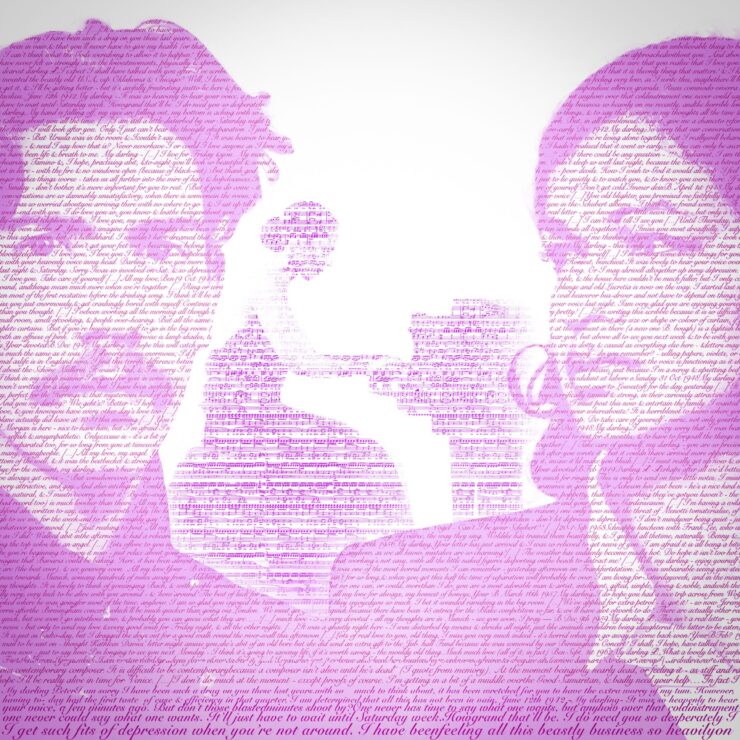
Simon Christian is one of the co-founders of QVIA (Queer Voices in Art), a musical collective putting together upcoming Voila! Theatre Festival show HIDDEN VOICES: Queer Artists in Exchange. The piece documents the personal and public histories of artists who had their queer identities erased both in their time and in ours, and looks to weave their stories into a musical-literary exchange across the hour run time. We caught up with Simon to unpack the process of the show, and find out what audiences can expect.
You can catch HIDDEN VOICES: Queer Artists in Exchange as part of Voila! Theatre Festival at The Space on November 13th at 7pm and November 14th at 9pm (60mins). Tickets (£16 / £12 conc.) are available through the Voila! Festival Online Box Office.
Jake: Hi Simon! HIDDEN VOICES brings together the stories of many queer musical composers across history – tell us about what inspired you to create the piece.
Simon: Neelam Brader and I have been childhood friends. We founded the collective QVIA (Queer Voices in Art) earlier this year not only to collaborate and create our own work, but also to tell queer stories during a time when the LGBTQIA+ community is increasingly under attack. So first and foremost, we were looking for a queer story. As a classical singer, Neelam had worked on various Franz Schubert projects.
Being Austrian, I knew of him of course and was familiar with his music, but had no idea that he might have been queer. I’m a bit of a history buff, so was immediately intrigued, did a bit of research and stumbled upon a podcast, not about Schubert, but about another famous romantic composer: Frederic Chopin! The podcast was about letters Chopin had written to close friends and there were a lot of innuendoes and references in them that, at least through a modern (queer) lens, read as very queer. I went back to Schubert and interestingly found similar letters Schubert had written to ‘close friends’. Further research lead us to Pyotr Tchaikovsky, Francis Poulenc and the famous English composer Benjamin Britten, who were all homosexuals and had all had their letters published posthumously.
Our pianist, Judith Valerie Engel, who we were lucky to bring on board, rightly asked why we hadn’t included any women and suggested that we look into Ethel Smyth, who I had never heard of. Smyth was an extraordinary woman, a prolific composer and author, suffragette and a lesbian. We would’ve loved to include more female composers, but sadly (and very tellingly) we struggled to find any whose letters had survived, let alone been published. After reading copious amounts of letters, diaries, autobiographies and looking through the musical works of our six composers, HIDDEN VOICES was born.
Jake: The show is described as a musical and literary performance – what sort of process have you been on to develop the piece?
Simon: As mentioned earlier, the surviving letters and other personal writings of the six composers was the foundation of the piece, together with the music of course. Initially, we collected all the letters that seemed interesting and told us something about the people behind these great musical geniuses. The classical music scene is still quite conservative and throughout history, the queer identities of our composers remained largely hidden. We wanted to bring them to the forefront, in their own words. Let them speak their truth.
Neelam equally had selected musical works that fit the theme, where we could imagine they had been written for a lover or about a break up, or simply as a way of truly expressing oneself. We read the letters to each other, played the music and whatever resonated made its way into the script. It was a very organic process, which, we think, makes the piece all the more powerful. Rehearsing the show was more challenging, as Neelam is based in Berlin, I am in London and Judith is often between Oxford, London and Vancouver, but we made it work.
Jake: What will be the first thing the audience sees, feels, and hears as they enter the space?
Simon: As The Space theatre is an old church building, the audience will immediately be transported back in time. It is the perfect venue for HIDDEN VOICES, because religion aside, churches are community spaces and so are theatres. We really created this piece with the queer community in mind, but are of course inviting everyone on this journey. The first thing the audience will see is the impressive grand piano, which luckily is at the venue already, so it’ll be unmistakably a story with and about music.
Jake: What are you hoping the audience might take away from the experience, if anything?
Simon: Queer people have always existed, that’s a fact. Some of the most famous people in history and in our case, music, were queer, but were unable to live and love openly. We want our audience to hear the voices of our six composers once more, their own words, their own music, but this time unapologetically queer and free of the constraints of their times.
Jake: With Voila Festival 2025 just around the corner, what are you most excited for?
Simon: We are so excited to be part of this community of international artists coming together for Voila! Festival and to see as many shows as we can and support and celebrate multi-national, multi-lingual theatre! As a Londoner, I am of course extra excited to bring the show to the city I call home.
Jake: Given the themes of Binge Fringe, if your show was a beverage of any kind (alcoholic, non-alcoholic – be as creative as you like!), what would it be and why?
Simon: I would say if the show was a drink, it would be Campari with a dash of soda. Bittersweet, a classic, hopefully with a modern twist. Not what you’d expect in an old church, but hopefully enjoyable nonetheless.
A reminder, you can catch HIDDEN VOICES: Queer Artists in Exchange as part of Voila! Theatre Festival at The Space on November 13th at 7pm and November 14th at 9pm (60mins). Tickets (£16 / £12 conc.) are available through the Voila! Festival Online Box Office.
 Ben Powell
 Sarah Kher-Bek