

 Salvador Kent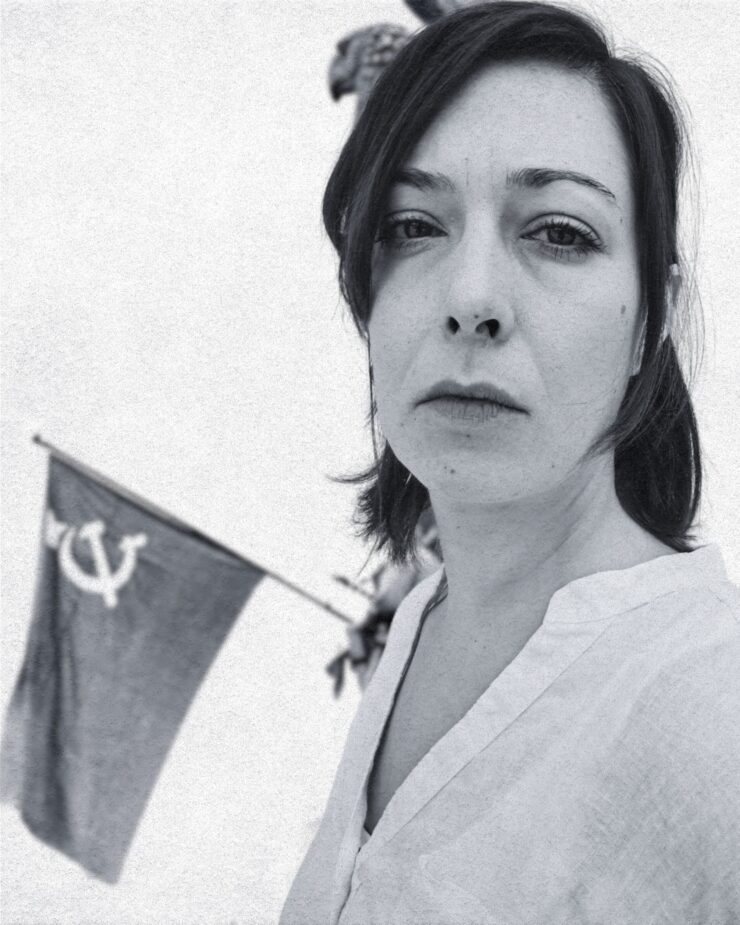
Magda Pohl is compelling in this monodrama written and directed by Tom Corradini, one of the five shows that made up new Fringe venue Teatro Fisico’s season of LeCoq derived physical theatre. The subject of A Woman in Berlin 1945 is the brutality of war, and there is no sweetness, honour nor patriotism in this harrowing story. But it is human, handsome and demands your focus through its hour.
Pohl plays a German woman at the end of the Second World War. Russian forces have occupied Berlin. Their behaviour is reprehensible; at worst they steal from and sexually assault the civilians. We first see Pohl’s woman thinking back on her childhood, on the Indian goddess of darkness. This theological bent strikes into the heart of what is otherwise a deeply materialist narrative adapted from the ‘anonymous’ journal of real life ‘Woman in Berlin’. The story tells of Pohl’s woman being brutally sexually assaulted by Russian soldiers, her plot to marry a Russian soldier to ensure her own safety, and the wider dismantling of Nazi ideology as Berlin falls.
The themes of the piece are difficult, but also necessary. Too often is war mythologised in narratives of the front line, not often enough are we shown the brutality in the everyday. In school, we might have been taught the Blitz — but how often is it that we were exposed to the realities of living in a military occupied city? How often are we confronted with the fact that figures of authority were brutal and abusive, and that the suicide rates for German women hugely increased in the direct aftermath of the Second World War. The story is then, an essential chronicle of stories brushed under the rug.
It is handsomely told. The physical theatre really works in this one. The entirety of occupied Berlin, from puddle-soaked roads to cramped basments to military parades is chronicled through a single body. Pohl is wonderful – she twists into different characters, she crouches in a basement and makes us believe it is full of women and children – she conducts a marriage ceremony as husband, wife and make-do priest. It is a performance of incredible range but also incredible pathos. The story being told here is real, and Pohl’s empathy makes this audience reckon with that. It is a minimal, but beautiful performance. Understated in its delivery, yet it hits like a tidal wave.
This is a harrowing war piece told in a wonderful form. An intense, moving hour of theatre which ultimately asks us to put ourselves in someone else’s shoes, only for a moment — the shoes of a woman in another country, another time. To empathise with a woman who was indoctrinated by fascists, yet still, for the fact of being human, deserves to be heard.
Recommended Drink: I spoke to Tom earlier this month (you can read that here!), he said a bold glass of red wine. I’m inclined to agree with him.
Performances of A Woman in Berlin 1945 have concluded at EdFringe 2026.

 Shay Mace