
 Freddie Haberfellner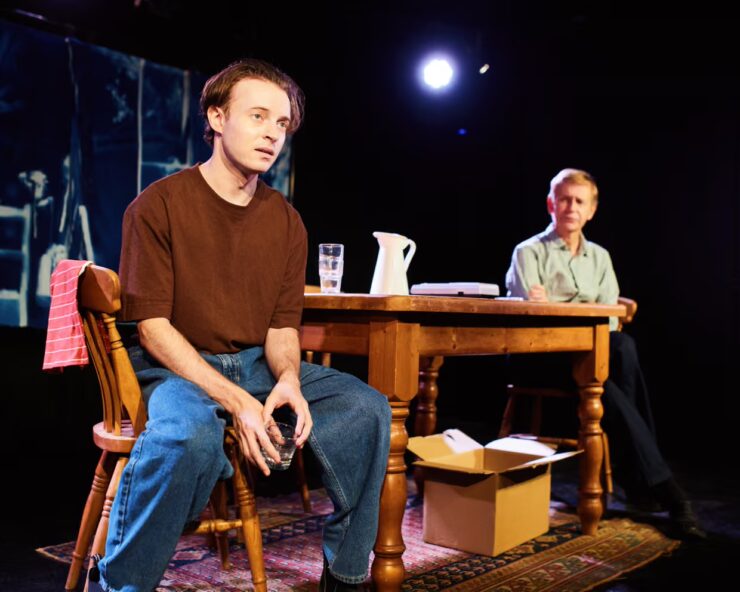
Where do we belong, and how can we find a way forward when there is no blueprint? Sanctuary, written by Jacob Sparrow and presented by Daniel Hinchliffe, explores these questions through a conversation between two gay men of different generations.
They meet in a house in Suffolk where the younger and HIV-positive Michael has been staying, waiting for his own death. Never seen are the owners of the house, Wendy, who is hoping to turn her home into an AIDS hospice, and Mary, a trans woman who is in a similar situation to Michael. We only hear about these two women, as well as a brewing conflict caused by the local community not being on board with the planned sanctuary for HIV-positive people. Whilst this is explored brilliantly at the top of the play – ‘They’re worried the cows will get AIDS – can cows get AIDS?’ – the conversation between the two men soon steers into a different direction as we hone in on Michael’s life story and struggles.
The younger man starts off quite defensive but even though it’s not quite clear why the visitor is here, Michael soon begins to open up to him in frequent monologues. Whilst it the older man’s identity and purpose are revealed later on, throughout the play this character feels like more of a device than a fully rounded character, only here to enable the other to tell his story. The story itself is deeply moving and one that still needs to be told; Michael talks about his friends dying of the virus, the fear of telling his family, the uncertainty of how much longer he would be alive… Conveying the emotional complexity of this situation is no doubt a challenge for any actor but Matthew Tennyson rises to it well aside from occasional moments when he could afford to relax more and simply let the beautifully crafted script to its job. Whilst Richard Cant has less lines he brings a gentle presence and depth throughout, truly inhabiting the role of a queer elder.
Michael also describes his unexpected friendship with a local boy and the pain caused by other’s hostility, who assumes he is a predator simply because he is gay. This is one of the ways Sanctuary dives into the struggles many in the LGBTQ+ community will be familiar with; prejudice, self-loathing, a lack of elders we can look to for advice. However, it only does so through the lens of a cis white gay man whereas the premise could have allowed this play to envelope a wider range of characters. We never get to hear directly from Mary who still does her make-up every day and listens to Agatha Christie tapes until she passes away. The conflict with the local community is also left unexplored and the final verdict on the hospice merely reported back to us.
As mentioned before, the end of the play reveals why the older man was visiting and what his relationship to Michael is. Without giving anything away, to me the ending undermined the emotional impact the Sanctuary might have otherwise had as it felt almost corny and far-fetched. Finding a simpler and more realistic option could make this piece much more impactful, and perhaps there is also a world where it is developed into a longer play which dives further into the other characters and circumstances surrounding Michael.
Still, despite its issues, Sanctuary is a moving piece of queer writing performed with great nuance and emotional depth, especially by Richard Cant in the role of the older man.
Recommended Drink: Amaretto Sour. Complex, sophisticated, a slow burn.
You can catch Sanctuary at Ace Dome @ Pleasance Dome between August 5 – 31 (not 17) at 16:00 (60 minutes). Tickets are available through the EdFringe Box Office.

 Shay Mace
 Ellen Leslie