 Shay Mace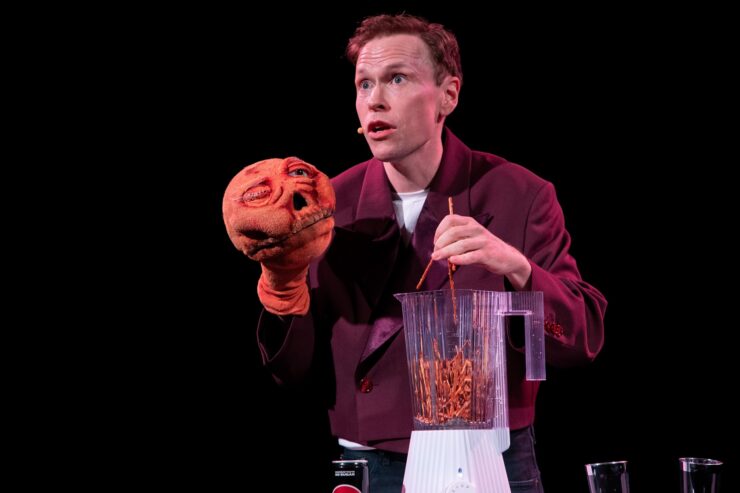
Hendrik Quast’s puppetry performance really captured me at the Greenside Venues Press Launch – puppetry, clowning and storytelling that explores Inflammatory Bowel Disease (henceforth, IBD) through what Hendrik describes as ‘sick theatre’. We caught up with Hendrik, and with IBD, for a pixelated pint, to explore what exactly that means, and what audiences can expect from his show Spill Your Guts.
You can catch Hendrik Quast: Spill Your Guts at Greenside @ Riddles Court (Pickle Studio) from 20:45 (50mins) on August 10- 15 & 17-22.Tickets are Available Through the EdFringe Online Box Office.
Shay: Hello, Hendrik. Tell us about the concept of Spill Your Guts, and its relationship with “sick theatre” as a form.
Hendrik: The work began with a very concrete fear: that one day I might actually shit myself on stage. I have inflammatory bowel disease.
IBD: That’s me.
Hendrik: After my diagnosis, I honestly wasn’t sure whether I could continue making theatre at all. Theatre assumes a body you can rely on: rehearsals scheduled months in advance, fixed performance dates, a body that turns up every evening. Mine suddenly didn’t work like that anymore. There were rehearsals where abdominal pain left me unable to stand for more than a few minutes, and immunosuppressive medication meant even a common cold could cancel a performance. For a while I wondered whether I should change genres altogether. Instead, in 2021, I decided to learn ventriloquism. I was fascinated that the German word for ventriloquism is Bauchreden—literally meaning “speaking with the belly.” Suddenly the very area of my “problem-organ” also became the source of another voice.
Ventriloquism is a strange art form. You’re trained to speak for two while hiding that you are. The whole technique is based on concealment: keeping the lips still, making one voice appear as several, convincing the audience that someone else is speaking.
That felt strangely familiar. Living with a non-visible chronic illness also involves a kind of concealment. You’re constantly negotiating between the body in remission and the body in flare-up, and neither one ever gets the final word.
The puppet became a way to give that second body a voice. Not a metaphor for illness, but illness personified—stubborn, theatrical, needy, funny, and completely unwilling to cooperate.
IBD: Honestly, I’d take a body swap. Anyone looking for a illness? I’m getting sick of living in this one. This one: talking too much.
Hendrik: From that emerged what I call sick theatre. Not theatre about illness, but theatre whose very structures are reorganised by illness. The rehearsal process changes. The rhythm changes. Interruptions become dramaturgy. Dependency becomes performance. And there is no final recovery scene, because chronic illness doesn’t end with a satisfying resolution.
Shay: How has the creative process been of putting the show together? Give us an idea of the journey you’ve been on with it so far.
Hendrik: I started learning ventriloquism in 2021. Throughout 2022 I kept testing scenes in workshops before eventually creating a ninety-minute German-language production, which premiered in 2024, toured across Germany, and was later invited to one of Germany’s major directors’ festivals.
Now I’m rebuilding the piece for Edinburgh as a fifty-minute English-language version. People often assume translation is mostly about language.
IBD: Pain is my second language. Blood is my first.
Hendrik: For me it has been about rebuilding the entire architecture. Every pause, every comic beat between me and the puppet, every misunderstanding has to be relearned in a language that isn’t my own. This provides a useful way of negotiating proximity and distance to the experience of illness. But I operate the puppet much more slowly than in German, and I still struggle enormously with the F consonant while ventriloquizing. These new difficulties remind me that I’m still in the process of becoming a ventriloquist.
The biggest shift throughout the whole process, though, wasn’t linguistic. It was temporal.
After becoming chronically ill, I realised theatre and illness organise time in completely different ways. Theatre expects bodies to adapt to rehearsal schedules. Chronic illness demands that rehearsal schedules adapt to bodies — a shift that resonates with what disability scholar Alison Kafer describes as crip time.
Between tours, costumes have to be altered because a flare-up changes how my body looks and moves.
If the work is genuinely shaped by sick time, then the rehearsal room has to operate according to sick time as well. That probably only became possible because I work in devised theatre and live art. Those practices leave room for bodies that don’t function predictably.
Shay: What will be the first thing the audience sees, feels, and hears as they enter the space?
Hendrik: A chair. A small artwork. Nothing much at first. Gradually the space reveals itself as a medical waiting room.
Waiting rooms fascinate me because they’re places where almost everyone is waiting for the same thing—certainty—but nobody knows what anybody else is waiting for. You begin reading faces. Who’s here for something routine? Who’s just been diagnosed? Who’s pretending everything is fine?
IBD: Honestly? Worst waiting room ever. Nobody’s fasting. Nobody’s crying. Nobody even has a stool sample. The puppet and I start doing exactly describing that. But she becomes frustrated when she realises they’re only theatre audiences rather than actual patients.
Hendrik: Behind the comedy there’s something I recognise from living with chronic illness. Medicine constantly decides which bodies require intervention, which symptoms count, and which forms of suffering remain invisible. That uncertainty runs through the entire performance.
Shay: What are you hoping the audience might take away from the experience, if anything?
Hendrik: That chronic illness is a relationship rather than a story. Stories usually promise progress, climax and resolution. Chronic illness doesn’t.
I don’t think of the performance as carrying a message. Messages imply there’s something to decode. I’m much more interested in creating a situation people have to live through together. Language is very good at describing symptoms, treatments and timelines. It’s much worse at describing everything that remains afterwards: uncertainty, contradiction, dependency, boredom, absurdity.
That’s probably why I needed theatre in the first place. Not because theatre explains illness better. Because theatre can hold things that remain unresolved.
But there’s also something about contemporary theatre that I’m suspicious of.
As soon as you disclose illness on stage, audiences often start measuring authenticity instead of watching theatre. They begin asking whether the body is really sick enough, as if biography were evidence rather than artistic material. In one scene, I hand my own body over to the puppet.
IBD: Your shit is always perfect. Never too firm, never too soft, never too liquid. It just slides through.
Hendrik: She takes control of my mouth, speaks through me, and starts heckling the healthy audience.
That’s where I try autobiography to stop functioning as proof and becomes theatre again.
Shay: What journey has the show been on to find itself at EdFringe 2026?
Hendrik: It’s a leap into the unknown. This is the first time I’ve performed a full-length scripted solo in English. Learning a fixed text in another language has been surprisingly difficult—not only because English isn’t my first language, but because chronic illness has changed my relationship to repetition.
IBD: There we go, that’s my boy!
Shay: Given the themes of Binge Fringe, if your show was a beverage of any kind, what would it be and why?
Hendrik: I’ll hand this one straight to the puppet.
IBD: A purée malade from pretzel sticks and cola. Not sure it can cure anything, but it tastes good – better than you’d think.
A reminder, you can catch Hendrik Quast: Spill Your Guts at Greenside @ Riddles Court (Pickle Studio) from 20:45 (50mins) on August 7–15, 17–22.Tickets are Available Through the EdFringe Online Box Office.
Image Credit: Johan Palme

 Ellen Leslie