
 Shay Mace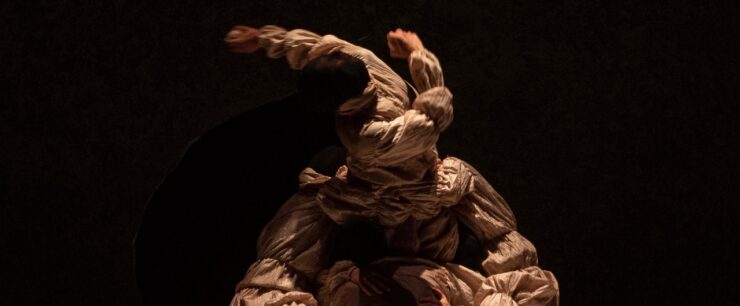
As the curtain rises on Dewey Dell’s radical reimagination of Stravinsky’s score The Rite of Spring, the troupe command your attention. Beyond a distant haze, you squint, and somewhere in the mist of it all an embryo begins to crack. Such begins a cycle of life, sex, and death within the turning of the season – and a visceral visual banquet. It’s form-breaking stuff that affords a challenge to the audience, much in the way Ballets Russes’ original 1913 Paris production supposedly caused riots. But what is offered in form here tragically falters in depth.
Emerging from a chrysalis to a prelude arranged by Demetrio Castellucci (one of three siblings involved in the production, of whom The Guardian’s Lyndsey Winship duly notes are the children of impresario Italian Theatre Director Roman Castelluci), an insect-like creature bursts from larvae into expressive dance and physical theatre. As a cavernous setting reveals itself, the original performer is joined by an ensemble of cave-dwelling insectoids that flutter against one another to reveal shapes and forms reflected from choreographer Teodora Castellucci’s inspirations in animal behaviour and vignettes from classical art history.
It’s hard not to be impressed by the creative vision on show in the piece’s opening act. As the vast theatre is fumigated piece-by-piece by haze in the minutes before the show’s beginnings, we’re made sensually aware very quickly of the quirks to follow. It alienated some in my row immediately – leaving to more than a couple leaving within the opening moments of the show. While some might enjoy the reflective nature of that on Nijinsky and Diaghilev’s original Parisian imaginings of the score, the unorthodox sensory concoctions will alienate many more.
As focus sharpens, the piece pushes against its high-concept opening and allows for more conventional dance performance to ripen the organic concept of the rising tension. It is nature and the conscious bond all creatures have to it that is explored in these moments, through gyrating animalistic tendencies and flittering flora, all represented duly and dutifully in high octane performances from the ensemble. They dive over and into one another to represent systems of nature both below and above the surface.
When humanity finally reaches the stage, it is an impressive feeling to evoke that they/we are the ones who seem like the aliens against the tapestry of ecological ideas explored in the early moments of the show. A group of explorers in beekeeper-style costumes prod and probe their subterranean surroundings, with little regard for those who originally occupied that space as their home and only known experience of the world.
It is in this concept that Dewey Dell’s interpretation comes unstuck. While the piece commands such attention at its start, it knows little of what to do with it once more intense ecological themes appear. A natural progression in the current environment – but leaving the audience with little to walk away thinking about. For something so high concept and building itself on the shoulders of such giants, you’d hope there would be a takeaway. But alas, as the curtain falls, the larvae return with little to say about humanity’s intervention in the natural world.
The vast number of creatives involved in the costume, set and production design of this piece deserve rapturous applause – there are phenomenal visual moments pieced together with craft and precision, and in the symbiosis of costume design and choreography that seamlessly blend into one another. Flowing gowns merge into antennae and proboscis, and that creepy resemblance between nature and mankind is unendingly realised across the fifty minutes of design.
There’s unfortunately no thrust to Dewey Dell’s otherwise utterly engrossing reimagining of this piece – a musical work that has been reinvented as many times as the sun has revolved around the Earth. It is impossible to separate substance and style in this piece, given its nature, but it feels as though the combination of the two has watered down an opportunity for a message to actually resonate beyond the walls of the theatre. This is a piece you will experience, and then sadly just finish experiencing, rather than being left with anything to think about.
Recommended Drink: Lay yourself under a stalactite, and wait for the dripping liquid of the Earth to nourish you.
Performance of The Rite of Spring have now concluded at Manipulate Festival 2026.

 Ellen Leslie