




 Phoebe Bakker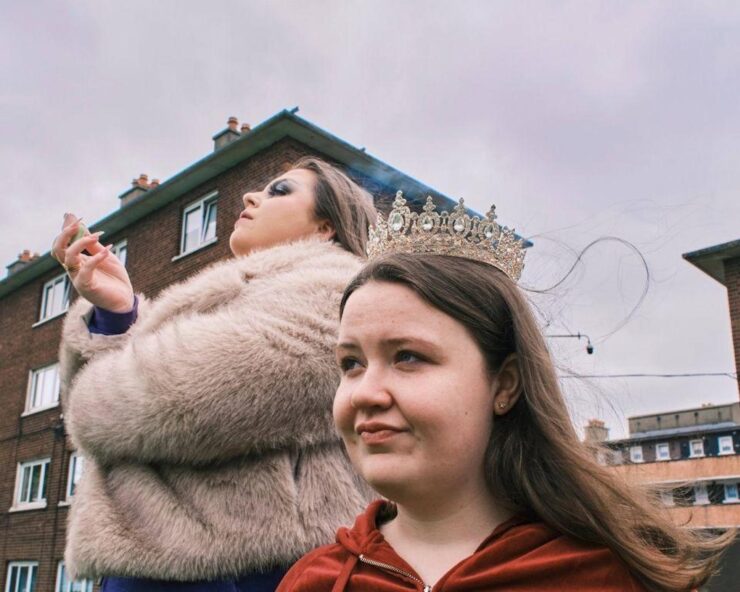
Last year The Guardian published an article that contained the statistic that 1 in 10 people in the arts came from a working class background. Studies from this year show that that number has shrunk by half since the 1970s. It’s no secret now that the barriers that face us in the arts are more rife than ever and with festivals like Edinburgh Fringe costing thousands just with the hope of potentially breaking even, it is no surprise then that working class representation is rare. That’s Soo Povo is almost a case study of the risks, and challenges that those from a working class background face when attending drama school, carrying around the joys and sometimes shame that a working class background can bring.
A class assignment of the Plough and the Stars causes friends Chantelle and Craoí to butt heads. Their fight summons Queen Povo, a dragesc figure that carries a larger than life attitude. It is with her guidance and celebration of all the stereotypes, but all the joys that come with being working class. Her entrance gives the play cause to leap into gear and brings about vibrancy and humour, allowing the characters to make their pointed commentary.
The script asserts itself powerfully with an intelligence that forces me to reflect and reminds me of my own drama school experience. Classes that police our speech, hidden behind terms like diction, articulation, and a desire to want you to speak ‘proper’ as a cover for the truth, which is that you just sound too common. A desire to talk softer and hide away, only to still be told that you are too loud and too much. Both are cast as the working class characters in The Plough and the Stars and point out the irony in the fact that a lot of these times these characters are meant to depict us but never really designed for us. The punch line of a joke.
That’s Soo Povo capitalises on the casualness we’ve grown to treat the term. When Chantelle finds out that Craoí’s friends have been using the phrase, it calls into question our own relationship with that term. They tackle it in a way that’s extremely nuanced and calls out our allowance of society as a result. There’s space for both’s feelings, not demonising either, but rightly pointing out the injustice of the term. This sentiment is solidified in their use of a video of women, presumably in their community, living their lives. A reminder that these women are so much more than the characters that we use to demean them. They’re brave, loyal, funny, strong; the phrase we stand on the shoulders of giants comes to mind. It is then in tandem with this that Queen Povo stands as an embracing force of all the stereotypes, confident in her identity but still so much more than the sum of those.
It feels like the group is still discovering themselves, but the core principles are extremely intelligent and nuanced. They’ve managed to strike an impressive balance between fun and the weight of social commentary. The arguments they construct are relatable and compelling, but sometimes feel like they come without a clear catalyst. As though we are going round in circles with a familiar setup to create new points rather change the catalyst completely.
The structure can feel a little loose at points; Queen Povo’s entrance doesn’t raise a lot of questions, more of a begrudging background for the girls, nor do they really have much of a conversation about what her presence means, but rather is purely used as a plot device to further the conversation between the girls. Her appearance causes enjoyable moments, such as the use of breaking out into song, but this feels more atmospheric than for a specific purpose. With more clarity in these choices, the show’s argument would land harder.
Still, the play ends on a high, with a grounded rendition of the scene from The Plough And The Stars now transformed by the journey they have been on. Offering 3D portrayals of what were once 2D characters.
That’s Soo Povo has all the great hallmarks to be great. It needs a little refinement and clearer direction but it’s bursting with potential. More importantly, it’s a bold, joyous celebration of the working class. Made by them, for them.
Performances of That’s soo Povo have now concluded at Dublin Fringe 2025.
 Ben Powell