
 Salvador Kent
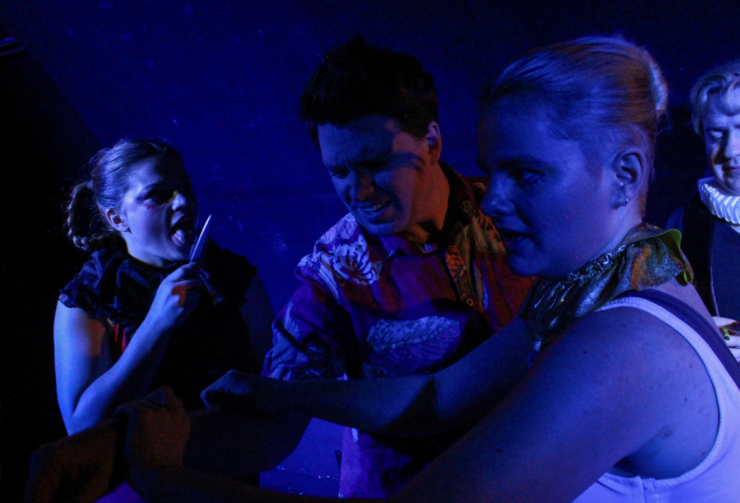
Watching the last night of The Faustus Project in the twilight of this year’s Fringe was confirmation to me that the (hopefully temporary) loss of Half Trick Theatre was one of some weight for Edinburgh grassroots theatre. Their work was that rare work that allowed countless young theatremakers to dream of a sort of theatre that might otherwise seem impossible. A theatre which is always visually striking, committed to its content and unapologetically smart. Plus in Half Trick’s case, it is always bloody entertaining. Over this article, I revisit memories of some of their work. Losing them would be a tragedy, and should you wish to help, they are currently fundraising for their visa application. The link is below.
One of the perhaps unintended consequences of the Edinburgh grassroots scene being either Fringe-focused or populated by scratch nights is a dearth in visual tricks and full length plays outside of August. Half Trick’s productions always seemed richer, fuller and more playful than anything else at its level. The beautiful, twisted candy land of Waiting for Wonka was a brilliant creation when I caught it in the summer of 2025. Parodying kitchen sink dramas, the trappings of something like a John Osborne play were transported to a sickly sweet Wonka land. Candy-coloured doors, chairs and beds littered the space, beautifully designed by James Jennifer Wright. Perhaps the best-remembered use from this set was turning Augustine United Church’s infamously annoying pole into a massive candy cane which the cast frequently licked. Either that or the eerily real Willy Wonka corpse Half Trick couldn’t resist inserting in the final act.
Caden Scott was a hilarious Augustus Gloop – he had a tendency to know exactly to embody a physicality, from Gloop here to her Mephistopheles in Faustus or even the linguistically dense Brandt in my production of Till Schindler’s Crawl in the summer. Alex Medland was a bouncy and cruel Violet and Courtney Bassett directed the cast of five with the glee that she must have conceived of the play with chucking all the characters into a Sims save at the start of the pandemic. There was no high or low to Half Trick, everything had its own craft, and the care with which Wonka was conceived was thrilling and beautiful.
King of the Scouts was equally stellar on a smaller scale. Haunting loops of DV video and archive newsreel created a beautifully multimedia piece that frazzled the viewer’s eyes. Meanwhile the broken father-daughter relationship central to Alex Medland’s script provided a stark, minimal contrast to the constant TV drone. This was a visceral piece that started with actor Caden Scott drinking from a bottle of milk and ended with Medland chewing on a dead fish (I still need to ask how James Jennifer made that). They put it together in four days or so, which was utterly remarkable, and the play was a rich and moving thing – unapologetically Kiwi, and with a beautifully dreamy language.
Half Trick have also been committed to the grassroots scenes in Edinburgh and Glasgow outside of their own productions. Courtney and Alex tested out Juney McCloud and the Zombie Apocalypse at Martyr Theatre’s February scratch night. Caden worked with Tired Horses, Framework and the exciting A Dumb Production Company on scratch nights. Half Trick’s continuing friendship with the emerging Glasgow company Martyr Theatre (an irreverent and brilliantly DIY outfit in its own right) led to a collaboration on Fandemonium! Alistair Maxwell’s 2024 Gateway Writing Festival offering that was a suitably Byronic tale of a teenage superfan of Lord Byron. This was a company that was always busy and wanting to uplift a scene around them whilst consistently producing stellar work.
Their work was pitched as irreverent adaptations of untouchable classics, but what always struck me about Half Trick was their consistent engagement with the theatrical form. Their work plays with the Kitchen Sink, the revenge drama, eco-theatre and horror. They have parodied or used works from Christopher Marlowe and Edward Albee and from the most obscure corners of the Elizabethan canon in John Marston. Each play was its own world from the clownish Elizabethan-punk of The Faustus Project to a suburban North Pole in Who’s Afraid of Santa Claus. In my own processes, they were always a port of call, and often the first. I have received invaluable insights from Courtney and Caden, I’ve had weirdly touching conversations with Alex about Clown School, James Jennifer has teched my shows at the last minute and somehow learnt a desk in an hour. They were at open rehearsals, grassroots events, the pub after a show and always keen to contribute. Besides, no one was making work quite like them.
Their fundraiser slash performance art “spectacle(?)” Right to Remain was a pretty intense Bedlam Late that culminated in all four members of the company shaving their heads. It was yet another provocation for all the weirdos trying to make experimental theatre in Edinburgh. The tone was one of celebration, laughter, and the donation of money, but the four of them singing O Flower of Scotland was a strange reckoning. How can it be so difficult and expensive for artists of such influence and quality to remain in a country they want to be in? This is a group who has time and time again worked with some of the most prestigious institutions in the country but has always remained fervently committed to the grassroots. They have been an influence to me, and to countless others, teaching us that more than we can imagine is possible in theatre, so long as we commit to it. We can build corpses, tar and feather, use multimedia, parody Wonka and Santa Claus and do that in the same breath as Godot and Who’s Afraid of Virginia Woolf.
Now, and I hope in the future, their influence on Edinburgh is unmistakable. I wish them a good stay in New Zealand, but I’m shouting from the rooftops Haste ye back!
If you’d like to support Half Trick, they’ve still got a GoFundMe up to raise half of their funds for a Visa application. You can donate here. But this article is more than a fundraiser — it aims to, I hope, preserve a small fragment of this company’s contribution to the Edinburgh creative arts scene.
 Sarah Kher-Bek
 Lamesha Ruddock
 Binge Fringe