

 Sarah Kher-Bek
There are things women carry that cannot be packed into a suitcase. The voices of their mothers, the memories of their grandmothers, the weight of histories written long before they were born. Some cross oceans with them. Others live quietly in the language they are afraid of forgetting.
In Short Stories about Latin Women, three women step onto a small Melbourne stage carrying entire worlds within them. And for one extraordinary hour, they invite us inside.
It begins with a phone call. A young woman, curled beneath a blanket, casually files her nails as she reassures her mother that no, Melbourne is not crawling with crocodiles. It’s a familiar conversation, full of the affection and gentle exasperation reserved for mothers worrying from thousands of kilometres away.
But as the conversation unfolds, the fears begin to change shape. She isn’t afraid of the wildlife. She’s afraid of rejection, of making mistakes in a language that isn’t hers, of growing accustomed to the distance between herself and those she loves. She’s afraid of being a woman. Because, “There are dangers in this world that don’t have teeth.”
Spanish moves through Short Stories about Latin Women without apology. It isn’t softened, diluted or constantly translated for the comfort of an English-speaking audience. I loved living in their world without needing it watered down for me.
We are so accustomed to expecting the world to explain itself in English that we forget the extraordinary privilege of being welcomed into someone else’s language.
I understood fragments: a word here, a sentence there, but I never felt excluded. I felt honoured to hear these women speak in the language holding their histories, their families and the parts of themselves translation cannot capture. When the words escaped me, the emotion never did.
Then comes a scene that reaches straight into my childhood. A mother, a daughter, and a grandmother on the other end of the phone. Three generations connected by blood, separated by distance, struggling to meet somewhere between two languages.
The daughter’s English is never quite good enough for some, her Spanish painfully inadequate for others. Her mother watches the distance grow between her child and the language that connected their family. And somewhere across the ocean, an abuela waits to hear her granddaughter’s voice.
I recognised this ache immediately. Different cultures, different tongues, yet the same strange inheritance shared by so many children of migrants. The guilt of losing words you were supposed to know. The frustration of translating yourself before you can speak. The quiet heartbreak of watching a parent realise that the world they’ve brought you into is slowly pulling you away from the one they came from.
The three performers seem to understand that humour and heartbreak live so comfortably next to each other. They make every moment count, effortlessly moving between tenderness, frustration, longing, history and hilarity, each transition as natural as the last.
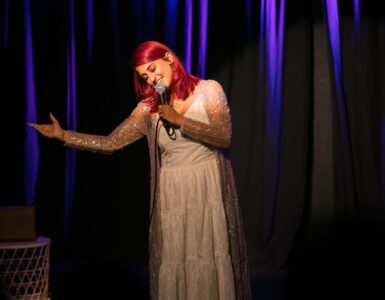
The staging is stripped down to the essentials. A table, a chair, a few familiar objects. Shifts in lighting and the pulse of Spanish music carry us between worlds. Small gestures have room to become enormous here. Silence speaks louder than any language. A glance across the room. A hand that hesitates. A face struggling to conceal what the heart has already given away. Nothing extravagant, nothing to hide behind.
The humour is subtle and always on target. It makes the grief more human, and the grief gives the laughter somewhere deeper to land. In one monologue, a woman discovers she’s unexpectedly pregnant. She looks at the test, then the toilet, then back at the test. Then the toilet again. Somehow, she coerces the toilet into becoming her supporting character. For a moment, we share in the ridiculousness of a woman trying to comprehend what might change her life.
But the laughter begins to carry a different weight. A little heavier. “I’m not exactly sure where my body ends and my circumstances begin.” It’s a line that lingers. How much freedom does a woman really have over her own body when her circumstances, and the systems she lives within, have already begun making decisions for her?
The dangers without teeth are everywhere. In the systems that govern women’s bodies, in the distance from home, in the quiet uncertainty of whether you will ever truly belong.
“I am too foreign for here, and too foreign for home.” To cross oceans in search of belonging, only to find yourself a stranger on both shores. A feeling that runs through the veins of the diaspora, passed from migrants to their children, and their children’s children. What a lonely thing, to belong everywhere in pieces and nowhere in full. Scattered in mind, soul and spirit.
Short Stories about Latin Women gives that loneliness a voice. Rooted in the Latin American experience, its echoes reach across diasporas, finding recognition in lives shaped by different languages, histories and homelands. But it refuses to leave us there. Something rises from it. Something older than borders, louder than rejection, and far more difficult to silence.
And when the three women finally stand together, the stage seems almost too small to contain them. History lives in their voices. In the Spanish that rolls from their tongues without apology, in the laughter, in the rhythm of bodies carrying generations of stories that were never theirs alone.
They look like witches. Like women who know things the world has spent centuries trying to make them forget. An ancient power, alive and unashamed. And beneath those stage lights, the ground feels almost sacred. The very magic the world once tried to burn out of women escapes their tongues and breathes again.
Power. Femininity. Something that feels remarkably like a spell.
Not one that needs translating.
One that needs feeling.
Recommended drink: Mezcal Margarita. It’s smoky, it’s earthy, and it’s a little wild – For the witch in all of us.
Performances of Short Stories about Latin Women have now concluded at Melbourne Fringe.