







 Salvador Kent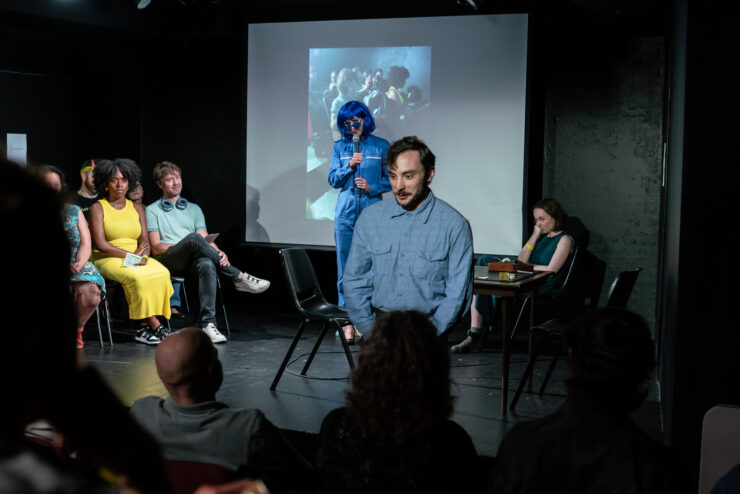
One of the thrills of Fringe is flicking through the programme or being pitched a show that feels like its right up your street. I felt this encountering exit strategy’s How to Win a Gameshow which the New York based theatre collective are bringing to this year’s Edinburgh Fringe. It self describes as ‘part performance art, part improv show, part ethics inquiry’ and explores surveillance capitalism through the liveness of theatre. I sat down for a digital pint with artist MaryKate Glenn to ask more about the show, and discuss its unique social contracts…
You can catch exit strategy’s How to Win a Gameshow from 7-15 August at theSpace @ Niddry St from 20:35 (Runtime 50 mins). It then moves to theSpace @ Venue 45 from August 17-22, from 21:10 (Runtime 50 minutes). Tickets are available from theSpaceUK Online Box Office.
Salvador: Hi Team! How to Win a Gameshow is ‘part performance art, part improv show’. How did you go about developing the performance and what drew you to these forms?
exit strategy: Hi Salvador! Excited to chat. How to Win a Gameshow came to be in sort of a topsy-turvy way. We spent the winter and spring of 2025 developing a (totally different) (physical theatre) piece to bring to a residency in the Netherlands that May (shout out Triplets Amsterdam!). Our last rehearsal in New York before we were set to leave we were all kind of like, wow, I think we hate this show? Let’s come up with another one! Just for fun! And this second idea, sketched out on a giant sheet of white paper in one four-hour rehearsal, turned out to be Gameshow. Though the form is radically different from our initial idea, the questions Gameshow explores are, at their core, the same.
The piece has always been structured as a strange, uncanny game, one that necessitates the audience play for the game to proceed. We found after a few workshop performances, the structure was heavily improv-driven, out of necessity, since so much of the piece depended on the way the audience engaged with us and the space, and vice versa.
We continued to learn about what this show was while in the early stages of performing it. Our work asks questions about boundaries, about danger, about reality–what is or isn’ t real that’s happening in front of you? What is or isn’t planned? What is or isn’t in the performer’s control? Who is or isn’t safe? Many of these questions, these experiments we began to play with in the space, lived blurrily in a gray area between “theatre” as most people understand it, and performance art. But more on that later!
That’s the long answer. The short answer is-we didn’t set out to explore these forms-they just ended up being the forms that fit the story!
Salvador: exit strategy is making its Fringe debut, so tell us a little bit about the collective, who’s involved, what’s the aim?
exit strategy: exit strategy is a New York City-based performance collective asking questions about the role of the audience in live performance. Our company is rooted in a decade-long collaboration between Jane and MaryKate, who began exploring the themes of audience culpability and danger in performance in 2015, in a tiny blackbox theatre in the Bronx. Dozens of individual projects, grad school, and multiple cross-country moves later, the duo teamed up with Rupert and began to combine our work and praxes. Drawing on our respective backgrounds in dance, visual arts, and Grotowski-lineage physical theatre, our work pursues a state of primal, kinetic presence in performers and audience alike-often blurring the line between the two. Our process is heavily image-based, non-linear, sometimes nonsensical, and non-heirachical.
One of the particular challenges of Gameshow is how to rehearse it without an audience. We learn the most about it when its main character is present (that’s you) (the audience). Our time in Edinburgh will be our longest consecutive run of performances of Gameshow to date. It’s an invaluable opportunity for us to continue to learn about the piece and how audiences respond to it, to continue to develop, shift, and tetris our ideas as we experiment with the form.
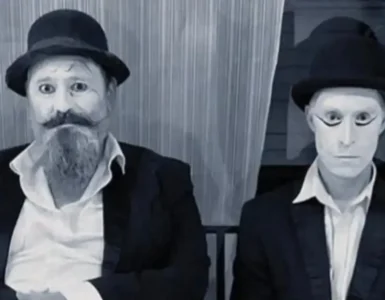
Our company on the ground in Edinburgh is made up of four multidisciplinary artists: exit strategy founding members Jane Skapek, MaryKate Glenn, and Rupert Krüger; as well as our fourth performer and incredible fellow collaborator and guest artist, Samori Etienne.
Salvador: The play is about ‘our own complicity under observation’. Why do you use theatre to explore this?
exit strategy: Gameshow began with the exploration of a shared idea: the feeling that, within the last decade, something has fundamentally shifted in people’s willingness to be surveilled in day to day life, matched by technological advancements that have made this surveillance possible. Because this systemic observation happens in such a ubiquitous way, many of us like to believe we must be independent from the effects of it.
In a way, this misconception is perfectly mirrored in live performance. A group of people (the audience) sits down to watch something from a presumed place of safety and passivity, while another group of people (the performers onstage) go through something in front of them. There’s the artifice of the fourth wall which – usually – allows the audience to feel that they are invisible.
In Gameshow, we are simply acknowledging the givens of theatrical space – I am here, you are here, we can see each other and speak to each other. And yet, this simple switch of the expectation that audience members are invisible seems to be very disruptive. By flipping the voyeuristic eye to include the audience with the performers, we are hoping to theatricalize meticulous surveillance in a way that asks people to think about the ways in which this happens to them everyday, all the time, constantly. We are all complicit to what the surveillance state can do, and we are all, for the most part, obedient under it. So Gameshow wants to bottle up both of those realities in a little 50-minute whirlwind of an immersive experience, because we think actually theatre is an obvious and easy place to do so.
Salvador: Did your analysis of surveillance capitalism have any influences? How might they manifest through the show?
exit strategy: We are certainly not working alone–in both content and form! We owe a tremendous debt of gratitude to one of the OG scholars of surveillance capitalism, Shosana Zuboff, whose book on the topic was instrumental to the piece in its original form and current DNA. We would be remiss not to mention American performance artist Ann Liv Young, whose confrontational relationship with the audience served as an initial spark for the form of this piece. The NYC performance collective Reverend Billy and the Church of Stop Shopping is another leading light, for their inspired site-specific work critiquing capitalism. And tonally, Gameshow was certainly influenced by things like Severance or Twin Peaks–art that (often through imagery) asks us to consider what is absurd and horrifying in our everyday.
Salvador: Do you believe there to be a boundary between performance art and theatre?
exit strategy: Yes – 1000%. The implicit contract of consent between audience and performer in theatre and performance art is different. Performance art implies that something real is happening in front of you. Theatre implies that it isn’t; that there is safety in artifice or narrative. Our work likes to live somewhere in the middle. It’s play pretend, but is it? We understand the rules of theatrical space, but do we? That audience member is really up there onstage, the show can change based on what they do or say, the improvisation is happening before us in real time etc. Part of what we’re interested in is exactly the unpredictability of this behavior, and how that transforms energy in space. We don’t always agree on where exactly we should draw the line between theatre and performance art, on how far we should go. In this round, we’ve skewed more on the side of theatre. But given our respective backgrounds and interests, we think this won’t always be true. And that constant possibility of evolution is what makes the work fun.
Salvador: How did you construct the performances for this work? Is the process text-based, devised, precise, exploratory?
exit strategy: Our process is heavily image-based. We actually use a lot of the devising tools our company members learned from training with physical theatre companies such as Frantic Assembly, The Useless Room, and Teatr ZAR. In the same way they will improvise and generate physical sequences that they eventually re-order and weave together to create a piece, we generate images, improv structures, sequences that we then organize tetris-style into the show. The version you will see at Fringe has many re-ordered component parts of the version we did a year ago. We are constantly learning, changing, experimenting with what works or doesn’t. For our NYC previews, we even changed the ending for the last show!
In the room, we talk a LOT. Argue a LOT. And write a LOT on the biggest pieces of paper we can find. In general in our rooms – best idea wins, we’re almost always willing to try something out, and no one is afraid to admit when they were wrong.
Salvador: What will be the first thing the audience sees, feels, and hears as they enter the space?
exit strategy: The audience enters the space to the dulcet tones of Dionne Warwick singing “There’s Always Something There to Remind Me” (our favorite cover of the song, sorry Naked Eyes). They make their way to their seats and may or may not be asked to confirm name, height, date of birth, favorite morning beverage, first memory of seeing the ocean, who knows. There is a man alone on an almost empty stage. Who is that guy, the audience may ask. We hope from the outset the audience will have the feeling of, how fun! So fun! Is that guy okay? Am I okay? Wait, is anyone okay? What’s actually going on here? But also, now we’re dancing? It’ll be a blast! And everybody will have a nice time 🙂
Salvador: With EdFringe now just around the corner, what are you most excited for?
exit strategy: Meeting amazing people. One of the best parts of performing our show is it gives us permission to get to know the people who come see it. If this freaks you out, be brave! Come play! We’re very nice and fun. Really!
Salvador: Given the themes of Binge Fringe, if your show was a beverage of any kind what would it be and why?
exit strategy: Four Loko? Do you guys have that in the UK?
It’s like, bright blue and fizzy and in a giant shiny can and tastes like blue raspberry and chemicals. It was the fastest, cheapest, funnest way to get drunk if you were an American college student in 2014. But it was also kind of scary and dangerous because it also has caffeine in it which supposedly occasionally causes heart failure (that’s what everyone’s moms said, but you drank it anyway).
So your experience of drinking Four Loko was like, fun! I’m hanging out with my friends and laughing and having a great time! My tongue is blue! I’m gonna have a great night! But you were always a little worried in the back of your mind that something really bad might happen and your mother would be disappointed in you. Our show is like that.
A reminder! You can catch exit strategy’s How to Win a Gameshow from 7-15 August at theSpace @ Niddry St from 20:35 (Runtime 50 mins). It then moves to theSpace @ Venue 45 from August 17-22, from 21:10 (Runtime 50 minutes). Tickets are available from theSpaceUK Online Box Office.
Image Credit: Mary Kate Glenn
 Shay Mace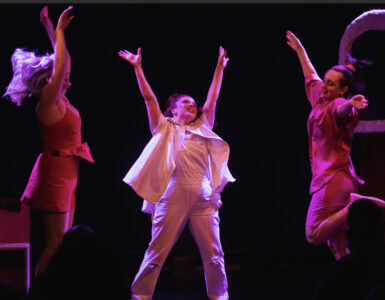
 Lamesha Ruddock