

 Shay Mace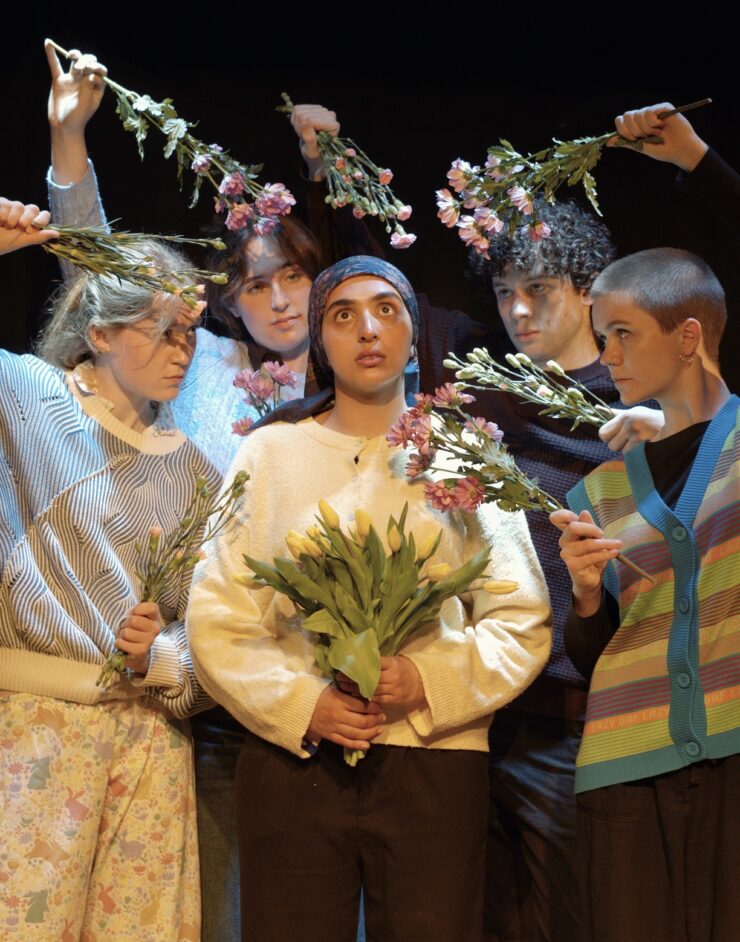
Rowan Brown is the writer of upcoming Edinburgh Festival Fringe show Launa, a physical theatre piece that follows young mother Edna navigating the shifting terrain of grief as memory begins to consume her present. Produced by Oxford-based Tidal Theatre and featuring an ensemble cast, the story explores ideas of memory, resonance, and the restlessness of the mind after experiencing loss. We caught up with Rowan for a pixelated pint to unpack the show.
You can catch Launa at theSpace @ Niddry St on August 7-15 from 12:05 (50mins) and on August 17-22 from 10:35 (50mins). Tickets are Available Through theSpaceUK Box Office.
Shay: Hi Rowan! Launa is described as your second play in your unique style, blending ensemble movement with the distinct internal experiences of isolated women. Tell us about your style, and why you’ve decided to tell this story on stage now.
Rowan: I wanted to write a show about loss because I wanted to create a show in which the main event has already happened. What happens when you enter a space dominated by absence?
I have always loved working with physicality and script simultaneously – I think there is often an idea they are separate artforms, and that a rich script telling a very raw realist story is a separate entity to a show focused on movement-based ensemble work. I would argue that the luxury of an artform like theatre, is that we have a language capable of containing both the horrifically mundane and the uncanny at once. And isn’t this the experience of something like grief – which is both brutally normal and completely beyond the bounds of reality?
So that’s where Launa came from really. I think with something like grief, the only way I can express it is physically – you need bodies and rhythm and music to inhabit the restlessness of the mind as it spirals between silence, fury, longing, joy, nostalgia, hope in milliseconds.
As humans however – we’re not really allowed to start frantically spinning and pounding to music in the middle of the street. We have things to get on with, we have to take calls and do the washing and have an awareness that people are watching.
So, with this in mind, Launa attempts to embody at least part of the landscape of loss as we watch a young mother navigate her daily routines in the midst of grief. It’s sometimes terrifying and its sometimes funny or beautiful. Nick Cave said after the loss of his son– that absence can, after a while become a kind of spiritual freedom – and this is the arc I wanted to explore in Launa. How can letting go be something both terrible and transformative?
Shay: How has the creative process been of putting the show together? Give us an idea of the journey you’ve been on with it so far.
Rowan: Having lost her daughter aged six, part of Edna’s grief is an imagining and reimagining of what her daughter might be like older, how many of her childhood interests would have bled into a young adulthood.
The creative process echoes the themes of the show itself, as we start in a world of actual childhood play. We bring in all the props, costumes and lights into the room and we ask – ok, what does this world look like, how does it feel, how does it breathe? How can making a cup of tea erupt into something totally weird? I like to make a little patchwork of visual images and sequences which create the texture of the show and its atmosphere, and then it’s only from there we add script in.
I think this is one of my favourite ways to work, as while we have the structure – we also have the liberty of letting the visual world grow beyond the text.
Shay: What will be the first thing the audience sees, feels, and hears as they enter the space?
Rowan: It’s a cluttered, domestic space which feels trapped in time. Flowers and cards litter the back walls, there are still a child’s drawings on the walls and her bed is centre stage, covered by a dust sheet. We can hear the flickering sounds of childhood memories and old songs which bleed into each-other haphazardly. It’s a naturalistic space on the boarder of the surreal.
Shay: What are you hoping the audience might take away from the experience, if anything?
Rowan: The desire to play music very loudly and dance alone at home and remember that to lose very painfully is to love very powerfully.
Shay: What journey has the show been on to find itself at EdFringe 2026?
Rowan: The first draft of the script appeared a couple of years ago, it then went through an open read-through. From there after making many whales out of cardboard, sewing matching pyjamas and learning how to operate a shadow-puppet suitcase, we made the show and performed it in November. It met a fantastic reception in Oxford, which propelled us to remaking the show for the Edinburgh Fringe. However, due to the nature of Fringe we have since had to cut down what was a 1.5 hour show to under an hour which has meant a major reworking of the script, physicality and arc of the show which has been a very challenging but rewarding experience.
Shay: With EdFringe now just around the corner, what are you most excited for?
Rowan: Aside from testing our cast and crew relationships by sharing a bell tent for an obscene amount of time, I’m so excited to see what people take from the show and how the reception may differ to the Oxford run. I’m excited to see which part of the show audiences latch onto. Some people see a play about grief. But others tell us afterwards that it’s about sisters, or motherhood, or growing up, or therapy, or childhood. That feels right to me, because grief has a way of touching every other part of life.
Shay: Given the themes of Binge Fringe, if your show was a beverage of any kind (alcoholic, non-alcoholic – be as creative as you like!), what would it be and why?
Rowan: Ribena. It’s nostalgic and reminds you of childhood but it’s also diverse. You can have it diluted and refreshing, or drink it straight and burn your throat until you cry. You can have it with vodka and dance the night away or make it bubbly and joyous with fizzy water. You can have it in summer with ice or boiling hot to sooth a sore throat. It’s a multi-media of drinks, it’s a beautiful colour, and makes you see the world through a slightly different lens… if you look through your glass while drinking it.
I’d say all those things sum up Launa. It’s childhood, it contains a lot of memories, it stings, its joyful, it’s hybrid, it’s hopeful, it’s summer and colour and winter and dancing and hiding away at home all at once.
A reminder, you can catch Launa at theSpace @ Niddry St August 7-15 from 12:05 (50mins) and on August 17-22 from 10:35 (50mins). Tickets are Available Through theSpaceUK Box Office.
 Ben Powell