






 Shay Mace
Some of the wealthiest people in history are investing huge amounts of money into trying to live forever. Lynda Radley’s upcoming Edinburgh Festival Fringe play Lifelong explores what makes that life meaningful, and the ethical questions surrounding extending our lives, and who gets the power to do so. Set in a facility where powerful people have harnessed science to realise the impossible, and AI dictates a daily regimen for wellbeing, how will the residents react when their routine is disrupted by an outsider? We caught up with Lynda for a pixelated pint to find out why she’s bringing this story to the stage now.
You can catch Lifelong at Assembly George Square Studios (Studio Two) at from 12:00 on August 5 – 17 (70mins). Tickets are Available Through the EdFringe Online Box Office.
Shay: Hi Lynda – Lifelong explores the potentiality of abuse in technologies we’re seeing rise all around us – tell us about what inspired you to write this script, and why you feel it’s important to tell this story now.
Lynda: The starting point for Lifelong was actually quite simple: I became fascinated by the idea that some of the world’s richest people are investing huge amounts of money into extending human life. The more I learned, the more I realised the really interesting questions weren’t scientific but actually human and political.
If we develop technologies that allow people to live longer, healthier lives, that could be an incredible achievement. The problem is that technology doesn’t arrive in a neutral world. I started asking: what happens when the ability to extend life becomes something that only some people can afford? That’s where the drama began.
I’m interested in the gap between intention and consequence. The characters in Lifelong aren’t villains. They don’t set out to create something harmful. They genuinely believe they are solving one of humanity’s biggest problems. The difficulty is that human beings are notoriously bad at predicting how their inventions will be used once they leave their hands.
We’ve seen this throughout history. Scientific breakthroughs can be transformative, but they can also be shaped by politics, money and power in ways their creators never imagined.
I think we’re living through a moment where technology is moving faster than our ability to have conversations about the consequences. Artificial intelligence, biotechnology, surveillance technologies — these things are already changing how we live. Lifelong takes that conversation and pushes it into a possible future, asking what happens when the thing being transformed isn’t how we work or communicate, but how long we get to exist.
Ultimately, though, the play isn’t about living forever. It’s about what makes life meaningful, and who gets the chance to experience more of it.
Shay: The piece is a collaboration between Pepperdine Scotland, Scissor Kick, and yourself – tell us about how that partnership started, and what the journey has been like thus far.
Lynda: I first worked with Pepperdine Scotland back in 2016 on my play The Interference. That production went on to win a Fringe First and was shortlisted for an Amnesty International Freedom of Expression Award, so I was absolutely delighted — and slightly surprised — when they invited me to create a new piece for the programme.
Although Lifelong is a continuation of that relationship, it’s also a new creative journey. This time I’m working with a different group of artists, including Hollace Star as director and Paul Dufresne as production manager. They are also the people responsible for bringing the wider Pepperdine Edinburgh programme together, which is a huge undertaking.
Getting a large group of young artists from California to Edinburgh Fringe is no small feat. It requires a huge amount of organisation, care and creative ambition. That international element is one of the things I love about the project — it brings together different perspectives and experiences to create something that none of us would have made alone.
Because the production is taking place in Scotland, it was important to have Scottish producing expertise alongside the Pepperdine team. That’s where Stephanie Katie Hunter and Scissor Kick came in. They’ve been instrumental in helping us navigate the practical realities of bringing the show to the Fringe and connecting the international team with Scottish theatre makers.
The journey has been genuinely collaborative.
Shay: What will be the first thing the audience sees, feels, and hears as they enter the space?
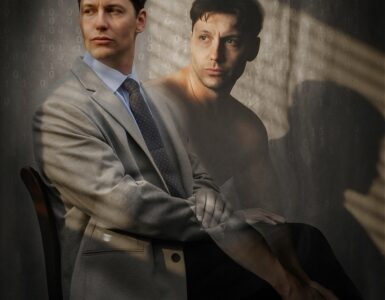
Lynda: The first thing the audience will encounter is uncertainty. When they enter the space, they’ll see two bodies on stage. We don’t immediately know what they are, or even if they are human. There should be a slight sense of unease — a feeling that something familiar has become unfamiliar. You might not know exactly where you are, and that’s deliberate.
The world of Lifelong is sparse and isolated. The play explores ideas around technology, artificiality and what it means to be human, so we wanted the design to acknowledge that rather than create a completely realistic environment. We haven’t tried to disguise the fact that the audience is in a studio theatre/lecture space.
Our lighting design uses moving light sources to gradually draw the audience into this world of technological possibility. The space transforms through light and atmosphere rather than lots of physical scenery. It is a fringe show after all!
The set and lighting elements have been created by incredibly talented student designers, and they’re almost sculptural in their own right. They don’t just decorate the space; they help create the world of the play. Costumes are also key in helping us to understand who the characters are, and where they have come from. Sound and movement will create atmosphere and also some unexpected moments.
Before the story has even begun, we want the audience to feel that they have entered somewhere slightly strange — a place that might be the future, or might simply be a reflection of where we already are.
Shay: What are you hoping the audience might take away from the experience, if anything?
Lynda: I’m not sure I want the audience to leave with a single answer. Theatre is much more interesting when it creates questions that stay with people after they leave.
With Lifelong, I hope audiences come away thinking about the relationship between technology, power and what it means to be human. The play isn’t arguing that scientific progress is bad. In fact, some of the developments explored could be genuinely extraordinary. The question is what happens when those developments enter a world that is already unequal.
I’m interested in the gap between what we can do and what we should do. Human beings are very good at creating things, but we’re not always as good at thinking through the consequences.
I also hope people leave thinking about the value of ordinary human experiences. There’s a strange irony in the fact that some people are spending enormous amounts of money trying to extend life, while some of the things most strongly linked to a longer, healthier life are actually very simple: connection, friendship, community and belonging.
Ultimately, Lifelong isn’t really about immortality. It’s about time, and how we choose to spend it. If people leave the theatre having a conversation about who gets the extra time, and what we do with the time we already have, I’ll be very happy.
Shay: What journey has the show been on to find itself at EdFringe 2026?
Lynda: The journey to Edinburgh Fringe has been a really exciting and unexpected one. It began when Pepperdine Scotland approached me about developing an idea for a Pepperdine production at the Fringe. I pitched the beginnings of Lifelong, and they commissioned me to develop the piece.
From there, the play went through several drafts, shaped by conversations and notes from the creative team. The next big step was meeting the cast for the first time. I travelled to Pepperdine’s campus in Malibu during the students’ Spring Break, and we spent a week workshopping the script together.
That week was invaluable. There’s a huge difference between having a play exist on the page and hearing it spoken by actors in a room. It gave us the chance to test ideas, discover new possibilities and explore moments that had previously only existed in my imagination.
The script continued to evolve through further drafts before the cast and crew travelled to Scotland. Since arriving, we’ve been collaborating with a brilliant group of Scottish creatives, rehearsing at the Royal Conservatoire of Scotland before moving to Edinburgh for technical rehearsals and previews.
One of the most rewarding things about this process has been watching the play become something bigger than the original idea.
Shay: With EdFringe now just around the corner, what are you most excited for?
Lynda: I have a huge affection for Edinburgh Fringe audiences. I’ve experienced the festival as a punter, an actor and a writer, and there is still something incredibly exciting about bringing a new piece of work to The Fringe.
There’s a particular energy to the festival. Audiences arrive ready to take a chance on something they might know nothing about, and I love that sense of curiosity and discovery. It feels like one of the few places where a completely new idea can find its first audience.
I’m also really excited for the whole team to finally share what we’ve been working on. We’ve spent months building this world, and it’s been a genuinely collaborative process. The young cast and creative team have brought so much imagination and skill to the production, and I’m especially excited for some of them to experience Edinburgh Fringe for the first time.
There’s nothing quite like that first Fringe performance — the mixture of nerves, excitement and possibility. I’m also excited for them to see so much incredible new work. My time at Edinburgh Fringe as a young person ignited my love for theatre.
Shay: Given the themes of Binge Fringe, if your show was a beverage of any kind (alcoholic, non-alcoholic – be as creative as you like!), what would it be and why?
Lynda: A mango-flavoured breakfast shake and if you come to the play you’ll find out why!
A reminder, you can catch Lifelong at Assembly George Square Studios (Studio Two) at from 12:00 on August 5 – 17 (70mins). Tickets are Available Through the EdFringe Online Box Office.
 Ben Powell