


 Roe McDonnell
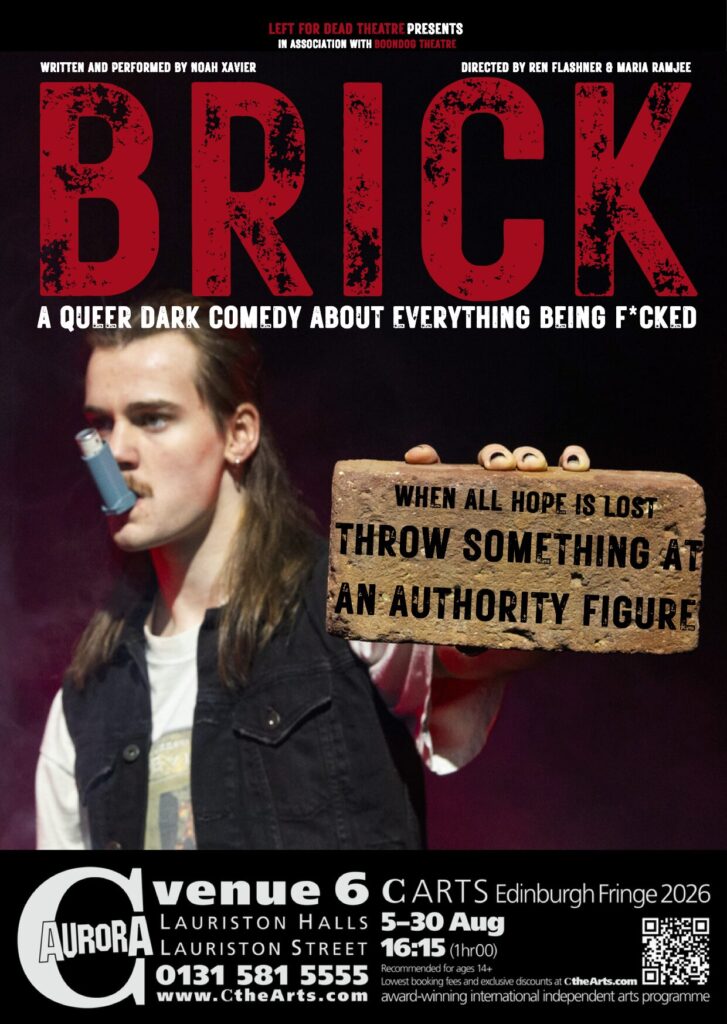
First time fringe-goer Noah Xavier brings up ‘Brick’, with help of the incredible Boondog Theatre team, to tell this ever relevant story of youth activism and what the world has actually turned into.
Show content warning: Mention of police brutality, homophobia and other distressing themes
Roe: Hey Noah! Great to chat! Give us a synopsis of the show and what we can expect
Noah: Brick is the story of a young man named James who gets arrested after throwing a brick at a police officer during a queer rights protest. It takes place entirely within a holding cell over the course of one night. Essentially he gets put in there with this other unnamed and unconscious cellmate who he develops this sort of strange, almost parasocial relationship with and begins to just sort of divulge his life story to and you sort of see all of the events in his life that have led him here.
Roe: Tell me a bit about your theatre journey
Noah: I think I probably started when I was quite young. My brother had music lessons and then my mum just sort of needed me to go somewhere for like an hour and a half on a Saturday morning and sort of just plopped me into like a drama class thing and then I just really enjoyed it and sort of refused to stop doing it. Especially as I was like going through my teenagers and like discovering things about myself and not necessarily conforming to sort of gender stereotypes and like neurotypical stereotypes, to have part of my day where I could go and do something where everything was planned and I knew what I was going to say, and I knew who I was in that moment, and I think really gave me a nice experience. I went to college in the middle of Nottingham for it, and then applied to drama school. I actually started writing Brick while I was applying and now I’ve just finished my 2nd year so it’s very exciting. But unfortunately means that I’m gonna finish Edinburgh, come back on the 1st of September and then I’m back in Liverpool for my 3rd year on like the 7th of September
What was your inspiration going into writing this piece? (Events of the time, movements, people etc)
There’s a lot of stuff. I mean, I started going into protests like 2019-ish, it was the school strike stuff that was my first introduction to it. And then obviously COVID happened and I think the main thing getting back into it was the Pro-Palestine matches in Nottingham after October 7th and thinking and having this feeling of sort of wanting to do more and not really having any way to. There were a couple of other things as well. I remember I went to Pride in June, I was going to the parade thing and they have a lot of Christian protesters at Pride and I remember there was a police presence there. This moment is actually in the play, I remember looking and seeing that the police were facing us like they were protecting the Christians from us and not the other way around. That was a massive thing that made me sort of start to figure out who the sort of institutions are sort of put in place to protect. Then there’s also been a lot of other sort of rough stuff. There was McPherson report after the murder of Stephen Lawrence, that was like 30 years ago, but learning about that around the same time as the Baroness Casey reports which was after the murder of Sarah Everard and all of the stuff that happened at the vigil for her, and then more specifically in Nottingham, there were some attacks in 2023 around that same time where 3 people were killed. Ian Coates, Barnaby Weber, and Grace O’Malley Kumar. So it’s 2 students and uh, a van driver. There was a whole sort of inquest and it revealed that the mental health services had not picked up on some very obvious signs that he wasn’t well and some other information. There was also some stuff where the Nottingham police were saying some awful stuff in WhatsApp groups. I think that those situations also got me thinking about the sort of institutions that are directly responsible through this sort of chain of commands for these things happening because they’re not protecting the right people. So I think, all of those were happening around the same time and I think I knew I wanted to write a play about protest and something about that, but I think it coalesced into something more about the failures of societal institutions and the connections around it.
Roe: What was your writing/devising process like?
Noah: It’s sort of embarrassing to admit but I originally made a 30 minute version of the play for one of my final projects at college. I didn’t have a script at all. I had it in my notes app on my phone and it was just like that for like 4 months. I thought, maybe I should actually put it in an actual script. There was a lot of research and I think one thing that I wanted to really make sure of, especially when I was expanding the play out to be the full hour, is that the majority of the things that happen in the play are things that happened. But there are a couple of things that didn’t happen to one person but a mixture of loads of different things and it is a coalescing of all of those things that I wanted to speak about, like news articles that I was reading about thinking how can I include that and weave these sorts of themes into it? I think I write very instinctively, a lot of it is looking at what I’ve written and then sort of trying to reason it out afterwards, like sort of consciously making the connections that I wrote subconsciously. Like, oh, that connects to this, I didn’t think about that when I was writing, but that does connect to this and the thing of, ‘writers write everything for a reason’ I don’t think it’s necessarily true. I think good writers make these connections and things subconsciously, but I think it’s important to pull apart the strands to try and figure out ‘what did I mean when I wrote that?’. A lot of the devising process for the Fringe run was focusing on how the show is in a very small space and when we were getting it on his feet was about how can we make this dynamic? How can we make this small space seem interesting? I watched a really good film called Waste Man. quite recently. It’s David Johnson, who I am obsessed with, and Tom Blythe and it was set in a prison and the thing that struck me was the cinematography and the angles of making this sort of prison cell seem like every place in the world at once and like how can we bring that to the stage without having a camera to focus the point of view, just letting the audience see that.
Roe: What’s your favourite line in the show and why?
Noah: I have, there’s a couple, there’s some bits right at the start. The 1st word of the show is ‘Fuck’ I really like, just a full effect of his brain. There’s a couple of others on the more serious times, there’s a line about someone called Fred Hampton. who was the leader of the Black Panther Party, and the line is about how ‘there are bullet marks on Fred Hampton’s grave’ because the Chicago police killed him and every year on the anniversary of his death, they would go and shoot his grave which is horrifying and I had like a couple of uh, other people have like come up to me and been like, and and been like, oh my, I didn’t know who Fred Hampton was and I like, looked him up after the show and that’s that’s horrible. I think I like that line because it’s something that people don’t know about and that I think is quite inedicative of the state of things. And I think my other favourite line is right near the end and it is ‘They probably unload the dishwasher differently’. which doesn’t really make any sense, but it does to me.
Roe: How does queerness and neurodiversity shape the art you create
Noah: It’s in everything that I do. There’s a lens of looking at the world differently and from outside of certain structures. I think deconstructing sort of gender norms and starting to destruct sort of hetero-patriarchal structures has definitely changed how I see every societal structure and the ways in which I view it. Everyone’s sort of struggling it’s a really interesting way of looking at something because you’re sort of outside of the norm, but there’s also like a degree, there is a degree of privilege in something like, in like queerness and neurodivergent because, um, they are some of the time, not necessarily visible differences and I’m privileged to live in a part of the world that is uh, where it is legal – for the moment – to be queer and I think seeing the way that it affects me and the people around me, really informs the way that I write about identity. And I think the feelings that James, the main character in Brick has, even though James is a certified he/him I think that sense of being ignored or being let down or being sort of left to fend to yourself. I don’t feel it’s not an autobiographical play. But I think in the same sense every play is in some sense autobiographical for the writer because they wrote it and it’s, you know, a lot of it is informed, like even there are some bits of it that I’m like, oh, I wrote this because I was struggling with drama school auditions and there were certain moments of it that were almost directly tied to the institutions and the elitism in drama school editions and it will sort of blend from you into the character, and especially because I’m playing the character as well. No one taught me how to be queer and neurodivergent. And James is finding out about the world that he lives in and how, how the personal and the political have always been intertwined, whether he has been aware of it or not. And I think that definitely sort of mirrors my own coming into my own understanding of myself and the world around me.
Audiences would love the play if they love this: TV Show, Movie, Theatre show Book and Celebrity
TV Show: I’ve got two. ‘I May Destroy You’. Um, which is Michaela Cole’s TV show, which is, I’m just obsessed with just incredible. And a show that I watched recently, ‘This Is Going to Hurt’ the Adam McKay show about the NHS. With both of those, there’s a real, institutional failure feel and how it sort of seeps into your personal life
Movie: I’ve got two again. Bo Burnham’s ‘Inside’. It was a real cultural moment when it came out, but like that kind of intimacy really comes through. There’s another film that I love called ‘How to Blow Up a Pipeline’. Bunch of kids blowing up a pipeline, an oil pipeline that’s running through indigenous land.
Theatre Show: I’ve got to say ‘Punch’ it made me bawl my eyes out. The first time I did the half hour version of Brick, was the same day that I saw the press night for Punch. ‘Angels in America’ another one and I’ll say ‘Prima Facie’ and the ‘Death of England’ monologues
Book: Cheating a little but theres a book of ‘How to Blow Up a Pipeline’ a non-fiction book about the debate between non-violent resistance and violent resistance. Reading it was one of the, it was one of the most eye-opening books that I’ve ever read. One of my favourite books and was so integral to, my thought process for the show.
Activist: Ian McKellen always, a lot of people obviously love him for his incredible theatre stuff, but a lot of people don’t know that he was part of the original group that created Stonewall, all of their like charter was made at Ian McKellen’s house and he was like a founding member. Greta Thunberg as well. And then I think finally, I think I’ll be skinned alive by Kai, who is the other actor in the show, if I don’t say this, because he is very Welsh: Michael Sheen as well, his sort of not-for-profit acting and all of the stuff that he’s done for for people and fighting back against the sort of elitist institutions around theatre.
Roe: What’s your experience been like working with the Boondog team on their mentorship scheme
Noah: It’s been awesome. Doing Edinburgh fringe was such a pipe dream when I first conceived of this show and I’m so unbelievably excited. I couldn’t have done it without them. Jamie and Lucy have both been just incredible, so lovely and supportive. They’ve made the logistics and production elements so much easier, which has really allowed me to focus on the actual performance of the show. Making it as easy as making a Fringe show can be which is still not easy, but it’s it’s been such a brilliant help just to have both of them on board to, to be able to text them at 2 in the morning panicking about something and full of reassurance.
Roe: Anything else you want to talk about?
Noah: I think I’m just excited to go to the Fringe and I just want to say that the first Fringe was a protest. In 1947, 8 theatre companies turned up unannounced to the Edinburgh International Festival because the Edinburgh International Festival had this focus on ‘high art’, whatever that means, and also banned Scottish theatre companies from participating. They turned up and they performed as a form of resistance and staged the shows anyway. And as much as Fringe has become a more of a sort of consumerist entity, I think it is, um, I think it’s, it’s, I think I want people. I just want people to know. I just want people to remember that.
Roe: Plug the show
Noah: Brick. 5th to 30th of August, 4:15 PM at C Aurora Studio. Edinburgh Fringe. It’s gonna be awesome. You will laugh, you will cry, you will throw things at authority figures. Come down, say hi, come hang out. Come get bricked!
 Salvador Kent
 Shay Mace