


 Elisabeth Flett
Come out of Pitlochry train station, turn right down a mysterious wooded path – or slide down it, if like me you visit in snowy January – follow the burn down to the river, cross said river on a excitingly rickety wee bridge and puff up one more mini hill…and you’ll find yourself at Pitlochry Festival Theatre. Haven’t heard of it? It’s worth a visit, especially as it’s the home of Alan Cumming’s new arts programme and the venue for Scotland’s brand new queer arts festival, Out in the Hills Festival.
It was because of this new queer arts festival that fellow Binge Fringer Jake and I found ourselves in the icy splendour of the ‘gateway to the Highlands’, and the sheer array of events available to see over the weekend made the journey more than worth the effort. While Jake focused on events based around lived experience and ‘big name’ panels, my Out in the Hills was firmly based in the Studio space and included queer archiving, a film screening, a concert and a theatre show!
Friday 16th January: Reimagining, Re-contextualisation and Reclamation
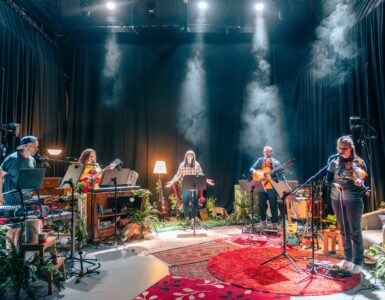
I started off my Out in the Hills with a classical music concert by Resol String Quartet., Rainbow Classics. The programming of this hour-long performance focussed on highlighting and celebrating the queerness of several well-known composers, and clear thought went into the repertoire and the order in which that repertoire was played. For me the two particular highlights of Rainbow Classics were the piece by Caroline Shaw – it was a delight throughout, full of methodic deliberation mixed with soaring melody and rhythmic motifs – and the clever decision to programme John Cage’s 4’33 right before Barber’s Adagio for Strings. (When that first Adagio chord emerged from the silence I got actual goosebump-worthy chills.) I came for the important premise of the programming, but I went away genuinely moved by the music I’d heard.
My second event of the day for the Friday was a screening of the 2025 film Who Will Be Remembered Here, preluded by a beautiful in-person performance by musician Malin Lewis. As someone who writes poetry and is very interested in psychogeography, hauntology and the concept of liminality I knew this film was going to be very much my kind of thing – but even I had no idea just how good it would prove to be. Featuring truly excellent performances from writers Robert Softley Gale (English), Harry Josephine Giles (Scots), Robbie MacLeòid (Gaelic) and Bea Webster (BSL), this film was a time-slipped exploration into Scotland’s past, our landscapes and unknown queer lives re-imagined through a contemporary, achingly intimate queer lens. Conceived and led by Lewis Hetherington and CJ Mahony, gorgeously soundtracked by the talented Kit McCarthy and beautifully directed by Michael Sherrington – this film nerd was just about out of my seat with excited appreciation for how each segment of the 30 minute film blended into the next with circular arial shots – Who Will Be Remembered Here will stay with me for a long time to come.
Saturday 17th January: Sapphic Stories, Stolen Histories and Joyful Silliness
Did you know that Scotland has its very own Anne Lister-style historical lesbian, who was writing about her love and desire for women in the – pause for dramatic effect – sixteenth century? I didn’t, which frankly feels unacceptable for someone who has a retired archivist for a father, a masters degree in folklore, an interest in Scottish history and a love for all things sapphic. The life of Marie Maitland, however, is one which has been deliberately swept under the historical carpet by historians and archivists over the years, and the lived queer experience which can be so clearly identified within her writing has been…let’s say determinedly and deliberately misinterpreted… with repeated fervour. (She writes about desiring to marry and ‘ravish’ a woman. That is a stretch for ‘they were gal pals’ claims, even for the queer-people-didn’t-exist-before-1950 mindset of traditional historical academia!)
Historian and writer Ashley Douglas is, thankfully, bringing our collective understanding of Marie Maitland up to date with her upcoming new book, With My Own Hand: The Secret Life of Marie Maitland, Scotland’s sixteenth-century Sappho, and it was inspiring to hear Douglas talk about historic queer lives and hidden queer stories with such enthusiasm and passion. I’m definitely going to be buying the book when it comes out later this year. The other member of the Whose History Is It Anyway? panel was archivist Catherine McPhee, and it was fascinating to hear her talk about contemporary archival practice and the politics behind whose stories are preserved and whose are deliberately erased. McPhee even brought along a few Victorian photos, taken on Skye and showing decidedly queer behaviour (it took me a moment to realise what I was looking at with one of them!) to bring home the rather beautiful point that we have literally always been here. Scottish history is queer history. We just need to know where to look for it.
I finished off my time at Out in the Hills by going to see The Green Knight (But It’s Gay!) by Niall Moorjani. As a fan of the Dev Patel 2021 film I was struggling to imagine what a queer comedy theatre show version of this Arthurian legend might look like, and it turned out I couldn’t have predicted the joyous, chaotic mayhem of the following hour even in my wildest dreams. There was music. There were audience sound effects. There were aquatic-themed hats with glittery bits and googly eyes. There was a whole scene with a Scottish bog witch with an accent which had to be experienced to be believed. There was heartfelt poetry. There was really good lighting. There was a whole running gag about ethically non-monogamous polycules which was very, very funny. I’m so glad I went to see The Green Knight (But It’s Gay!) with my fellow Binge Fringian, Jake, as it was definitely an experience best enjoyed with a mate or two – even better if they’re friends who are also up for groaning at Chappell Roan puns and making SPLASH! noises on demand.
Out in the Hills was a fun time, and an affirming one: LGBTQIA+ Scots are making our voices heard, and we are here to stay. Here’s to being back at Pitlochry for more of this festival in January 2027, and hopefully for many years to come.
Image Credit: Tommy Ga-Ken Wan
 Jake Mace
 Moss Meunier