








 Julia Bottoms
What is it like to write the story of your life? Does it ever really reflect reality, or just your perception of it? And what of the people within it—do you have the right to shape their stories too?
This play-within-a-play weaves a meta-narrative braid of heartbreak and hyperreality, of mania and muses. At the heart of this tale lies a charged power play between the artistic and sexual dynamics of gratification and degradation – throughout an intense 70 minutes unfold a tense negotiation of control, authorship, and desire in which wielding the pen is the ultimate weapon of power.
According to Grace (Amaia Naima Aguinaga), ‘Stories are better than real life because they make sense. And what you did makes no fucking sense’. Reeling from a half-loving, half-destructive, wholly messy situationship with Eli (Francis Nunnery), Grace spins her story as she goes along. It’s a spiralling, daring yet delicate dance into Grace’s psyche as the realms of the real and the surreal tangle and collide.
Hannah Caplan’s debut writing is effervescent – the story is a masterfully woven web of a narrative, much like the webs of crocheted red yarn sprawled across the walls. The play loops and folds on itself time and time again, offering endless reimaginings of what was and what might have been. Masterfully slick staging involves beautiful mixed-media artifacts such as impeccably timed projections, hilarious sex puppets and a metamorphosing B&M trolley. Everything is within reach of the audience and is close enough to touch – you can see the meticulous time and effort taken in every stitch.
Romantic two-handers are notoriously hard to pull off – but this one is handled with depth and humour. The chemistry sizzles between Aguinaga and Nunnery as they volley lines across the room like they’re in a tennis match; the runway-esque stage setup leaves audiences furiously whipping their heads from left to right. Every reference is meticulously selected; as the pair sit down to watch ‘Eternal Sunshine of the Spotless Mind’, Grace and Eli’s surreal pathway mirrors that of Clementine and Joel’s suspension in cinematic unreality. Beyond that, the anecdotal specificity of the pair’s courting is sharply observed and relatable; I too felt part of the narrative as moments from my own experience were mirrored with uncanny accuracy,
In a closing scene that transcends the play’s already violated meta-narrative boundaries, Grace and Eli sit down to re-watch the film of their life. It’s a bittersweet and wholesome ending to a chaotic narrative, one which somehow still manages to keep you on board right until the end.
In the spirit of the play, it’s tempting to speculate on the extent to which Caplan has modelled the script off her own life. It also prods at how much of ourselves we choose to see in it too. In all its humanity, its messiness and chaos, in my perspective, the play turned out to be very much about me – and about all of us.
Recommended Drink: Espresso Martini – dark, edgy, and a much needed hit of caffeine to navigate the complex narrative layers.
Performances of THIS IS NOT ABOUT ME. have now concluded at EdFringe 2025.

 Jess Turner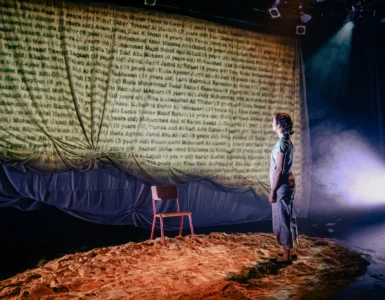
 Jake Mace
 Moss Meunier