






 Eve Miller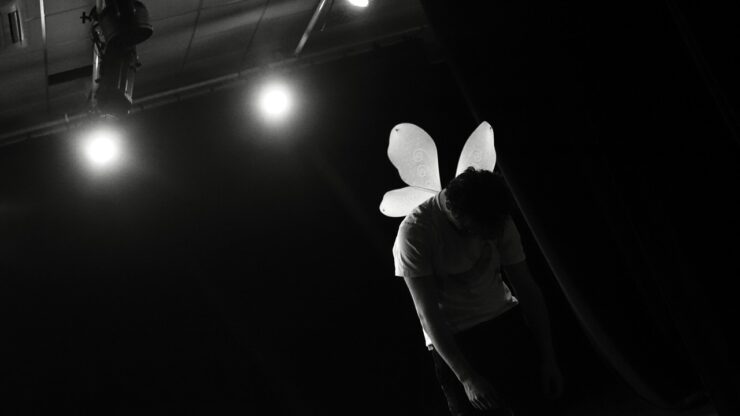
Two boys in detention scribble on whiteboards – I can spot the words ‘RAGE’, ‘femoid’, and many, many cocks. Lights flash and a screen flicks through footage of sports and manosphere content. The scene is set.
Through time-jumps, we follow Moth and Dog as they unpack their sexualities and explore their attraction to one another in the leadup to the COVID-19 pandemic and into lockdown. It explores the risky online sexual behaviour that young gay men often engage in, such as using Grindr and Omegle underage, and the impacts of internalised homophobia and gendered expectations on identity formation.
Aidan Monks’ script is dynamic and pacey, with some really hard hitting poetic inclinations. The characters are beautifully drawn, and their diverging understandings of masculinity and queerness are clearly and cleverly laid out. My biggest problem with the script is its use of time-jumps; often switching scenarios line-by-line. This technique creates real emotional distance for the audience, making the piece difficult to follow and robbing key moments of their emotional impact by demolishing the tension that has just been built. More than that, it creates obstacles for the actors, who have to jump between emotions in a split-second and work up to heightened states from nothing.
I generally love a non-linear timeline, and think that jumping about in this piece could definitely work – the way that Monks has written his script is very cinematic, and if each of those time jumps was a cut in a short film it would be very impactful. I think that this excellent concept needs developing, either into a screenplay that would facilitate the time-skips and allow them to create impact rather than destroy it, or reworked for the stage with dramaturgical support to use the time-jumps more effectively.
Moth and Dog are brought to life by Ben Philips and Dylan Swain respectively, who both deliver committed and vulnerable performances. The chemistry between the pair is strong, and (spoiler!) they share the best on-stage kiss I’ve seen this Fringe. It is easy to believe that they are two young men figuring out their sexualities, and working out how to hold one another.
Philips’ performance is particularly impressive. His coiled-spring physicality crackles with potential energy, lending Moth a restless, directionless dynamism. He finds the truth in the character, even when the writing is at its most abstract and experimental, and I really believed every word, motion, and glance. He tackles the sensitive subject matter with grace and authenticity, and effortlessly traverses the age shifts throughout.
There is a lot of promise in this production. I would love to see it in a new form – either as a short film, or a revised play at next year’s Fringe or beyond. Its message is important, its viewpoint interesting, and its characters tangible. It sets itself lofty goals, and just because it doesn’t quite achieve them doesn’t mean that it lacks merit; indeed, I think there is far more to be gained from watching an ambitious young company tackle some really complex themes and not quite hit the mark than from the many safe crowd pleasers this Fringe.
Topical, energetic, and engaging, Moth and Dog Are Dying to Get Out is a sparky piece of new theatre from an exciting emerging company.
Drink recommendation: Vodka redbull, to keep you dancing all night long at the illegal pandemic rave.
You can catch Moth and Dog Are Dying to Get Out at 10 Dome at Pleasance Dome from 5-31 August (not 15, 17, 25) at 13:20 (60 mins). Tickets are available through the EdFringe Online Box Office.

 Shay Mace
 Mary Kennedy
 Sarah Kher-Bek