






 Isobel Jacob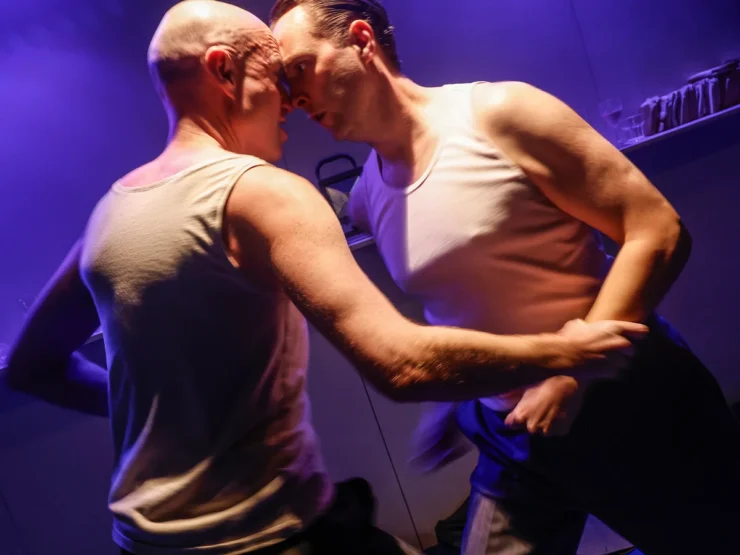
“I paint what I see.”
“I’m not mangled.”
A sparse, confined stage, enclosed by clear plastic screens on either downstage corner and decorated with wine glasses along the back wall, is set to an ominous and brooding pizzicato soundtrack as we enter Upstairs at Pleasance Courtyard. Writer and performer Alistair Hall and, playing opposite him, Peter Clements occupy the claustrophobic and already intoxicating space. Costumed in grey suits and bare feet, they eye each other up intensely, licking their lips, sometimes grinning, sometimes grimacing. To set this imagining of painter Francis Bacon’s consuming and volatile relationship with burglar George Dyer in motion, we see the moment the couple connect and begin a fervent, erotic dance, a duel, that doesn’t stop moving until the performance in complete and the audience are left to sit in an overwhelming murky mix of beauty and tragedy.
Set in 1960s London, Buggers follows Francis and George as they return to Francis’ small South Kensington apartment following meeting in a pub earlier that evening. An animalistic face-off begins as they enter a passionate, sadomasochistic love affair. However, fuelled by drugs and alcohol, and a class imbalance that invades with greater and greater insistence, their relationship descends into a dark and violent battle of lust, power and addiction.
This is not a play that is written simply for the sake of creating a play about Francis Bacon. As a representation of the real lives of Bacon and Dyer, Buggers is hugely successful in its unselfconscious and immersive approach: Hall, in his writing, deftly weaves together real and imagined details of the couple’s story without ever feeling pretentious or overly worried wedded to accuracy. The dialogue feels Wildean at times, Pinter-esque at others. By not allowing the drama to be limited by its source text, Hall enables the play to tenderly explore the euphoria, pain and loneliness that his characters cycle through with historical details such as mentions of the police, or Dyer learning to read, etc. to truly deepen the relationship and create an entirely engrossing sense of their world.
This said, when looking photos of some of Bacon’s paintings after the show, I felt a newfound weight, even sorrow, in many of them.
Buggers’ lighting design by Lucy Adams is astounding, and completely immerses us in the heady and surreal atmosphere of hazy overdose as a bewildered George falls further out of reach of Francis who is trying to steady him in a hungover, yes, but material reality of London. The set design by Rosie Elnile and at once classical and post-modern composition by Jack Baxter
complement this beautifully, underscoring the sexually charged intensity and then George’s eventual desperate spiral with a perfect pacing towards the play’s climax.
Hall and Clements are captivating: with incredible precision and truthfulness, they maintain the an energy of obsessive urgency for the full hour in this challenging feat of such confronting, heightened staging. Director Alice Wordsworth and Movement Director Ken Nakajima have choreographed highly effective sequences of movement in between the visceral dialogue. For a short play where so much happens, Wordsworth has enabled the relationship to unravel with an impressive believability and momentum that is not easy over only an hour.
I do, however, think that Buggers could benefit from an additional twenty minutes – or needs to perfect the hour-long pacing. The descent into addiction felt rushed in the second half. The opening and ending were so perfectly executed, and it was a shame that, in the middle, the fragmented structure meant that some issues, such as George’s difficulty with getting an erection, and his sudden extreme loneliness, felt like they’d come a little out of nowhere. I think Hall could have achieved greater emotional payoff had this production worked out a solution to needing to fit many years of the relationship into a short play that didn’t simply involve skipping such pivotal scenes.
Yet this is a hypnotic and arresting portrait of a complex and tortured relationship that does not hold back in any element: its striking design on all fronts, and powerful performances at the centre, make for a theatrical experience that may leave you speechless. I hope there’s a bigger future for Buggers.
Performances of Buggers have now concluded at EdFringe 2026.
 Shay Mace
 Mary Kennedy
 Sarah Kher-Bek