
 Romeo Lau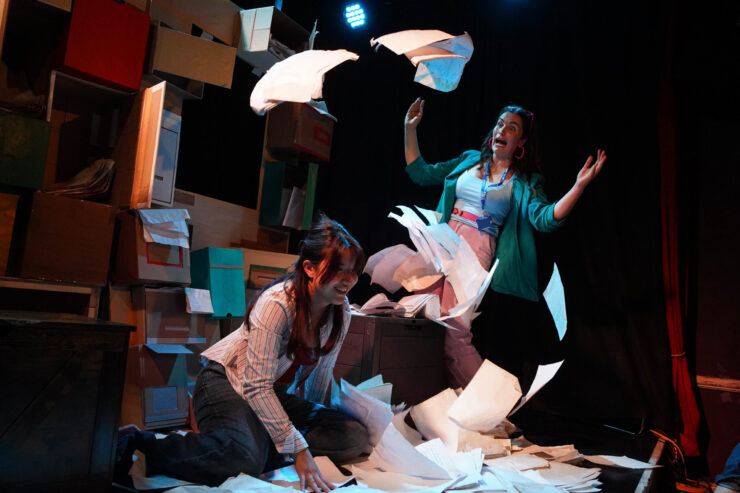
「世界上没有真正的中间」– “there is no true middle in this world.”
Dear Lihua is a bilingual dark comedy in English and Mandarin, revolving around the story of Qiuqiu (Zoe Rowe), a go-getting immigrant from China who passed in the middle of the night from a stress-related heart attack. GOD3456 (Rafi Essex) appears, revealing that due to the fact that she died in the UK, she is assigned to an “English-speaking Heaven” and has to earn enough credits to return to a “Chinese Heaven”.
This is ironically juxtaposed with the fact that Qiuqiu was in the middle of applying for her Global Talent Visa when she passed away, creating one immigration struggle after another – but this time, it’s for her transition to the afterlife. Qiuqiu is joined by a not yet fully realised assistant Barbara (Naomi Crosby) who is equal parts endearing and disconcerting in her physicality and voice. The two take on the impossible task of sorting letters left unreceived, when a number of letters signed by a mysterious Lihua (李华) begin to appear.
The name “Lihua” is commonly used as a pseudonym by Chinese students learning to write English, a pen name for an imaginary foreign penpal. Through the play, the significance of “Lihua” changes from a simple moniker to a symbol of the immigrant dream – the promise of learning English opening more doors to opportunities in the West – showing an impeccable wit in symbolism from playwright Xinyi Chen.
Heading into the Studio, the audience is greeted with an ensemble of shelves built from plywood and cardboard boxes holding thousands of letters – designed by Eizo (Yizhuo) Zhao. At the very beginning of the play, GOD3456 makes a striking entrance by knocking a window through these shelves, which immediately showed the set’s brilliance in design and dramaturgical effect.
The genius of Dear Lihua’s design doesn’t stop there: one of my highlights of the show was the piano motif of a single note whenever Qiuqiu began to forget words in Mandarin – her mother tongue. I would love to see this explored more as a source of grief and pain for the diaspora, especially in the wake of a rather abrupt ending where Qiuqiu is suddenly accepted into the Chinese afterlife.
Reminiscent of The Good Place in its concept, Dear Lihua asks the question: How much suffering should one have to go through in order to ‘earn’ their place? Throughout the performance, Qiuqiu consistently feels the need to explain herself to Barbara, who has never truly lived. This manifests itself in monologues about her experience, which doubled in function as an indirect audience address.
However, as a play with a majority target audience of other Asian immigrants, I’d like to challenge the necessity of this device: Why do we always feel the need to overexplain ourselves in our art? The fear of alienating an audience in turn alienates the artist – I’d love to see a version of this script which leans in more to showing and not telling Qiuqiu’s background which has made her the way she is.
Dear Lihua is a melancholic lamentation of suffering which steers the audience towards reflection.
Recommended Drink: A carefully crafted ritual of 工夫茶 (lit. Kung-Fu Tea – a traditional Cantonese tea preparation method).
You can catch Dear Lihua at theSpaceTriplex (the Studio) between August 27-29 at 11:05 (50mins). Tickets are available through the EdFringe Box Office.
 Shay Mace