

 Salvador Kent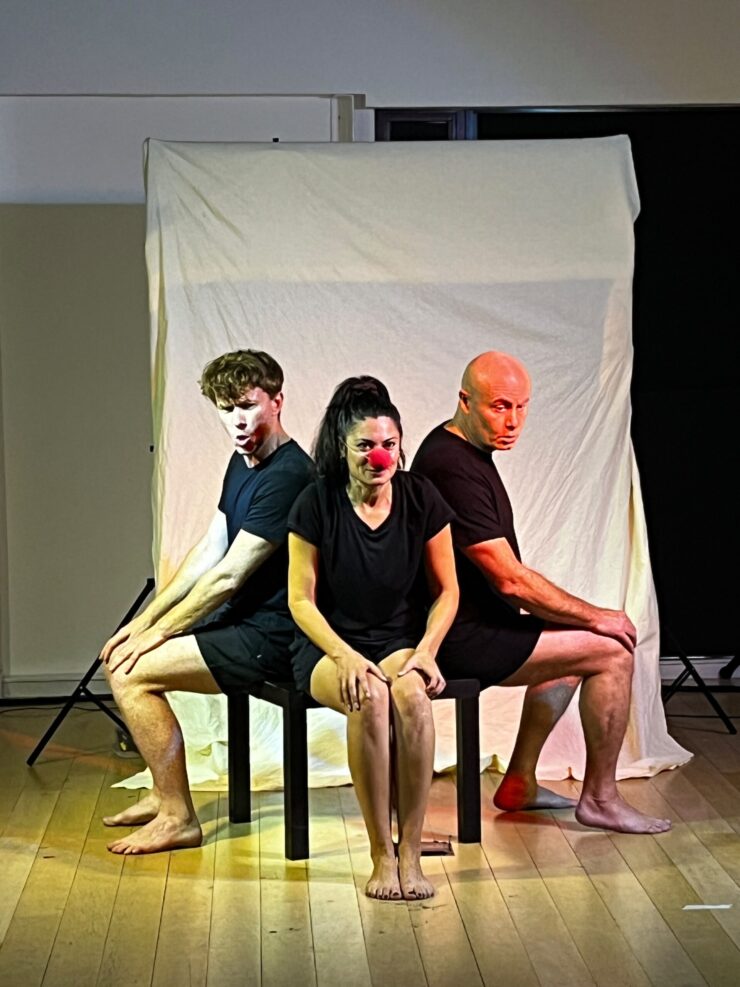
Tom Corradini’s Caligula is the last of five shows played at new Fringe venue Teatro Fisico. It is the most experimental, loosely structured and my favourite. In some ways it is a tract on madness – madness in the broadest sense, in the same way the painter Francisco Goya would paint ‘the madhouse’. Rightfully, this idea of madness has been replaced by clinical illness. But it is a madness worth discussing nonetheless. It is the madness that influences our cultural perception of sanity, and the madness we have ascribed to poets, philosophers and emperors…
Nike Redding plays Professor Frank Wilkinson, an expert in Roman history who researches the fall of the Roman Empire. He also hallucinates that he is Emperor Caligula. Caligula — a tricky case. He is the subject of a play by Camus in which he is portrayed as the ultimate existential hero. He is portrayed by Tinto Brass as the hero of a porno. Corradini is commenting on this ‘cultural hallucination’ of Caligula, and his hedonism through to his tyranny is the subject here. It is always understated and played within the context of the psychiatric ward.
Corradini and Isabella Egizi play a supporting act to Redding’s professor-slash-emperor. They are credited as ‘Nurse’ and ‘Patient’ but their roles are slippier than that. Donning a red nose, Egizi puts in the most ambigious performance — she is supposedly meant to help Wilkinson, she enables him instead. Her function is a little like that of a clown – she’s the innocent to which Frank presents the broken world. Corradini is in some ways a technician, he literally mixes the music, especially the drums which punctuate the piece. His character is wordless – he simply laughs, screams, gestures. It is less a portrayal of a ‘madman’ more a portrayal of the wordless aspects of human life. So our troupe might be credited as Professor, Nurse, Patient – but maybe it is better to see them as a rather old fashioned ‘divided self’, or a mind (professor) body (patient) spirit (nurse) (or any combination you like).
The point is that Caligula’s achievement is to move beyond the conventions of psychological drama and instead transform something rote into something tricky, slippery and physical. The life of Caligula might be the subject of the piece, but the content of it is the sequences constructed by the cast. It is a rhythm of screams and laughs. It includes a horse mask, a dance in which Redding becomes a seductress in the shadows, constant rhythm and movement created by the patient’s music.
The play ends with precisely the sentiment it creates. “Rome has fallen”. Indeed — this is a play of decay. It is using a decaying form. It is using decaying notions of psychology; it is speaking of characters in decay. It’s from another era. It is injected with a vibrant vitality – and it is in this contradiction, taking something rotten and making it feel alive and screaming — that makes Caligula legitimately beautiful.
Recommended Drink: I downed a massive can of red bull sugar free before this performance and I thought it was very nice.
Performances of Caligula have concluded at EdFringe 2026.

 Shay Mace