 Shay Mace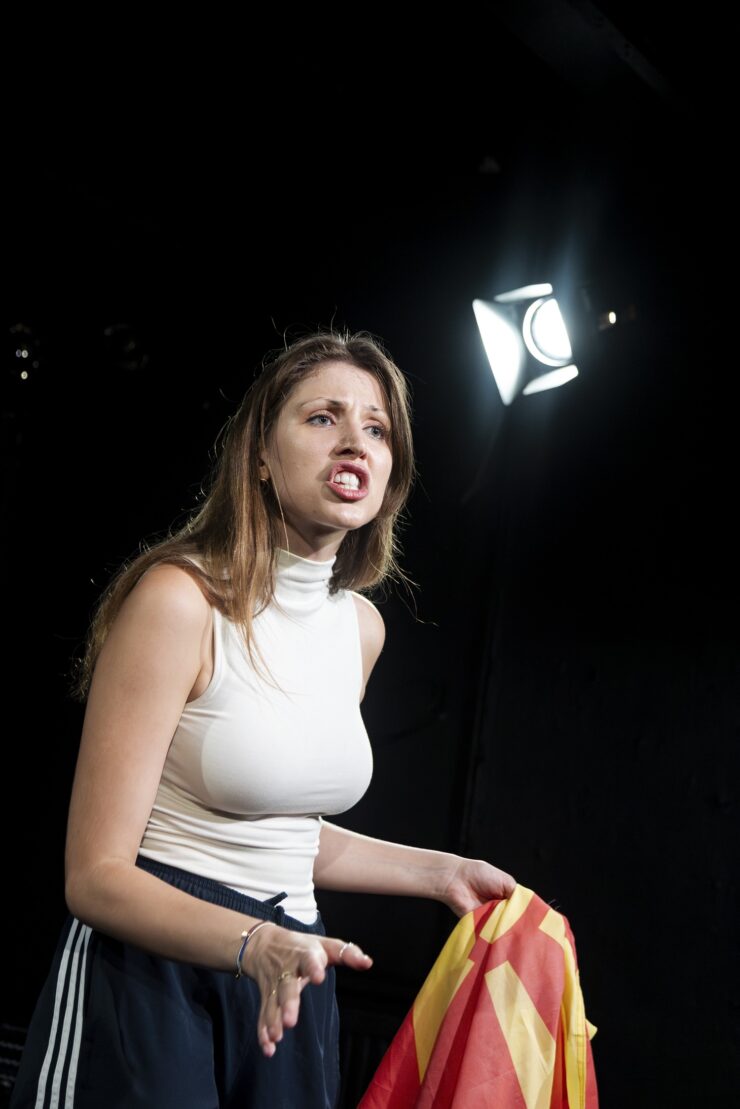
Isabella Heaver and Harry Conway’s new play Racists, Recessions & Revolutions explores the Macedonian teenagers who built a fake-news empire during the 2016 US election. Marking the tenth anniversary of the fake-news gold rush, this darkly comic solo show follows one ambitious young woman as her online hustle spirals into something far more dangerous. We caught up with performer and co-creator Isabella to separate fact from fiction and find out more.
You can catch Racists, Recessions & Revolutions at ZOO Playground (Playground 3) from 15:55 (60mins) on August 7–11, 13–18, 20–25, 27–30. Tickets are Available Through the EdFringe Online Box Office.
Shay: Hi Isabella, tell us about the Macedonian teenagers who built a fake-news empire during the 2016 US election and inspired Racists, Recessions & Revolutions, and why you have decided to bring this story to the stage now.
Isabella: In 2016, an English friend sent me an article about Macedonian teenagers who had discovered that they could make money by spreading fake news online. They found that pro-Trump stories generated the most clicks during the US election, so they doubled down. Their fake stories became so widespread that some people argue they actually helped Trump win the election. Rumour has it that Trump still sends one of the teenagers $100 a month as a thank-you.
One of the joys of being half Macedonian is that whenever a story about Macedonia appears in the news, I become like a dog with the zoomies. It’s a country I’ve spent most of my life explaining actually exists, so seeing it suddenly make international headlines felt surreal. It was the ultimate underdog story, but with a twisted outcome. When Harry Conway, the show’s co-creator and director, and I began brainstorming ideas for a play, we kept coming back to it.
As the cost of living continues to rise, the play asks what lengths people are being pushed to simply to get by, or to get ahead. Social media has created a world of “main character syndrome”, where there’s a growing sense that living an ordinary life means we’re not doing enough. Our spare time must be commodified: if you don’t have a side hustle, what are you doing with yourself?
The show’s protagonist embodies these qualities. She’s ambitious and resourceful, but her pursuit of “making a name for herself” draws her into the dark world of online misinformation.
It also happens to be the tenth anniversary of the Macedonian fake-news gold rush. What better time to revisit this story?
Shay: How has the creative process been of putting the show together? Give us an idea of the journey you’ve been on with it so far.
Isabella: We took the show to Brighton for three work-in-progress performances, which was invaluable. I had just finished another play and had around two weeks to learn our 30-page script while balancing a full-time job. I nearly had a nervous breakdown.
During the first Brighton performance, I skipped a massive paragraph in the middle and thought I was going to cry when the show finished. Then a group of audience members came up to me afterwards and told me how amazing they thought it was. Thank God for those people, because they really propelled me through the following two nights. I’m so, so grateful to them.
The Edinburgh version is much more developed than the Brighton version. We had a dramaturgy session and asked some trusted directors to read the script and offer notes, which was bloody useful. Sometimes, when you become so close to a script, as we were after Brighton, giving it to a fresh pair of eyes feels like opening the blinds in a dark room.
Shay: What will be the first thing the audience sees, feels and hears as they enter the space?
Isabella: They’ll hear the dulcet tones of Toše Proeski, see an orange-and-yellow wash across the auditorium and, hopefully, feel the Balkan sunshine on their skin.
Shay: What are you hoping the audience might take away from the experience, if anything?
Isabella: I hope they find our protagonist conflicting. I wanted her to be someone who does terrible things but whom you can’t help liking, even as her actions become progressively worse. I don’t know whether that will translate but, fingers crossed!
Shay: What journey has the show been on to find itself at EdFringe 2026?
Isabella: Initially, we thought we’d perform a couple of nights in London and perhaps spend a week in Edinburgh. Harry, the director, is Irish, so we also threw Dublin Fringe into the mix. Then this slot at ZOO Playground came up for the entire month, and now I can’t imagine doing anything less. It’s been an unexpected joy!
Shay: With EdFringe now just around the corner, what are you most excited for?
Isabella: Last year, when I was at the Edinburgh Fringe with a show that had a week-long run, I kept saying that I had FOMO because I wasn’t there for the whole month. I think I spoke this year’s run into existence.
I also have a feeling that ours might be the first play about Macedonia ever staged at the Edinburgh Fringe, which is pretty exciting, although I need to fact-check that. How fitting that I might be spreading fake news myself!
Shay: Given the themes of Binge Fringe, if your show was a beverage of any kind (alcoholic, non-alcoholic – be as creative as you like!), what would it be and why?
Isabella: It has to be rakija, a grape brandy local to the Balkans. It tends to be somewhere between 40% and 60% ABV and is often homemade.
The rakija for this show would be decanted into an old plastic Sinalco bottle, with layers of Sellotape wrapped around the cap so that it could survive the journey back to the UK in Gordana-down-the-road’s suitcase. It smells strong and perhaps looks a little questionable, but once consumed, it’s guaranteed to leave an impression.
A reminder, you can catch Racists, Recessions & Revolutions at ZOO Playground (Playground 3) from 15:55 (60mins) on August 7–11, 13–18, 20–25, 27–30. Tickets are Available Through the EdFringe Online Box Office.
Image Credit: Daragh Drake
 Ellen Leslie