
 Salvador Kent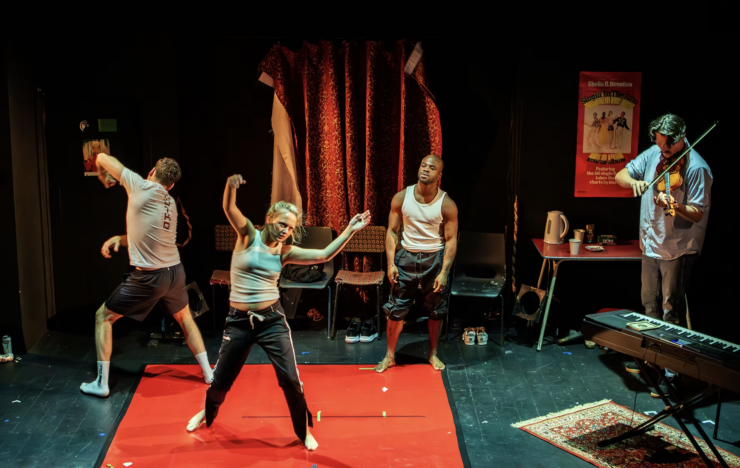
Echoes of Caesar permeate Joy Nesbitt’s hour on tyrannical directors in times of political crisis. Three actors, asked to choose names different from their own (such as legendary Shakesperean actors), audition for a nameless director’s next production of ‘Julius Caesar’.
A musician accompanies them. The play-within-a-play here is most interested in the rhythms of rehearsal, and how marginalised bodies choose to adapt to the demands of the white, wounded director. Meanwhile, a race riot has kicked off outside, and everyone’s trapped in the theatre…
In some ways, the content of the play is closer to the theatrical rehearsals of Jacques Rivette films (espeically ‘Out 1’), than it is to the text of ‘Julius Caesar’ itself (it’s echoed but rarely delved into explicitly). This is to say the audition exercises are extended, non-conventional, and characterisation is apparent from the work in them.
The play is at its best when we observe these exercises, which might seem ‘artistic’ to the director but are often abusive. The subjectivity of the work is very clever here though, as whether the audience thinks it makes the performances better or worse is left up to them, at least until the play’s ending (no spoilers).
Themes of marginalisation are woven into the physical text of the work successfully, with Loré Adewusi and Pattie Maguire’s Sidney and Marlene being objectified often and cruelly by Ultan Pringle’s Director. Oftentimes though, rather than go down an easy route of showing explicitly reprehensible behaviour, it is subtle actions with plausible deniability that characterise Director’s oppression. Daniel Mahon’s Laurence is hated by Director, but used by him to encourage the other two actors to ‘up their game’. The implication being that their presence is merely to fit a diversity quota.
The cast of five are all strong and willing to dedicate themselves. The play goes into some intense places and they perform it with a rigour that entrances. The ending came across as a little silly – it presents an overly-real tint it doesn’t necessarily call for.
Perhaps the race riots occurring offstage are used as a sort of dressing rather than something integral to the piece. They’re a plot device, and never much more, which seems a shame. The discussions in the locker room sometimes edge into stereotype, although they remain plausible enough that it doesn’t diminish from the much more interesting audition scenes.
Still – I can’t help but feel there’s a version of the work more focused on its strongest elements – how different bodies react to, and are sometimes oppressed by, the impositions of a director in an audition room.
On the whole it is a fascinating piece of theatre. Long discussions ensued in the Summerhall courtyard afterwards and still sticks in the memory. Julius Caesar Variety Show is a smart, slick piece from Joy Nesbitt and worth cathcing for meta-theatre heads this EdFringe.
Recommended Drink: Pfft, the Summerhall tap is expensive. I’ve had the plague for the last couple days so been soothing the throat with the Lonkeros. It’s like a long G&T (I’m never getting better).
You can catch JULIUS CAESAR VARIETY SHOW at Summerhall (Red Lecture Theatre) at 16.45 (60mins) from August 10-31 (Not 17, 24). Tickets Available at the EdFringe Online Box Office.

 Clara Sunset
 Ellen Leslie
 Shay Mace