




 Salvador Kent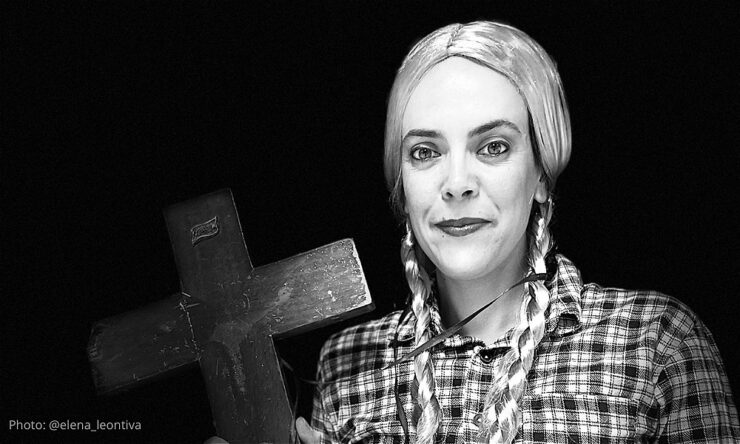
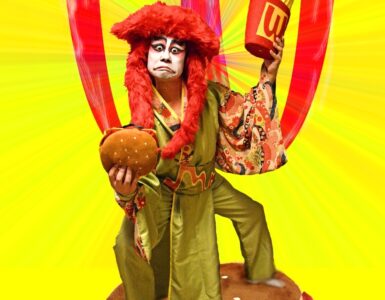
Bombastic ukulele and a painful laugh pierce the cellar of Café Club Míšenská. (W)holy Helga in procession sings Amazing Grace, presumably to save a wretch like me. So starts Nazaret Froufe’s grotesque and resplendent debut hour that I think might be the best Bouffon this Prague Fringe.
Bouffon, a key point of the late Phillipe Gaulier’s pedagogy, has been described by the master as ‘a crippled outcast […] chased into the swamps and ghettos by the children of God’. Necessarily blasphemous, the Bouffon begins from deformities and then distils them into a sometimes free–moving character, and one that is at the limits of our societal tolerances. To watch a Bouffon is not to sympathise as one might with a clown. When we laugh, it is out of sheer amazement at its excess. Froufe employs other forms and plays other games throughout her show, but it is the Bouffon she keeps coming back to, and it is a brilliant one. Helga is a cruel, sympathetic, painful, illuminating creation. She ogles the crowd with naïve hope; she desperately wants us to be saved. And she is relentlessly corrupted, dirtied, drags herself down to the depths of earth.
Froufe gives the impression she could carry this performance no matter what conditions she was given. Her work with the public is smart and imaginative, and her mastery of the game between public and performer means she can make us do outrageous things. Each element that occurs is unexpected… one audience member constructs the Shroud of Turin, another is asked to help a bouffon of the Virgin Mary give birth. It ends in a climax that I think is so audacious you just have to see it for yourself. This is the work of someone who has spent a lifetime forming in these arts, and to watch Froufe is a genuine pleasure, a great hour of your time.
Even in this early version, the material that Froufe has created here has a subversive brilliance to it. The show mimics a mass, making us stand up and sit down gratuitously, close our eyes and pray, observe Jesus at Mount Sinai, and give offerings. This would be clever if it was left at this – Froufe satirising the motions of Catholic mass, but it goes further than that. Not only does she begin with this lampooning but she makes key theological decisions that are prescient and make her commentary more biting. Her interpretation of Christ is too obsessed with his own image, but he values family, and he instructs us to tell each other ‘I love you’, ‘peace be with you’. Helga herself is corrupted by the American dollar, which she finds in the offering bag, and then the show turns into an outrageous striptease, an indulgence of earthly sin taken to a grotesque end. This is, then, theologically bold work that uses the mechanisms of theatre to confront us with the hypocrisy or excess of our religion or non-religion, thus reconsidering our relationship to the divine and the profane in our lives.
The show ends on such climax at the moment. There is more to explore. Froufe has crafted a character that needs further life, further development. Such a character won’t always add material to her show, indeed, fringe shows are often worth cutting. But what we have here is the formation of a bouffon that consists clearly of much work. It is an excellent hour with an excellent performer, recommended to any Prague Fringe goer itching for the bonkers and the sacrilegious.
Recommended Drink: (W)holy Coca Cola in a glass for the communion wine.
You can catch (W)holy Helga at Prague Fringe one last time this Saturday 30th May from 20:15 at Café Club Míšenská. Tickets are available through the Prague Fringe Online Box Office.
 Shay Mace