
 Madeleine Martin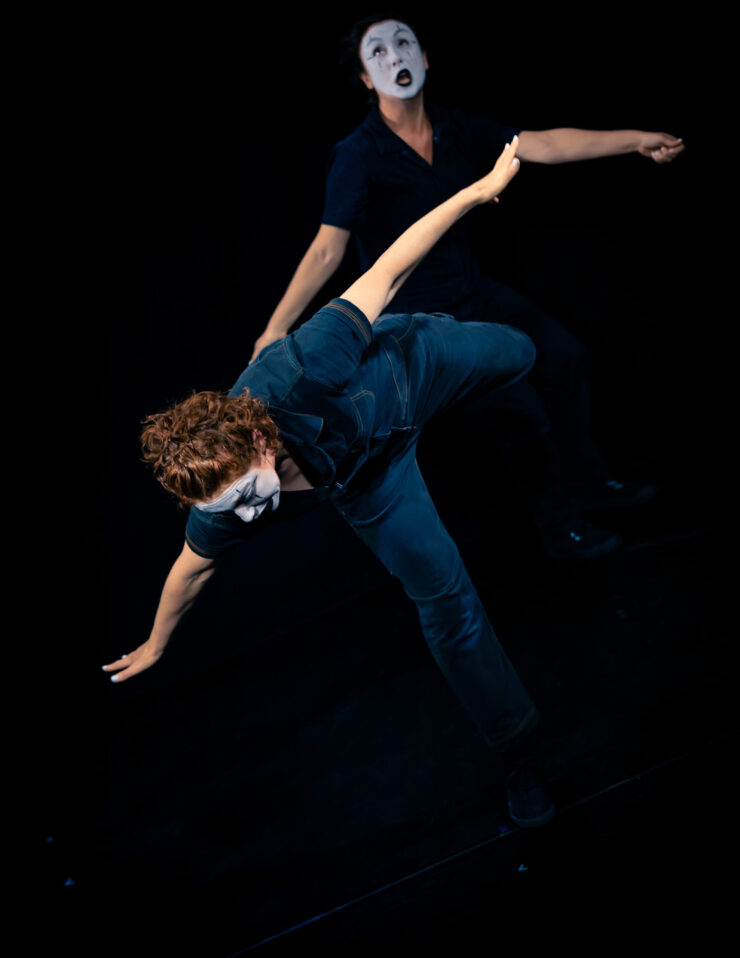
Broken Box Mime Theater and Dutch Kills Theater Company return to Adelaide Fringe in 2026 with Double Take, a non-verbal physical theatre work told through mime, hand puppetry and a series of short, wordless scenes. Made up of eight brief stories, moving from the minutiae of the everyday to the first moments of the universe, the show relies entirely on movement, sound and imagination to invite audiences to look closer and reconsider the ordinary.
We caught up with Becky Baumwoll and Tasha Milkman, Broken Box’s Artistic Director and Associate Artistic Director, respectively, over a digital pint to talk about co-creation, closer looks, and inviting audiences to lean in and participate imaginatively.
Catch Double Take at The Ballroom at Ayers House, from February 20 – March 6, various times. Tickets are available through the Adelaide Fringe Online Box Office.
Madeleine: For audiences encountering Double Take for the first time, how do you usually describe the show?
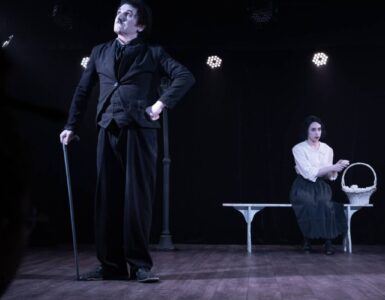
Becky: Double Take is a collection of eight mini-plays, all performed by just two people, the brilliant Kristin McCarthy Parker and Julia Cavagna, on an empty stage and without a single prop or spoken word. Through the mimes alone, the audience is transported to a rainy street corner in 1950, to a high end shoe store from hell, to a verdant forest floor, thanks to the graceful enlistment of their own imagination. It will be a wonderful celebration of Mime, and also a completely fresh take on the art form through the voices of contemporary theatre artists.
In addition to all being told in Broken Box’s signature style of contemporary mime that is set to a heart-thumping soundtrack by collaborating musician wet hands, what ties the stories together is the concept of a “double take.” What makes us lean in? When do we gasp with delight? How does it feel to not believe our eyes? The show is essentially a tour of “closer looks,” and each story takes a new riff on this concept.
Madeleine: The show relies entirely on physical theatre, hand puppetry and mime. What does working without words allow you to do differently as storytellers?
Tasha: We get to collaborate with the audience! When we leave empty spaces (words, props, costumes, sets, etc), we are leaving room for the audience to fill in the blanks. It creates a fantastic atmosphere of co-creation. When folks chat with us after the show, they often describe being more emotionally connected to the story than they had expected, or want to go into detail about what they saw. Mime invites audiences to engage with the show using the full power of their imagination. Each person’s experience is personalised – they are infusing the story with their own ideas, projections, colours, and associations. It’s a joy to write in this medium, especially when the stories are absurd, or political, or joyful, or cinematic.
We also love the magic and storytelling scale that is possible in Mime. Because we are working with the audience’s imagination as our primary medium, our imagery can change at the speed of thought. Characters can zoom backwards in time, or jump to a memory. An office can fill slowly with water, dinosaurs can disappear in a flash of meteor impact, or a mother and daughter can reflect on the past on a sunny afternoon. This medium is infinitely malleable – after the show people often say, “I didn’t know that mime could do that!”
Madeleine: Double Take is made up of eight short, wordless stories. What connects these moments, and how did you decide which stories belonged together?
Becky: For Double Take, we were interested in the magic of minutia. A literal “double take” is looking twice – something you witness quickly and then realise you need to take another look. The show riffs on this idea throughout in two ways: 1. Each story is a different interpretation of a double take, and 2. There are images or moments that mirror one another throughout the setlist. An umbrella might show up in a few different places, or you’ll see a character witnessing their own reflection in very different contexts, etc..
Tasha: Exactly. And from that common place, each piece has a unique tone, and we like to consider the audience’s experiential journey when we’re building our setlist. Some of the pieces are laugh-out-loud funny, and some invite contemplation, some often bring up strong emotions. We place them in an order that we think lifts each story, and invites the audience to draw connections. We also include what we call “palate cleansers,” which are shorter images that are not as narratively driven as the other pieces. When the audience is doing so much work to imagine each world, we put a lot of care into crafting their journey and giving them time to refresh their minds, like the taste of lemon sorbet between courses.
Madeleine: Talk us through the atmospheric soundtrack and how it shapes the world of the show.
Tasha: We have been working with our resident musician Jack McGuire since 2019. Known in the music world as wet hands, Jack worked closely on this show, composing original music and pairing some of his existing tracks with our new work. We use music to bring tone and atmosphere to our pieces, with each story having its own unique sound. Jack comes to rehearsals with us, and he’s deeply connected to our work, often performing live with us. We believe that long-term artistic relationships are powerful, and find richer meaning in our work together as time goes on. We sometimes write a story inspired by music, and sometimes the music comes in later in the process.
In terms of the role of music, it’s important to us that the music never tells the story, or veers into a sound effect. For example, a sound effect might be a phone ringing to startle the characters on stage, a thunder clap to indicate a storm coming, or the sound of crickets singing to evoke a summer evening. We choose to avoid sound effects for two reasons: 1. We like the challenge of telling the story using movement alone, centring the body as a holistic storyteller, and 2. We are proud that our work is accessible to hearing and Deaf audiences alike. Without relying on sound to tell the story, we can share an untranslated theatrical experience among people who have hearing differences or speak different languages.
Madeleine: How has Double Take evolved since its premiere? And what does returning to Adelaide Fringe mean for this work?
Tasha: Double Take’s first draft premiered as we were just emerging from the pandemic in NYC. Since then, it’s been performed in Adelaide, NYC, and Edinburgh. Each time we’ve presented it, we discover new things about it. It’s changed a lot since we were last in Adelaide! In addition to a brand new cast who interprets the roles uniquely, we’ve changed the order of our setlist, swapped out some stories, and adjusted the internal flow, transitions, and palate cleansers. We think it’s the best it’s ever been, and we can’t wait to share it!
Becky: More context about us! Double Take is an original work drawn from the extensive repertoire of Broken Box Mime Theater, which is composed of 20 company members. We’ve been working together for 15 years, and most of our work is performed with a cast of 5 or more. Putting together this intimate work for a duo has been a special opportunity to investigate how much we can discover between two people. Double Take has now been performed by six of our company members, in three distinct casts. Each version is completely unique to the performers who are embodying it – we have a dream of putting it up with a rotating cast so audiences can come back and see a different version each night! Stay tuned…
Madeleine: What, if anything, are you hoping the audience at Adelaide Fringe might take away from the experience of Double Take?
Tasha: We hope audiences come away with a reinvigorated connection to their own imagination. It’s a profoundly human thing to be able to imagine, and we are all skilled in doing so, even when we feel out of practice. Kids are very connected to their own creativity, and adults are too often pulled away from this power source. Our show invites you to play.
Becky: We also hope audiences leave feeling a sense of limitless possibility! When Kristin and Julia meet at the top of the show, there are multitudes of possibilities between them that we then explore over the course of the hour, one billion little worlds that can and do and could and will exist. They become masters of creation, and lovers, and family, and enemies, and friends, and a snail with its reflection. When something catches your eye, are you seeing a glimmer of one of those billions of worlds? How exciting!
Madeleine: Given the themes of Binge Fringe, if your show was a beverage of any kind – alcoholic, non-alcoholic, be as creative as you like! – what would it be and why?
Tasha: A fizzy cocktail, of course. Something fun and fresh, easy and inviting. You can pronounce all the ingredients. It’s a little bit sweet, with a spicy kick, and a zing of salt on the rim. It’s designed for adults, but we’re happy to invite kids to share in a non-alcoholic version, especially if a grown-up is there to explain some of its complexities. A flavour you had forgotten but when it hits your tongue it transports you instantly to another time and place…
Once again, catch Double Take at Adelaide Fringe 2026 at The Ballroom at Ayers House, from February 20 – March 6, various times. Tickets are available through the Adelaide Fringe Online Box Office.
 Salvador Kent
 Shay Mace
 Lamesha Ruddock