









 Shay Mace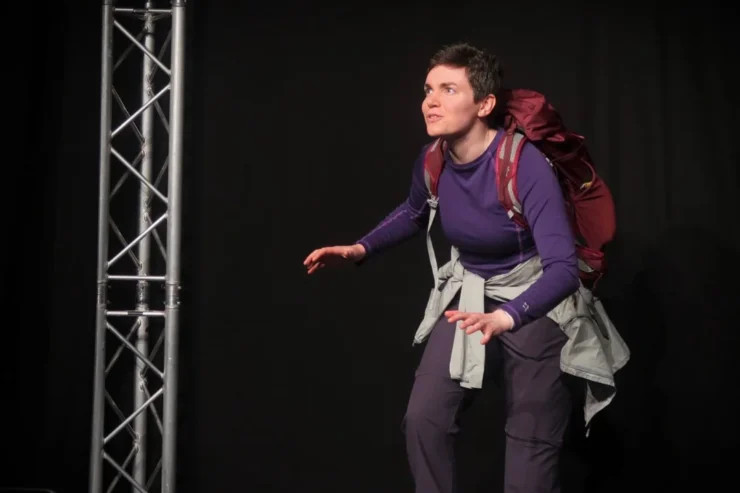
Embraced by the peaks of Cairngorms, hillwalker Skye finds herself at a crossroads both in her life and her day. Cath Barrett’s script offers a charming, wide-eyed love-letter to the healing properties of rambling, in balance with an introspective interrogation of hustle culture that puts big ideas in personable focus. Coasting through life and meeting the expectations, Skye finds herself in a marketing job where the pressure to perform and workplace bullying provide unrelenting pressure. Finding kinship with the mountains, themselves of course formed under immense pressure, she sets out on a walk to unwind the uncertainties in her life, and ask her dearest friend the big questions she’s been hiding from.
Barrett’s sentimental script loops the literary past of 20th century Doric writer Nan Shepherd with the tribulations of modernity skilfully. The literal and figurative trails ahead of Skye offer both solace and challenge, yet there is an overbearing sense of fondness for the refuge and respite that taking to the hills can offer us. Barrett doesn’t look to tribulate office politics, instead taking a vivid snapshot of how the strains of living fast can take the deepest toll on our mental wellbeing and approach to those around us. It’s a big undertaking for a small show, yet Barrett approaches it with a candid and life-affirming tenacity.
Sarah Rose Graber offers encompassing direction, that makes fruitful use of the little space afforded in The Little Theatre’s Paint Room (the rest of the year, quite literally a paint cupboard). A stool becomes an object that is used to make Skye appear both big and small – big as she marauds across the glen, small as she is made to feel by the intimidation from her oppressive boss. While at points the size of the stage does limit Barrett’s movement, the duo manage to overcome it with refined storytelling, and a coherent story that manages to wind into pathos in its closing moments.
The emotive elements of the piece find their feet in the latter act, though threads surrounding Skye’s father and Shepherd do not neatly resolve. While the analysis of hustle culture that is deployed could go further, the emphasis in Barrett’s writing is Skye’s lived experience rather than a broader critique of late-stage capitalism. It’s powerful to see Skye still swirling in the mess of her life, yet stoically unyielding to the elements she cannot control, and finding comfort and consolation in the natural world. There’s a great reverence for how Scotland’s outdoors can provide space for reflection, that is rooted in a sensibility asking us not only to stop and breathe, but to consider what alternative forms of being in the modern world that outdoor space can offer.
Where we find expanse and adventure, we also find crumbs of ourselves, and the people that form us. The humming natural backdrop of My Friend, The Mountain is not simply an absent character, but an impetus for reflection, revelation, and remembrance. Skye lingers in its embrace, and asks us all to consider whether life is better taken just one step at a time.
Recommended Drink: A neat sip of whisky from your hip flask as you reach the trig point for the first time.
Performances of My Friend, The Mountain have now concluded at Dundee Fringe 2026.
 Chris Brannick

 Pamela Banchetti