





 Ellen Leslie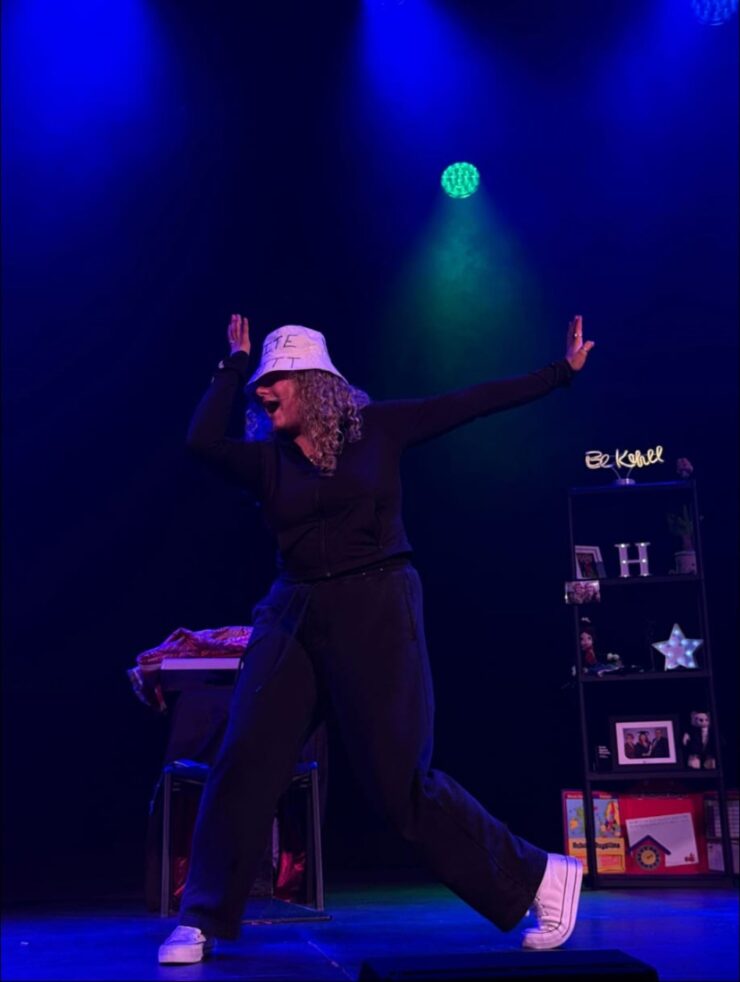
Written and performed by Hannah Rose Curtis, My Beautiful Brain! is a fast-paced autobiographical play, following Hannah, a young woman with dyslexia. After spending her childhood constantly losing things, messing up her lefts and rights, and falling behind her peers in school, she is diagnosed with dyslexia, a learning difference that can affect executive function, literacy skills, and information processing.
Equal parts funny, emotional, and inspiring, the play documents Hannah’s journey through education, including funny moments in classes, and heartfelt moments where she discovers her journey. She also discusses her personal feelings towards the condition, praying that she wouldn’t be diagnosed with dyslexia. She hates how it focuses on her weaknesses and not her strengths: people with dyslexia have wonderfully creative brains, for example, and are often excellent problem solvers. Hannah shows that dyslexia does not prevent people from achieving their dreams. She has worked extremely hard to get to where she is, and her tenacity is inspiring.
Curtis describes being whisked away from her peers during maths and English to work in a shed, which she calls the “Dumb Room”. She doesn’t actually learn much here, and most of her hard work is done at home, with her family members helping her to find study methods that work for her. The “Dumb Room” moves with her through education: first a shed at primary school, then her laptop as she starts to write her university essays, and finally, her office at work. It’s a powerful metaphor, emphasising how negative words can have a long-lasting impact.
In addition, the show inspires non-dyslexic people to work harder to ensure that dyslexic people are included and supported. Hannah tells a story about a casting director who knew she was dyslexic, so gave her extra time to prepare for a read through, and printed her script on green paper (it can ease visual stress, and make it easier for some people with dyslexia to follow lines of text). Seeing how this small adaption makes things much easier for Hannah is striking, and will hopefully inspire people to consider how they can make things easier for people with dyslexia, and other disabilities.
The show is so much fun, and Curtis is absolutely made to perform on stage. She is a brilliant storyteller, and she keeps the audience engaged for the whole performance. Her character work is excellent, and she morphs seamlessly into the evil Mrs Kay, an overly enthusiastic school counsellor, and her laid-back singing teacher. While I normally hate audience interaction, it works well in this show, and Curtis adapts well to the crowd.
Although she was pulled out of class to work on spelling while her peers learned how to be authors, and bullied at drama school because she couldn’t read sheet music, this wonderful show clearly proves the naysayers wrong. Curtis is such an energetic, likeable performer, and when you combine this with a compelling and educating story and a singalong to Dolly Parton’s 9 to 5, you have a winning show. My Beautiful Brain! is a hidden gem at this year’s Fringe, and I’d urge everyone to see it. You’ll laugh, you’ll cry, and you’ll leave the theatre feeling enlightened about the realities of dyslexia.
Recommended Drink: either join Hannah for a glass of wine, or her mum for a cup of tea.
Performances of My Beautiful Brain! have concluded at EdFringe 2026.
 Shay Mace
 Salvador Kent
 Mary Kennedy