
 Em Tambree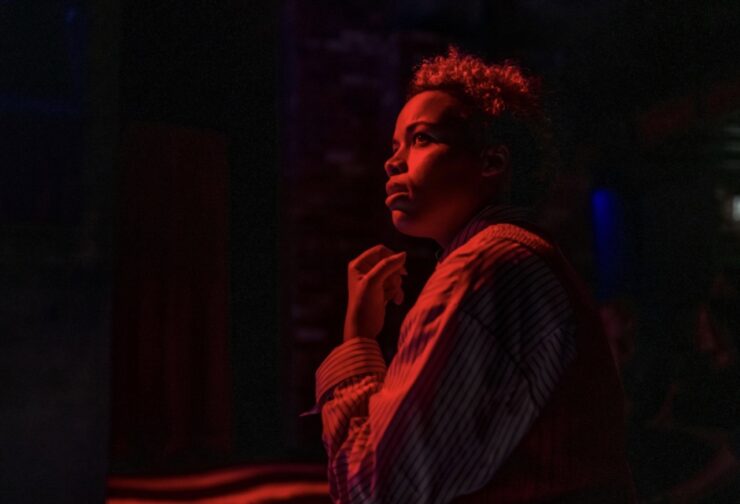
Everything is content now, isn’t it? Storytelling is in the hands of anyone and everyone, as our society slowly creeps towards a global social media surveillance state. It begs the question: who gets to capture our lives and decide when they become public property?
Malaika Kegode’s Badgers interrogates the ethics of our consumption. Blending spoken-word, live music, radio play, myth and theatre, this rural folk thriller is playful, poetic, and ahead of its time. Led by a radiant performance by Kegode herself, it is an ambitious new work whose theatrical premiere has anticipatory room to grow around its exceptional script and wynorrific composition.
In this arts landscape? Commissioning an original play is a cutting-edge act of cultural courage. Theatre Royal Plymouth’s investment in Kegode, supported by Bristol Old Vic, is worthy of celebration and essential to our artistic ecology.
New playwrights cannot become established playwrights without institutions willing to invest money, time, and trust in their imaginations. Badgers proves why that investment is necessary. It gives locally rooted artists the ability, resources, and platform to create something meaningful that is genuinely adventurous.
Our adventure begins with Meles. Meles is a seemingly insignificant podcaster who unearths a disappearance in her hometown tied to a mysterious folk song. This is a story that could change everything for her and finally turn her lackluster career into something worthy of her mother’s legacy.
As her investigation deepens, reality, folklore and her recordings bleed into one another. The revelation that Meles isn’t a reliable narrator is a particularly enjoyable one. Meles’ obsessive cataloguing of her life asks us again and again: does capturing another person honour them or merely transform their life into material?
Kegode undertakes the script’s epic, near-continuous monologue with warmth and charisma. Her crisp enunciation, fluid movement and instinctive rhythm give the language an ancient musicality, shifting effortlessly between poetry and the intimacy of a campfire story.
The surrounding vocal performances feel equally at home within this world of true crime podcasting, while Jakabol and Kirkbride’s composition, particularly the beautiful cello, dramaturgically embeds the rich musical traditions of folk throughout the piece.
The production establishes Meles’s professional world through a recording studio positioned across the front of the stage. It is an immediately readable image, although the booth occupies much of the available depth and restricts Kegode’s physical possibilities. She uses the remaining space with impressive control, but the script’s reality-bending magical realism leaves me with an appetite for more.
Allowing Meles and her microphone to travel throughout the room, with the live musicians, by permitting the studio itself to become mobile and makeshift, could invite more of the story’s inherent wildness onto the stage, or even beyond its conventional playing space. By combining multiple mediums, genres and forms, the script has a thrilling opportunity to embrace, reject or completely reinvent the conventions of traditional theatre across every element of the production.
Jack Drewry’s sound design is in turn an impressive feat that deserves greater gravitas within the production. Likewise the small screens surrounding the studio make the recording landscape feel peripheral when it could have brought the audience into the action with further thought.
Given that this is the work’s first presentation, I am excited to see how these possibilities might evolve throughout its future life. Glimpses of its potential for magic already appear in the BBC-style voice manipulations, effective jump scares, and exceptionally strong videographic language throughout by Christopher Harrisson. Lighting effects across the floor hint at the horror stylings alive within Kegode’s writing, culminating in a luminous and profoundly affecting finale.
That finale brings the work’s ideas beautifully full circle. By sharing the act of creation, Meles transforms recording from a tool of consumption into a modern ritual of oral tradition: song becoming story, story becoming memory, and memory becoming remembrance.
Refreshingly bold, wonderfully strange and wistfully poignant, Badgers asks not only who gets to share their story, but whether loving someone means knowing when a story doesn’t need to be told. Some moments are yours and yours alone.
Recommended Drink: The Black Forest Iced Chocolate at Maison Brew. Rich chocolate, decadent cherries as red as blood, and homemade vanilla cold foam create something as luscious as treating yourself to a bit of cold case whimsy before lunchtime.
You can catch Badgers at Traverse Theatre (Traverse 2) from August 13-30 at Various Times (70mins). Tickets are available through the EdFringe Box Office.
 Ellen Leslie
 Tom Clayton