






 Madeleine Martin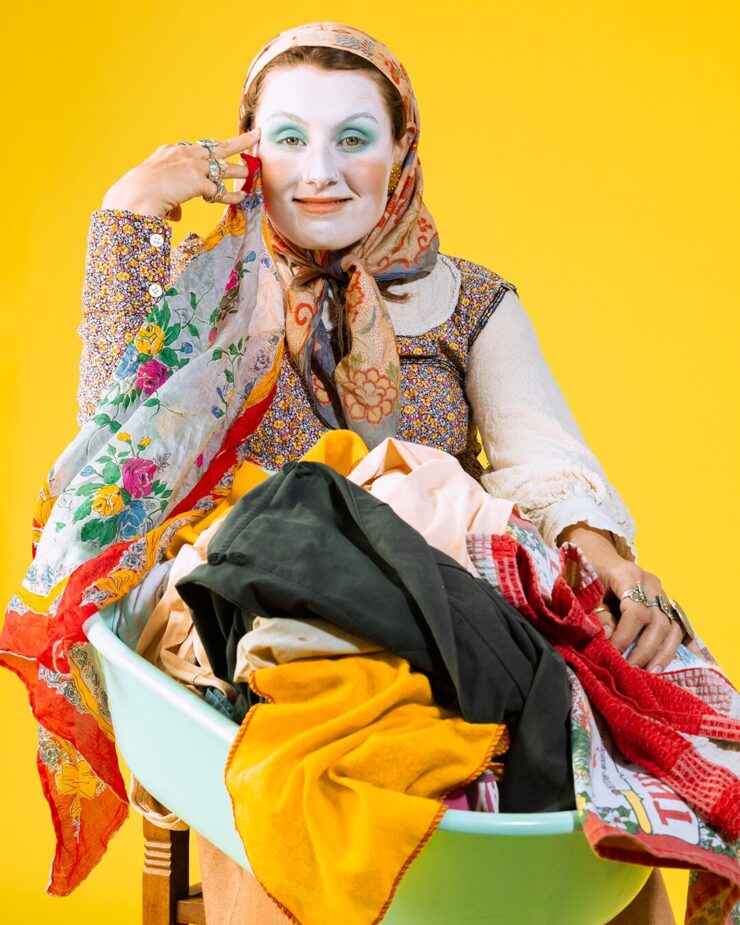
Ozzy Algar makes their Australian Fringe debut with Speed Queen, a darkly comic, solo character show set inside the last launderette on the Isle of Wight. The show is told through the character of Pet, an ancient washerwoman who divines her customers’ fates through dirty laundry. We caught up with Algar over a pixelated pint to talk about crones and hags, place and histories, and how contemporary folklores can shape cultural identity today.
Catch Speed Queen at Adelaide Fringe at The Chapel at The Courtyard of Curiosities at The Migration Museum, from March 10–22, at 7:50pm. Tickets are available through the Adelaide Fringe Online Box Office.
Madeleine: Hi Ozzy! For readers encountering Speed Queen for the first time, would you usually describe the show?
Ozzy: Speed Queen is an hour of dark character comedy and storytelling. We spend an hour in a decaying laundromat with an eerie yet familiar washerwoman, Pet from the Laundrette, as she tells us about the dirty laundry and faded glamour of a once booming seaside community. It’s got cabaret tunes as well as biting, sometimes morbid, tales of past and future.
Set on the Isle of Wight, an Island off the south coast of England, the show has been compared to the League of Gentlemen for its world of strange, small Englishness, and the iconic cult documentary Grey Gardens for its eccentric, theatrical old woman. There’s a bit of a Luna Park vibe in there too, of ghosts in a long ago closed down theme park.
Madeleine: The character of Pet feels at once, ancient, and yet completely of the present. How did this character first take shape?
Ozzy: I <3 Crones and Hags. I think Crones and Hags are the best character archetype, and always the most fun part of any story. It was exciting to me to make the whole story centred around this type of person.
She started with the costume, and some bits of pieces I’d written way back in 2019. Then the show’s incredible director, Tanika Lay-Meachen, and I worked on getting Pet up on her feet. The more I did it the more I realised there was a bit of my Grannie in the character, though it wasn’t what I set out to do. She’s kind of scrapped together from a lot of different places.
Madeleine: What is your relationship to the Isle of Wight, and how did it inform the world of the show, and your practice in general?
Ozzy: My mum’s mum was from Cowes in the North of the Isle of Wight, and my dad’s family retired to Niton in the South. My parents both spent many summers there growing up, as did my siblings and I. It occupies a very special, hazy place in my memory as childhood holiday destinations often do. It’s a place of hot summers on the south coast of the Island in Ventnor and Steephill (a subtropical region with fantastic beaches) of strange theme parks and animatronic attractions falling into the English channel. There was a smuggler’s museum below a car park where the Tuberculosis hospital once stood. A seaman’s museum run by Sophie Blake and her family on the seafront, Sophie who was born in that very room, and her family still rent the deckchairs and beach huts even now. The pirate-themed Spyglass Inn on the foreshore with a real human skeleton in a glass case. A garlic farm, a poo museum, Queen Victoria’s holiday palace and attractions like the Winter Gardens that had its last hurrah when Bowie and the Who played there in the 60’s, are all still there.
An island makes for a good setting because it is limited in terms of space. The land is a present character in my writing, because it grounds any stories real or fictional, sort of like how present the land is in Picnic at Hanging Rock. Essentially it’s a weird, nostalgic, gorgeous, isolated place and I love it.
Madeleine: The launderette is such a specific setting. What drew you to that space as the centre of the work?
Ozzy: In 2019, I used to visit this one Launderette in Bristol when I lived there in a teeny bedsit with no washing machine. It was very calming to be there. There was a woman who worked there behind a hatch giving out change. One day, she wasn’t there, and the shutter was down on the hatch with a note pinned to it that said she wouldn’t be returning to her duties, and asking us to “stay safe”. She signed it “Pet” and it all was really mysterious and compelling.
And again, having a limited space, but one that all sorts of people come through, gave good boundaries for storytelling. All the people I want to know are in a laundromat at one point or another.
Madeleine: You’re a folklore researcher as well as a performer. How did folk traditions influence the structure or tone of the show?
Ozzy: Folk stories always toe the line between tragedy and comedy and that is what makes them feel so honest to me, and I think part of why they endure. Many writers have said, the structure and characters of these stories have stuck around because they speak to something deep and human in us. I wanted to work with these stories, or at least story structures because of that.
I researched folk stories from the Isle of Wight to write the show. When they heard about the show, someone from the Island said to me “But the Isle of Wight has no folk stories.” But there are always folk stories, or gossip of local legend and myths anywhere you go! There’s even a Pied Piper story from the Isle of Wight that predates the one we think of as traditional. Gossip is folklore in action!
Madeleine: How do you think folklore might help us talk about contemporary anxieties?
Ozzy: I think a major contemporary anxiety is how we talk about Englishness, and what nationhood is when you are a citizen of a colonial nation. I’ve recently seen this same anxiety in Australia, as I was here on January 26th, Invasion Day. How do we talk about our history in terms of our lives now? What is Englishness (or Australianness)? Colonisation has flattened culture both violently in colonies and quietly in England in favour of uniting around Whiteness, Christian Nationalism and “Empire”. It is the English who have endangered our own culture by forcing an image of our Culture on those we colonised. We are seeing these attitudes play out across the world right now, including in the USA under Trump’s regime.
I think for English and British people, folklore gives us an idea of Englishness and Britishness to meet at. One that isn’t reliant on crusaders and conquerors and empires to unite us. As folklorist and artist Lucy J Wright (@lucy_j_wright) put it in a recent post, “The English don’t have any culture but we have so many cultural artifacts we scarcely even notice them anymore. Some of them aren’t even stolen.” Lucy argues for a “folklore of the present”. It is the need to recognise the value of our folk stories and traditions alongside stories of all the cultures that live in Britain today. A new folk culture to unite around, without using it to whitewash over the violence Britain has perpetuated. Things like local folklore from the land, but also modern myth making too. Like the England women’s football team the Lionesses, Kneecap’s call from Ireland to wake British people up to the ongoing colonisation there, even down to the rituals of travelling on the tube. To me this is where a modern folk culture can help us begin to work through these anxieties.
Madeleine: Speed Queen had a strong reception at Edinburgh Fringe. How does it feel bringing the show to Adelaide Fringe for its Australian debut?
Ozzy: I couldn’t have imagined I’d be doing this a year ago, I need to let myself take in how exciting this all is! I’m in Australia! My name is Ozzy! What the hell is going on!
Dear Aus, I hope you enjoy it! Please forgive me for being so English and come and see my comedy show. Love, Oz
I want to say a huge thank you to BIGHEAD comedy, in particular Charlie Ralph, and the Courtyard of Curiosities for making it possible. THANK YOU.
Madeleine: Given the themes of Binge Fringe, if your show was a beverage of any kind – alcoholic, non-alcoholic, be as creative as you like! – what would it be and why?
Ozzy: It simply would be gin. Mother’s Ruin.
Once again, catch Ozzy Algar in their Australian debut Speed Queen at Adelaide Fringe at The Chapel at The Courtyard of Curiosities at The Migration Museum, from March 10–22, at 7:50pm. Tickets are available through the Adelaide Fringe Online Box Office.

 Magalie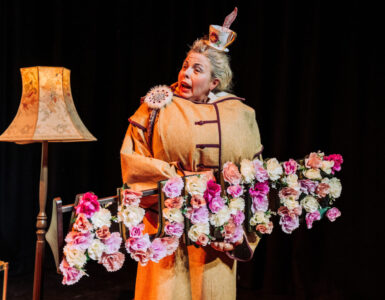
 Jake Mace