
 Elisabeth Flett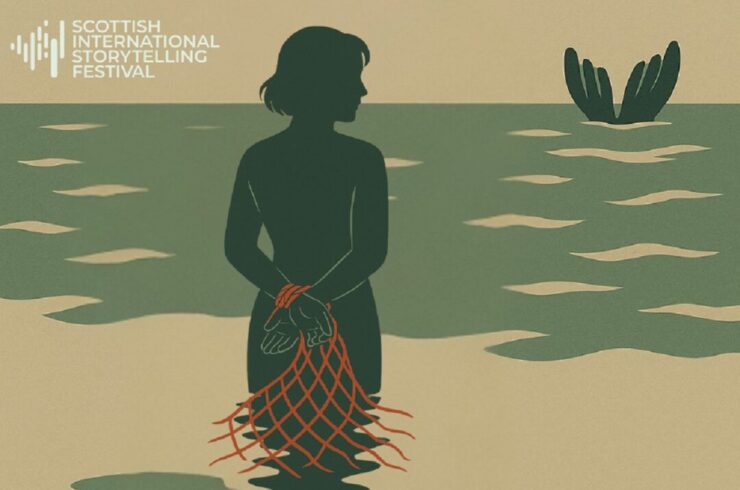

Lost to the Sea, Lost to the World is a showcase of two storytelling performances by Tania Allan and Craig McCulloch. Weaving together Selkie myths and Deaf history, these tales explore themes of oppression, abuse, environmental destruction and cultural erasure. Performed in British Sign Language with spoken English interpretation, these two performances were also followed by a short panel discussion at this reviewed SISF event in which the themes of sign language deprivation, climate crisis and the continued legacy of erased Deaf culture were discussed.
Two storytellers welcome the audience as we file into the Scottish Storytelling Centre’s Netherbow Theatre: Tania Allan, seated left, and Craig McCulloch, seated to the right. An empty chair draped in a tartan blanket and a projection screen showing rippling waves on the back curtains of the performance space take centre stage, giving a feel of expectant anticipation: we’re all about to step into another world. We are introduced to these two storytellers, and to the spoken English language interpreter who will be translating both BSL performances in real time from the front row for hearing members of the audience. Then the stage lights change to a wash of watery blue, the image on the projection screen turns to a watercolour painting of a fisherman and his boat, and Allan’s story begins.
Lost to the Sea is a retelling of the well-known Scottish Selkie Wife story. Usually it goes something like… A fisherman stumbles across a beautiful woman walking along the beach, and realises that a discarded seal coat at his feet is hers: she is one of the sea folk who can become a seal in the waves and a human on land. Being lonely, he then steals that coat and hides it so the woman cannot change back and return to the sea, then persuades her- or violently ‘persuades’ her, depending on the version – to come back to his house with him, marry him, and usually also bear him children. Eventually the woman finds his hiding place, reclaims her seal skin and – surprise, surprise – wastes absolutely no time in getting out of there as fast as possible and escaping back into the watery depths. Allan’s version of the tale covers many of these familiar plot points, but there are plenty of interesting changes too.
This fisherman lives on a lighthouse with his cute dog rather than in a generic cottage, and whilst his livelihood remains the same this 2025 fisherman is struggling with very realistic, modern problems brought on by late-stage capitalism and corporate greed. No matter how many catches he manages to haul in, it’s never enough. It’s a hard life. It’s getting harder. What could be better than to unexpectedly find a woman tangled in his fishing nets, one who’s willing to help out around the lighthouse and keep him company as he struggles to make a living in this world of overfished seas and underpaid long hours? Allan is a talented storyteller, and she tells this tale with a expressive, humorous energy which takes the audience along with her right to the inevitable end of the tale. (Thankfully, in this version the fisherman is ultimately able to admit that he might have been in the wrong when he stole the coat in the first place.)
There are many different inspirations to this piece, from the climate crisis – the selkie people hunt for ever decreasing fish in-amongst damaged coral – to language differences, but these multiple ways to read into Lost to the Sea add to the piece rather than detract from it, and this performance is a welcome addition to the Selkie Wife ‘tale-type’ catalogue.
Lost to the World is part performance, part informative talk, with Craig McCulloch’s passion for this subject shining throughout. Accompanied by a backdrop of bittersweet hand-drawn illustrations – a drawing of upset Deaf children with their hands bound together by red cord, unable to communicate with one another and facing a school teacher’s wrath, is particularly sobering – McCulloch discusses the rich history of Deaf signing and how hearing academics tried their best to destroy signing as a language altogether.
Taking us back to the 1880 Milan Conference where it was decided that ‘oral language’ was ‘uncontestedly superior’ to signing and that signing should therefore be banned in schools across Europe and the United States, Lost to the World speaks out about the unjust prejudice faced by the Deaf community for over a century, and celebrates the resilience and beauty of Deaf culture in the face of language deprivation, lost intergenerational connection and continuing lack of support and societal understanding (the UK Government, for instance, didn’t acknowledge BSL as an official language until 2003 and there are still widespread systemic injustices and issues faced by BSL users today).
The fallout of that cruel 1880 policy decision is still being felt in 2025, and work like Lost to the World highlights historic wrongs whilst asking us what is needed as we work towards a better future.
Lost to the Sea, Lost to the World is a powerful hour of storytelling at its most vitally relevant. McColloch describes the history of signing as, ‘a fire, catching and passing on stories to be told to the next generation.’
With work like this being made, I think that next generation is in good hands.
Performances of Lost to the Sea, Lost to the World have now concluded at the Scottish International Storytelling Festival 2025.
 Shay Mace
 Roe McDonnell
 Noe Productions