



 Sarah Kher-Bek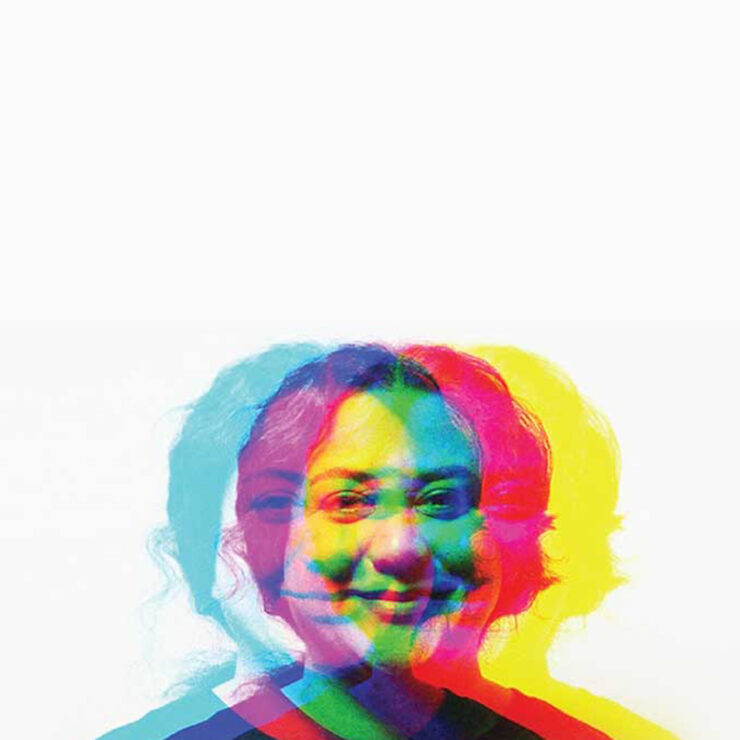
There is an exhausting amount of administration involved in being yourself. Especially when the version required depends on who’s asking. And who’s watching.
For Sahra Davoudi, identity is a role requiring constant rehearsal. In Am I Who? x 2, she traces a lifetime of learning which parts of herself to reveal, conceal or edit beyond recognition. From the restrictions of Iran to the peculiar social choreography of Australia, Davoudi has become an expert in being whoever the room requires.
From acting out childhood fantasies to the increasingly complicated performances of adulthood, Davoudi finds humour in the absurdity of navigating a world determined to define her. Her humour is wonderfully dry, her expressive eyes often saying more than her words. Even in painful memories, she finds absurdity hiding in the corners.
In Iran, she and her friends turn restrictions into mischief, finding creative ways to outsmart the rules imposed upon them, cleverly hiding bottles of vodka under intentionally chosen conservative clothing. She’s equally irreverent about the promised afterlife. Seventy-two virgins for the men? “Even heaven has a pay gap.”
Beneath the laughter lies a sharper observation: a system that demands obedience while calling it freedom. It’s a peculiar kind of democracy that invites you to have a voice, then hands you a script.
At twenty-five, Davoudi arrives in Melbourne, only to discover Australia’s own collection of unwritten rules. Here, “How ya going?” isn’t really a question; “sorry” is a performance, and even her name becomes negotiable. She answers to its many mispronunciations because she needs her coffee, her appointment, her job. Or because she’s simply exhausted.
But the constant negotiation of identity extends beyond cultural misunderstandings. In one particularly unsettling recollection involving a boss who believed the distance between their bodies was smaller than it was, Davoudi reveals how the performance of keeping others comfortable can become a means of self-preservation. She became “very skilled at the performance of not noticing.”
Beside me, my best friend sighs at precisely the same moment I do. Neither of us needs the implications explained. Davoudi trusts us, or at least the women, to understand. And in that moment, her restraint speaks louder than any dramatic declaration could.
The production builds towards a performance she seems to have been rehearsing her entire life. An immigration interview where identity becomes something to be assessed, rehearsed and made acceptable. Years of lived experience must be compressed into answers that satisfy someone else’s expectations. She anxiously considers which version of herself might be accepted for the role of the perfect immigrant. It’s a compelling premise: a woman forced to audition for the right to belong.
Yet this is also where the production’s limitations become more apparent.
Davoudi is an assured and engaging storyteller, and her transitions between humour and vulnerability are seamless. But that very smoothness occasionally works against the material. The writing builds towards an emotional reckoning that the performance doesn’t quite deliver. The stakes are enormous, but their weight is not always felt.
There is an extraordinary amount of life compressed into forty minutes. The restrictions of one country, the unwritten rules of another, the negotiations of womanhood, migration and belonging. Davoudi’s writing is rich enough to sustain these ideas, and the production moves between them with considerable ease. Yet in trying to explore so much, the production sometimes sacrifices the emotional depth these experiences deserve.
Perhaps what is missing is not vulnerability, but the space to explore it. I found myself wondering whether these observations might be even more affecting on the page, where their complexity could unfold without the limitations of a forty-minute performance. There are moments when Davoudi’s words seem to be carrying more than the performance has found a way to hold. And that’s what makes the distance so frustrating: the writing gives us every reason to want to come closer.
And yet, I keep returning to the half-empty seats.
Here is a woman who spent years moulding herself into whatever character the world would listen to, finally standing before us with a story entirely her own. At a festival celebrating storytelling, I couldn’t help wondering which stories we’re actually turning up to hear, and which we consider worth witnessing. The empty seats cannot answer that question, but they certainly made me ask it. We seem to be remarkably enthusiastic about celebrating diverse voices. Apparently, listening to them is another matter.
Am I Who? x 2 is an intelligent, sharply observed exploration of identity and the exhausting labour of belonging. Its humour and writing are compelling, but its emotional potential is not always fully realised in performance. The material deserves a theatrical form that can carry the full weight of what Davoudi has to say, rather than simply trying to fit so much of her life into a single performance.
A woman who spent her life being cast by others has finally become the author of herself. A quiet revolution in a world that demanded her silence. She has spent a lifetime learning how to be seen. The least we can do is show up and look.
Recommended drink: A cheeky bottle of vodka, strategically hidden, and shared with a friend.
Performances of I Am Who? X 2 have now concluded at the Melbourne Fringe.


 Shay Mace