





 Madeleine Martin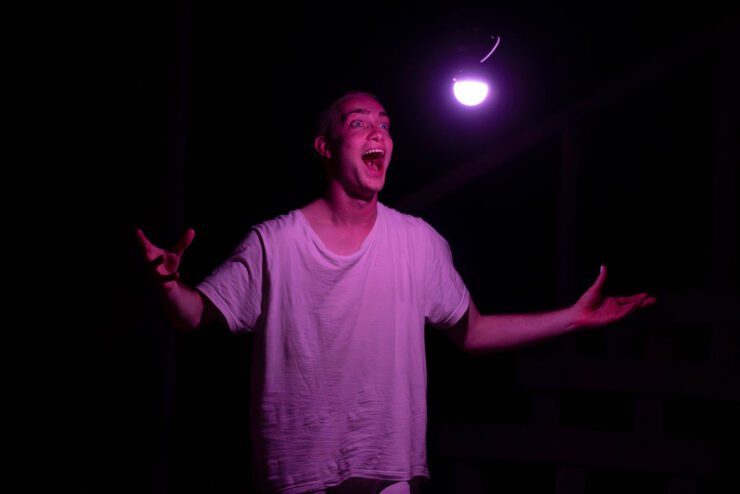
Developed in Aotearoa / New Zealand, Only Bones – Daniel Nodder comes to Adelaide Fringe in 2026 as the eleventh iteration of Thom Monckton’s Only Bones Project. Created under strict minimalist constraints, the work strips physical theatre back to the essentials, relying entirely on the body, rhythm and imagination to explore what becomes possible when theatre is reduced to its barest form.
We caught up with performer Daniel Nodder over a digital pint to talk about making work under strict limitations, cosmic storytelling and physical theatre, and heading across the ditch again after three years.
Catch Only Bones – Daniel Nodder at Adelaide Fringe at The Breakout at The Mill, from March 11–22, various times. Tickets are available through the Adelaide Fringe Online Box Office.
Madeleine: Hi Daniel! For readers encountering Only Bones for the first time, how would you describe the project?
Daniel: Kia ora Maddy! So, back in 2015, Thom Monckton (a fellow kiwi physical theatre artist) wanted to make a series of works that focussed on the use of physicality, and the unique way that each body moves and tells stories. He concocted a set of devising restrictions designed to push a performer’s skill and creativity to their limits and encourage them “not just think outside the box, but explore the space within it”. So, he made a show – the first iteration of the Only Bones Project – using the following rules: one performer, one light, no text, no set, no props and no narrative.
Today, this work has (technically) 11 different iterations, each created by a solo artist with distinct skillsets, approaches and performance styles, but all adhering to those rules. This has created a set of shows that align aesthetically but differ greatly in content. Each one has a beautiful spark of the performer’s personality, sense of humor and theatrical tendencies in it, which is really fascinating. Only Bones versions have been performed in over 25 countries to over 200,000 audience members over the years, with previous creators including Trygve Wakenshaw (NZ), Sampo Kurppa (FIN), Ella Bartilomo (AUS) and Marina Cherry (CA).
For me, the Only Bones Project is all about theatrical minimalism. It’s a beautifully simple, yet effective genre of theatre. It strips back all of the technological facades and often unnecessary complexity of modern theatre, and forces both audience and artist to focus on one thing – something we don’t get to do much nowadays.
Madeleine: You’re the eleventh performer to create a work for The Only Bones Project. What was that process like? And how does this show – Only Bones: Daniel Nodder – differ from previous iterations?
Daniel: Creating my version of Only Bones was truly an insane moment for me. I had been a fan of Thom’s work for years, especially his Only Bones version – it was the first show that I saw that made something click in my mind and made me go: “this is the kind of theatre I need to be making.” So when he invited me to make my own version, I probably almost passed out from excitement. I got to develop it with Thom in the room, which is not the case for lots of the other creators (I’m pretty sure Thom hasn’t even seen one or two of the shows), along with a group of my closest friends and collaborators. We basically locked ourselves in a dark rehearsal room with a light bulb for two weeks and tried to find every single thing we could do with it. We maybe went a little insane.
Coming into the devising process, I had this image in my head of a floating ball of light hovering above a person in a huge black abyss, almost as if they were floating alone in a vast, empty universe. So, like any science-nerd-turned-theatre-maker, I read a couple of sci-fi novels and “Quantum Physics for Dummies”-type non-fiction books as research, and arrived on day one with a bunch of ideas for scenes inspired by laws of physics, cosmological theories, chemical reactions and other space-themed stuff. So the show became this journey through the stars, following this weirdly omnipotent, curious clown-alien-creature, travelling through time & space across the universe. It’s very funny, intimate, a little grotesque at times, but ultimately a very joyful show. I shapeshift into various things – aliens, icebergs, dinosaurs, stars. I lose control of my arms, gravity disappears, David Attenborough is there for a bit. Once we got our composer Ben Kelly in to create a sci-fi jazz, synth-heavy score, it all came together as what we’ve started to call a “cosmic odyssey”.
Madeleine: The show operates under extreme limitations — one performer, one light, no words, no props. What drew you to working within such tight constraints?
Daniel: I think I have always liked theatre that is simple. I have loved mime and clown since I was a kid – Marcel Marceau, Charlie Chaplin, even Mr. Bean. They all create these whole worlds and tell these sprawling stories with nothing but their bodies and maybe a couple of little noises. That, to me, is pure magic. There’s a shared language in gesture, facial expression and nonverbal sound that can bridge so many gaps and reach so many people. Without language, flashy lights, crazy costumes or an ensemble of performers, we’re forced to boil down theatre to its most basic stuff, and focus (both as performer and as audience) in a way that other theatre doesn’t demand. That kind of engagement creates a really electric relationship between performer and audience – I think my own personal taste tends to steer away from live art with a fourth wall, anyway. I want to be there with people, in the room that we are in, experiencing whatever story we are telling together. That way, people feel like they’re part of something, and more connected to one-another.
Also, in a more boring sense, touring theatre is expensive. So why make productions that are difficult to take around? Why not instead make work that forces you to stay low-tech, and rely on your ingenuity and creativity instead of big production value. That being said, if any producers with deep pockets are reading this and want to fund my work, I’d love to graduate to shows with two or more lights at some point. Maybe not just yet, but at some point down the line.
Madeleine: Your piece moves from the Big Bang to the heat death of the universe — all without words. How did you approach telling such vast ideas through the body alone?
Daniel: I originally come from a street dance background – I kind of arrived at physical theatre by accident by way of improv comedy (sorry), so I have always loved using my body rather than words to tell stories. When we were devising, we did heaps of work to make sure that certain things read to an audience well, and explored how we could create certain images. I bent my body into every interesting shape I could find, and then figured out how we could weave it into the work. For instance, we once spent a whole day trying to find every mouth we could create with various bits of me: elbows, knees, fingers, neck fat, shoulder blades – you name it, we tried it (a couple of these ended up in the final show). We played with shadow, mime, body puppeteering, contortion, clown and I made a surprisingly large amount of weird mouth noises throughout. You can expect all of that in the show as well.
Our incredible production designer and technician, Rebekah de Roo, did a bunch of research into personifying set elements for her masters degree, so that came in super handy as well. She made the light-bulb a character in the show – it moves in and out of my reach (cheeky bugger), changes colour to set the scene, reacts to the soundscapes, and I puppeteer it sometimes. It’s kind of like an ever-present sidekick for our interstellar journey, which is a cool way to add story and character interaction into what could be a very lonely show. That, paired with the music and sound design, makes it a very full stage – even though I’m the only human standing on it.
Madeleine: What does it mean to bring this work to Adelaide Fringe for the first time?
Daniel: It feels absolutely amazing to be bringing the show to Adelaide for the first time! We have toured this work around Aotearoa pretty extensively for the last few years, so it is really special for us to be heading across the ditch to our neighbours!
We performed a less developed version of the show at Melbourne Fringe back in 2023, and met a bunch of artists from Adelaide who told us that we just HAD to take it to Adelaide Fringe. So, here we are, only three years later – I have since gone bald and attended clown school, so I (and no doubt the show) am in best form to have a great time at Adelaide Fringe.
Madeleine: What do you hope people notice — or feel — when the show ends?
Daniel: I want people not to notice how puffed I am at the end! Nah, I don’t know… I am always tentative about telling an audience how to feel, you know? We’ve had a huge range of responses – from emotional to joyous to tripped out to downright amazed at the physical moments in the show. I do like how the show makes people aware of their bodies! People start trying to recreate my weird movements, or will just randomly start showing me odd stuff they can do with their thumbs? So that’s cool?
I think the thing I really hope is that people feel like they experienced something together, and feel connected to one-another, and I hope that people feel a sense of calm in that. I think it can be hard to feel togetherness in the current shitstorm of a world, especially between strangers in a dark room. But if anything can help people feel a little less lonely in a vast, empty universe, it’s live theatre. So I hope that people can find a little bit of joy, laughter and beauty with me and our little light bulb.
Madeleine: Given the themes of Binge Fringe, if your show was a beverage of any kind – alcoholic, non-alcoholic, be as creative as you like! – what would it be and why?
Daniel: I think it would be a borderline-hallucenogenic shot of some glittering space-juice. Because it’s a real small show but it packs a punch and makes you feel like you might be floating outside your body a bit. But in a nice way? Like an instant-astral-projection shot? I’d buy that. Yum.
Once again, catch Only Bones – Daniel Nodder at Adelaide Fringe at The Breakout at The Mill, from March 11–22, various times. Tickets are available through the Adelaide Fringe Online Box Office.
 Padraig Bond
 Making Strange