

 Madeleine Martin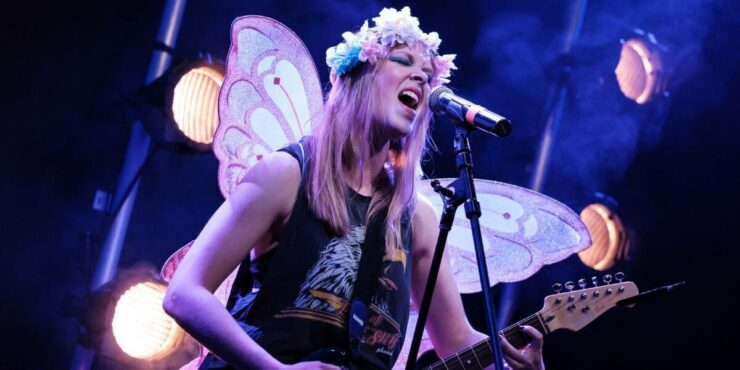
Lucy Heffernan returns to Adelaide Fringe in 2026 with her award-winning rock ’n’ roll monologue Party Girl. The show follows kids’ party entertainer Fairy Sprinkles, who is in a toxic cycle between performing for children in Sydney’s upper-class suburbs and supporting a parent during a mental health crisis. We caught up with Heffernan to talk about the creation of Sprinkles, using music as a storytelling tool, and returning to the show after touring internationally.
Catch Party Girl at Adelaide Fringe at The Gallery at The Courtyard of Curiosities at the Migration Museum, March 3-8, various times. Tickets are available through Adelaide Fringe Online Box Office.
Madeleine: Hi Lucy! For readers encountering Party Girl for the first time, how do you usually describe the show?
Lucy: Party Girl is a rock ‘n’ roll monologue created and performed Lucy Heffernan. The story is told by Fairy Sprinkles, a kid’s party fairy who, with her electric guitar in hand, sticks a middle finger up to traditional feminine behaviour. As she drives around the bougie suburbs of Sydney one disastrous party at a time (think face-painting fails and getting your period on the job), Fairy Sprinkles’ personal life implodes as her mum experiences a psychotic episode, and the line between what is real and what is fantasy is blurred. Featuring five original songs, Party Girl is a unique gig theatre experience; from feminist anthems to unicorn raps, this fairy is more Courtney Love than Tinkerbell. The show is brutal, funny, and heartbreaking, traversing themes of faith, family, mental health, and how to be rebel against being a ‘good’ fairy.
Madeleine: When did Fairy Sprinkles first show up?
Lucy: Sprinkles first showed up in 2019, when I first performed Party Girl in my hometown of Wollongong, NSW at MerrigongX. I was so inspired by Fleabag (duh) and wanted to write and perform in my own solo show. I’d worked as a fairy in Sydney for a short while and I’d accumulated so many stories, and the themes and imagery of the fairy world was such a rich landscape to start writing. There are rules to be a good fairy. No body hair, be gracious, be punctual. I had this idea of a fairy at a party breaking the rules in a catastrophic way… and Sprinkles was born. At first it was a straight monologue, but I was encouraged to write songs and incorporate them into the work. And so Sprinkles voice grew; she’s a rockstar with wings. She’s travelled around Australia and the world, and I love her so much.
Madeleine: How do you pace the emotional journey of the show, moving between humour, music and vulnerability?
Lucy: Start with the humour. The first part of the show leans into the comedy of kid’s parties: face-painting fails, kids who pull on your wings, yummy mummies from hell. The usual. The songs are where a different tone is introduced, and you hear the pain in Sprinkles’ voice. There’s more going on here. Then as the story unfolds and the glitter starts to hit the fan, a kind of rage seeps in, and the songs are infected with this feeling. The show reaches a boiling point, and after that we are left in a state of devastation. It’s a fast and furious emotional journey that starts in a lighthearted way, and quickly descends as the character is cracked open in front of you like a piñata. By the end of the show, the character is really laid bare, and as the performer I really try to lean into that vulnerability. The show is like casting a magic spell, breaking it, and looking around at what’s left.
Madeleine: Music carries a large amount of emotional weight in Party Girl. How do the songs help you say things that dialogue alone might not?
Lucy: Music is magic. You can say so much in one lyric that a whole paragraph couldn’t convey. The first line of the show is sung, ‘sometimes I wonder if I am real’. Coming from a fairy, this line is both funny and sad, and it really sets the tone of the show.
Singing is an incredibly vulnerable act. The act of singing, and inviting other to sing with you, creates this deep sense of connection. So, the songs don’t just articulate what words alone cannot, they also bring the audience closer together. Not just to me, but to each other. Music binds us. It’s really powerful. I can’t imagine this show without the songs.
Madeleine: Performing these songs night after night, do any of them still catch you emotionally?
Lucy: Absolutely! There is a song about Sprinkles’ mum, ‘Maryanne’, which is a ballad. That one came from a very personal place, and it catches me out when I sing it. It hurts – in a good way! I also love to lean into the rage of some of the songs and infect the audience with this feeling too. There’s a part of the show where we all get to be ‘motherf*cking unicorns’, and it’s so much fun to get the audience to sing with me. To share the feels through song!
Madeleine: What kind of care did you build into the process of making the show?
Lucy: Lots of care and time has gone into making this show. It’s been a slow-burn, and took years to find its final form: partly due to the pandemic interrupting it’s journey, but also because I made it, then pulled it apart, and re-made it again. So there’s care, but there’s also a brutality to making new work. I think as a creative you have to be prepared to put in the hard work and to push your work until you can finally step back and say: ‘there it is’. Like uncovering treasure you’ve been looking for.
I’ve had excellent collaborators who could not have done this without. [Co-director and dramaturg] Tim Maddock, [co-director and producer] Lily Hayman and [producer] Tyler Fitzpatrick have all taken such care with this work too. We all saw the potential of this idea, and have been on quite the adventure with this show.
Madeleine: Party Girl has travelled a long way, both geographically and creatively. What has returning to this show, after runs around Australia and the UK, taught you about yourself as an artist?
Lucy: When we did Edinburgh in 2024 it felt like climbing an artistic mountain. I have never experienced anything like it – so rewarding and so hard-core. At the end of that season, I thought to myself: if I never do this show again, I’m happy to leave Sprinkles in Scotland. I didn’t do the show last year at all, and sort of stepped away from my own practice for a while. And I realised it’s not enough. I need to share this work. I need to return to my practice. Because that’s who I am. Doing Party Girl again feels like a return to myself.
Madeleine: What, if anything, are you hoping the audience might take away from the experience of Party Girl?
Lucy: I hope they have a hoot and embrace the feels. I hope they delight in being naughty and singing in the dark with strangers. I hope they leave with their party hats on.
Madeleine: Given the themes of Binge Fringe, if your show was a beverage of any kind – alcoholic, non-alcoholic, be as creative as you like! – what would it be and why?
Lucy: Something pink that tastes bitter. A strawberry milkshake with a shot of whisky? That is very much the show.
Again, catch Party Girl at Adelaide Fringe at The Gallery at The Courtyard of Curiosities at the Migration Museum, March 3-8, various times. Tickets are available through Adelaide Fringe Online Box Office.
 Tomek
Tomek
 Patrick Meyer