





 Elisabeth Flett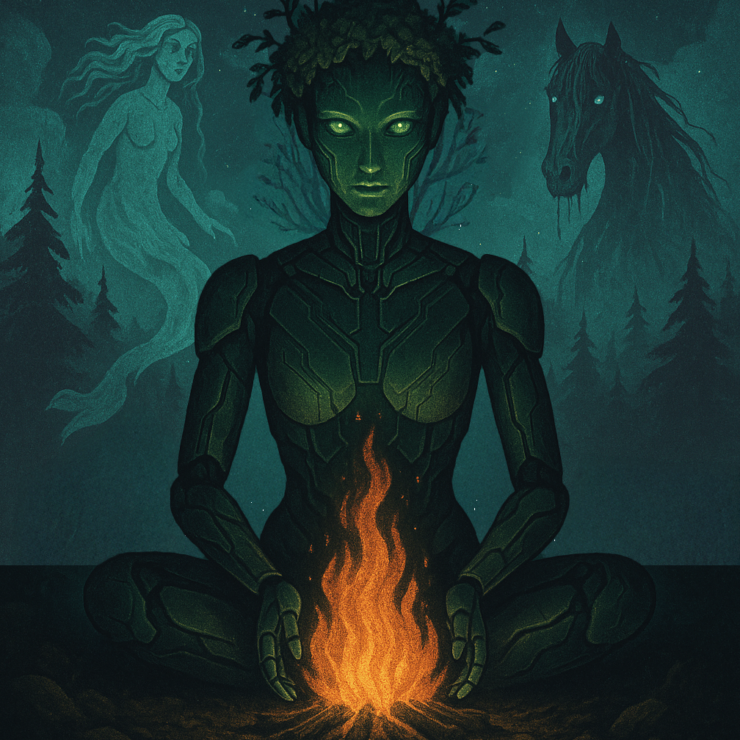
A.I. Campfire is an immersive film experience led by Symbiolene, an A.I. database-turned-host born from the lost Green Men who conjures memories of Scotland’s spirits, like Selkies and Kelpies. Throug audiovisuals evoking tales of ‘gentle warnings and broken covenants”, audiences are invited into a world where folklore turns into valuable teachings that will help preserve bonds with nature. Symbiolene tells us these tales as reminders that nature has its own ways of keeping judgement on human error, and that when the earth is pushed too far, its spirits may seek vengeance.
Created by Toasterlab, directed by ecoscenography expert Ian Garrett and written/co-directed by Vanessa Kelly, this 20-minute long film is presented as a campfire storytelling session, complete with real life beanbags on the floor and a complimentary marshmallow on a stick. The audience settles in; the computer generated camp fire fades into a gorgeously rendered forest scene; our AI host appears onscreen ready to introduce us to this strange new world.
The whole thing has the feeling of a introduction video at the start of a computer game, and it is immediately clear that this short film isn’t just about the concept of AI, but created with AI technology itself. Symbiolene’s mouth is rarely in time with her speech, and all the shots of the forest have that queasily blurred quality unique to AI generated film when we shift from one scene to another. The show advertises itself as show full of Scottish folklore, but there are in fact only two stories told in this performance; selkies, and kelpies.
The AI video accompaniment to the Selkie tale in particular is a very strange choice. The clips chosen to illustrate this story are not even entirely thematically relevant, and all have that ‘uncanny valley’ quality to them as limbs twist just slightly the wrong way and eyes don’t quite track right, the sea washing onto the shore with just a little too much elasticity in the movement and the wind ruffling hair from just slightly the wrong direction. It doesn’t take long for the wrongness to start to settle in, the not-quite-right visuals doing strange things to our eyes as Symboline tells us her stories in her computer generated, flat-line voice. It is an intriguing concept – the AI host using AI herself to share her tales – but in actuality the delivery of the concept falls short, not least because these generated videos begin to feel a little genuinely disturbing in their manufactured, slightly melting quality after the first few minutes.
AI eldritch horror aside, a different moral question rose to the surface during this short film. A.I Campfire’s ‘take’ on the Selkie myth is that it is a story of female empowerment; of acknowledging that the fisherman took her away from her family and her watery home without her consent, and that although we are expected to feel sorry for him at the end of the tale he in fact had no right to claim her in the first place.
This is, on the surface at least, a solid angle to take on a problematic tale. The problem, however, is that for a portion of the story the voice of Symboline is accompanied onscreen by artificially created videos of naked women. This is relevant to the story – the Selkies are often depicted naked on the beach when the fisherman first finds them and chooses ‘his’ wife – but when the images of those women are AI generated, troubling questions around consent in the art itself surface with no clear answers. AI isn’t intelligent enough – yet – to create images of women all on its own. The naked female figures we watch running through the surf will have been invented from some combination of pre-existing images of real-life women, and where is the ability for those women to give their consent to their unclothed forms being projected to dozens of people, again and again – and all whilst those people listen to a voiceover about the fisherman’s moral failings when it comes to female bodily autonomy and informed consent?
With AI ‘nudifying tools’ a growing concern and research showing already that AI tends to create ‘hypersexualised images of women’ due to the AI models being created by male developers and therefore susceptible to ‘emulating male decision-making patterns’ , I would urge anyone using AI to create video clips of women – clothed or otherwise, but particularly if those women are naked – to consider the ethics of doing so before committing to the decision. Perhaps – hopefully – Toasterlab considered these issues when creating these videos and came up with an answer to this issue of ethics before proceeding. If not, a seal, a coat, and some shots of water would surely have been illustration enough.
The kelpie tale is stronger, both thematically and in the quality of the AI videos used during the tale, but its themes of eco-crisis and environmental activism raise the other main issue with this performance. Venue 13, A.I Campfire’s home for the Fringe, is a venue which is ‘rooted in care, sustainability and community’ and one which is known for thoughtful and socially informed work. Ian Garrett is Associate Professor of Ecological Design for Performance at York University in Toronto, and has ‘long explored the intersection of sustainability, scenography, and immersive design‘, and Vanessa Kirkby describes this performance as ‘acknowledging the role technology might play in revitalising ancestral teachings’, although using a traditionalist word such as ‘ancestral’ is questionable when one out of the two of these folkloric tales have been rewritten entirely for this show. (Kelpies usually stick to being horses, although I did enjoy the concept of one turning into a man wandering around Edinburgh looking for litter-dropping prey.)
This is clearly a performance made from good intentions, and a desire to share an eco-activist message. It feels strange, therefore, that in this show all about AI art there is no acknowledgement to the profound ways AI itself is contributing to the current ecological crisis. Increased electricity and water consumption and increased carbon dioxide emissions are very real issues when it comes to this technology, and there is surely space within a performance piece about exploring the relationship between technology, ecology and sustainability to address these problems with AI’s energy consumption.
A.I Campfire is a show with an intriguing premise, good intentions, and plenty of promise when it comes to where these themes of folklore and eco-activism could go next. It just needs a little more humanity at the heart of its artificially constructed stories.
You can catch A.I Campfire at Venue 13 from now until 23rd August at 20:50, 21:00 and 21:30 (20 mins). Tickets available through EdFringe Box Office.

 Madeleine Martin
 Padraig Bond
 Jake Mace